If only 2% of the main current is to be passed through a galvanometer of resistance G, then the resistance of shunt will be
Text Solution
Verified by ExpertsB
The potential difference across parallel combination should be equal.
The shunt is a low resistance connected in parallel with the galvanometer as shown. Potential difference across $G =$ potential difference across S.
i. e. $i_{g}G = \left(i - i_{g}\right)S$
or $i_{g}G + i_{g}S = iS$
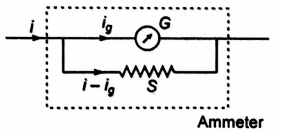
or $i_{g}(G+S) = iS$
$or \frac{i_{g}}{i} = \frac{S}{S+G} Given, \frac{i_{g}}{i} = \frac{2}{100} we have \frac{2}{100} = \frac{S}{S+G} or 2S + 2G = 100S or G = \frac{98S}{2} or S = \frac{G}{49}$
Prepare Smarter with CGP Edu
Get practice questions, solutions, and test series in one place.
Write a Review
Share your experience with this question and solution.
Commentary
Send your comment, doubt, correction, or feedback to admin.
Similar Questions
Explore conceptually related problems