Two point charges (+Q) and (-2Q) are fixed on the X-axis at positions a and 2a from origin respectively. At what positions on the axis, the resultant electric field is zero
Text Solution
Verified by ExpertsB
Suppose electric field is zero at a point P lies at a distance d from the charge + Q.
At P $\frac{kQ}{d^{2}} = \frac{k(2Q)}{(a+d)^{2}}$
⇒ ⇒ $\frac{1}{d^{2}} = \frac{2}{(a + d)^{2}}$ ⇒ ⇒ $d = \frac{a}{(\sqrt{2} - 1)}$
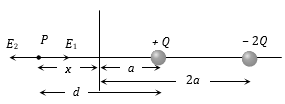
Since d > a i.e. point P must lies on negative x-axis as shown at a distance x from origin hence $x = d - a$ $= \frac{a}{(\sqrt{2} - 1)} - a = \sqrt{2} a.$ Actually P lies on negative x-axis so $x = -\sqrt{2a}$
Prepare Smarter with CGP Edu
Get practice questions, solutions, and test series in one place.
Write a Review
Share your experience with this question and solution.
Commentary
Send your comment, doubt, correction, or feedback to admin.
Similar Questions
Explore conceptually related problems