Two wires of equal diameters, of resistivities  and
and  and lengths
  and
and  , respectively, are joined in series. The equivalent resistivity of the combination is
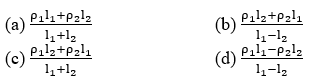
Text Solution
Verified by ExpertsThe correct answer is:
A
 . In series

 .
.
Prepare Smarter with CGP Edu
Get practice questions, solutions, and test series in one place.
Write a Review
Share your experience with this question and solution.
Commentary
Send your comment, doubt, correction, or feedback to admin.
Similar Questions
Explore conceptually related problems
The alloys constantan and managing are used to make standard resistance due to they have
When a potential difference is applied across the ends of a linear metallic conductor
The electric resistance of a certain wire of iron is R. If its length and radius are both doubled, …
A wire of diameter 0.02 meter contains 10 28 free electrons per cubic meter. For an electrical curr…
The following four wires are made of the same material and are at the same temperature. Which one o…
The colour sequence in a carbon resistor is red, brown, orange and silver. The resistance of the re…