Published by:
CGP EDU Academic Team
Published on: September 12, 2026
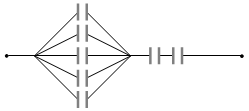
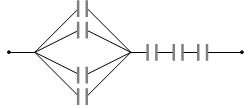
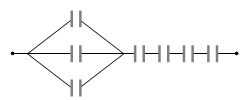
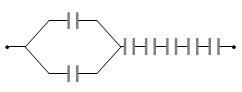
Seven capacitors each of capacity $2 \mu F$ are to be so connected to have a total capacity $\frac{10}{11} \mu \mathbf{F}$ . Which will be the necessary figure as shown


Text Solution
Verified by ExpertsThe correct answer is:
A
To determine the necessary connection for seven capacitors each of capacity C to achieve a total capacitance of C/3, we consider the following steps:
1. **Understanding Capacitor Configuration:** The total capacitance of capacitors connected in series is given by:
\[ \frac{1}{C_{total}} = \frac{1}{C_1} + \frac{1}{C_2} + ... + \frac{1}{C_n} \]
For two capacitors of capacity C in series, the total capacitance is:
\[ C_{total} = \frac{C}{2} \].
2. **Analyzing Total Capacitance Requirement:** We need to achieve a total capacitance of \( C/3 \). To obtain this capacitance using series and parallel combinations, we can connect a certain number of capacitors in series, then connect these sets in parallel.
3. **Creating Combinations:** For every 2 capacitors in series, we get \( \frac{C}{2} \). If we take 3 such pairs (6 capacitors), we can get three capacitors of value \( \frac{C}{2} \) in series. The total of these will be:
\[ C_{total} = \frac{\frac{C}{2}}{3} = \frac{C}{6} \]. We still have one capacitor left which can be connected in series to gain additional capacity.
4. **Placement:** Hence, if we connect two sets of three capacitors in parallel, plus one capacitor in series with them, we can achieve the overall capacitance of \( C/3 \).
5. **Final Configuration:** Referring to the provided figures for confirmation, the configuration represented in Option A meets these requirements. Hence, Option A is the correct connection to achieve the desired capacitance.
Therefore, the correct answer is A.
1. **Understanding Capacitor Configuration:** The total capacitance of capacitors connected in series is given by:
\[ \frac{1}{C_{total}} = \frac{1}{C_1} + \frac{1}{C_2} + ... + \frac{1}{C_n} \]
For two capacitors of capacity C in series, the total capacitance is:
\[ C_{total} = \frac{C}{2} \].
2. **Analyzing Total Capacitance Requirement:** We need to achieve a total capacitance of \( C/3 \). To obtain this capacitance using series and parallel combinations, we can connect a certain number of capacitors in series, then connect these sets in parallel.
3. **Creating Combinations:** For every 2 capacitors in series, we get \( \frac{C}{2} \). If we take 3 such pairs (6 capacitors), we can get three capacitors of value \( \frac{C}{2} \) in series. The total of these will be:
\[ C_{total} = \frac{\frac{C}{2}}{3} = \frac{C}{6} \]. We still have one capacitor left which can be connected in series to gain additional capacity.
4. **Placement:** Hence, if we connect two sets of three capacitors in parallel, plus one capacitor in series with them, we can achieve the overall capacitance of \( C/3 \).
5. **Final Configuration:** Referring to the provided figures for confirmation, the configuration represented in Option A meets these requirements. Hence, Option A is the correct connection to achieve the desired capacitance.
Therefore, the correct answer is A.
Prepare Smarter with CGP Edu
Get practice questions, solutions, and test series in one place.
Write a Review
Share your experience with this question and solution.
Commentary
Send your comment, doubt, correction, or feedback to admin.
Similar Questions
Explore conceptually related problems
Two identical capacitors are joined in parallel, charged to a potential V and then separated and th…
The condensers of capacity $C_{1}$ and $C_2$ are connected in parallel, then the equivalent capacit…
A parallel plate capacitor is made by stacking n equally spaced plates connected alternately. If th…
Seven capacitors each of capacity $2 \mu F$ are to be so connected to have a total capacity $\frac{…
The capacitor of capacitance $4 \mu \mathbf{F}$ and $6 \mu F$ are connected in series. A potential …
A parallel plate capacitor with air as medium between the plates has a capacitance of $10 \mu \math…