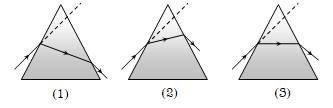
The figures represent three cases of a ray passing through a prism of angle A . The case corresponding to minimum deviation is
Text Solution
Verified by ExpertsThe correct answer is:
C
No detailed text explanation provided yet.
Prepare Smarter with CGP Edu
Get practice questions, solutions, and test series in one place.
Write a Review
Share your experience with this question and solution.
Commentary
Send your comment, doubt, correction, or feedback to admin.
Similar Questions
Explore conceptually related problems
Which source is associated with a line emission spectrum
The critical angle between an equilateral prism and air is 45°. If the incident ray is perpendicula…
When white light passes through a glass prism, one gets spectrum on the other side of the prism. In…
We use flint glass prism to disperse polychromatic light because light of different colours
A prism has the refracting angle of 30°. The deviation of a monochromatic ray incident normally on…
Fraunhofer lines are obtained in