Published by:
CGP EDU Academic Team
Published on: September 12, 2026
For the situation shown in the figure given below, match the entries of column I with the entries of column II.
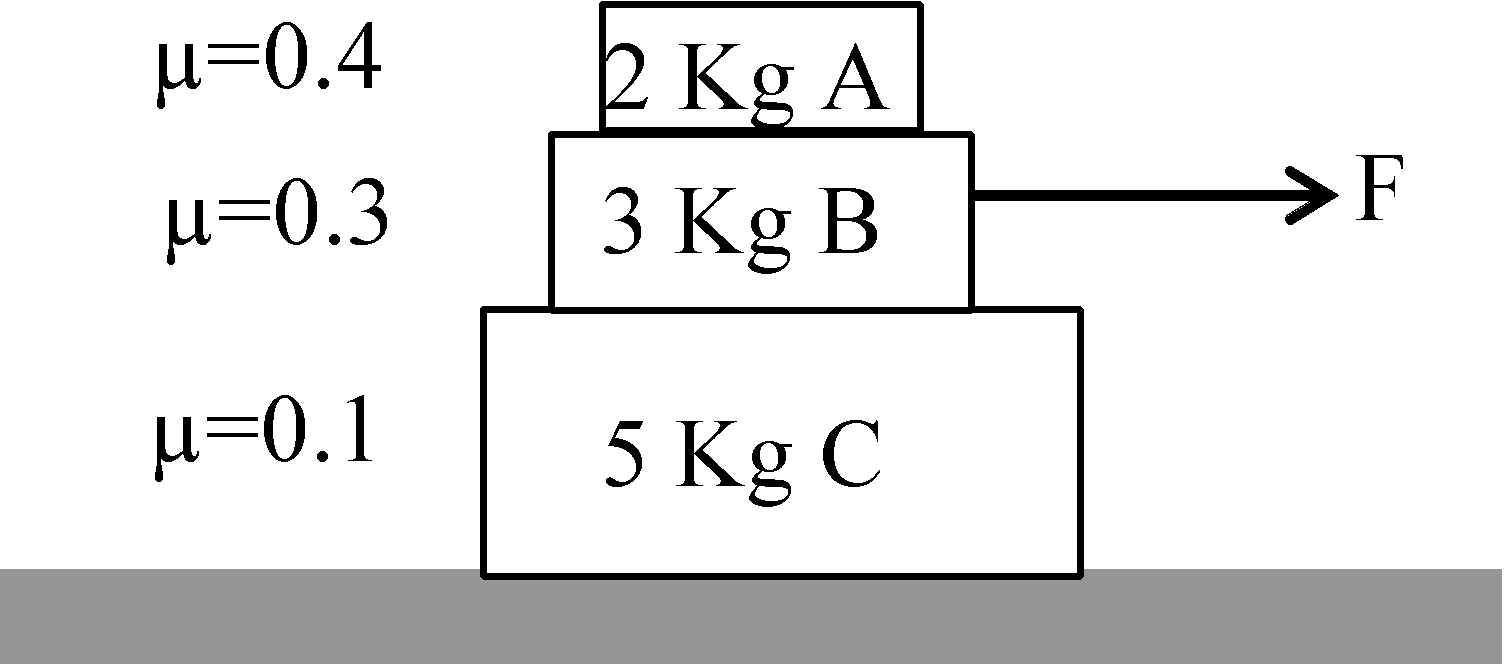
Column I | Column II |
(i) If F = 13 N, then | [A] Relative motion between A and B is there |
(ii) If F = 15 N, then | [B] Relative motion between B and C is there |
(iii) If F = 25 N, then | [C] Relative motion between C and the ground is there |
(iv) If F = 40 N, then | [D] Relative motion is not there at any of the surface |
Text Solution
Verified by ExpertsThe correct answer is:
C
To solve this problem, we need to analyze the forces acting on the blocks A, B, and C in relation to the applied external force F.
Step 1: Identify the mass of each block:
- Mass of A: 2 kg
- Mass of B: 3 kg
- Mass of C: 5 kg
Step 2: Calculate the maximum static friction force for each block. The static friction force can be calculated using the formula:
$$F_s = ext{friction}_{ ext{max}} = ext{friction coefficient} imes ext{normal force}$$
The normal force for each block is equal to their respective weights, where weight = mass * gravity (g = 9.8 m/s²). However, since the friction coefficient is not given, we will primarily focus on the given forces and check when relative motion occurs.
Step 3: Analyze the cases:
- For F = 13 N: This force is likely insufficient to overcome the friction between A and B, and B and C, leading to the conclusion that relative motion between A and B may occur, but without further information, we cannot definitively state about B and C. Therefore, this may correspond to [A].
- For F = 15 N: This force might just overcome the friction between B and C, leading to relative motion between B and C. This corresponds to [B].
- For F = 25 N: At this force, it might indicate sufficient force to create relative motion between C and the ground. Thus, it corresponds to [C].
- For F = 40 N: Since this force significantly exceeds the expected limits, relative motion is not present between any of the surfaces, leading to [D].
Summary: Based on the above analysis, the correct matching is:
(i) A; (ii) B; (iii) C; (iv) D.
Hence, the answer to the question 'match the entries' focusing on (iii) yields the correct answer as [C].
Step 1: Identify the mass of each block:
- Mass of A: 2 kg
- Mass of B: 3 kg
- Mass of C: 5 kg
Step 2: Calculate the maximum static friction force for each block. The static friction force can be calculated using the formula:
$$F_s = ext{friction}_{ ext{max}} = ext{friction coefficient} imes ext{normal force}$$
The normal force for each block is equal to their respective weights, where weight = mass * gravity (g = 9.8 m/s²). However, since the friction coefficient is not given, we will primarily focus on the given forces and check when relative motion occurs.
Step 3: Analyze the cases:
- For F = 13 N: This force is likely insufficient to overcome the friction between A and B, and B and C, leading to the conclusion that relative motion between A and B may occur, but without further information, we cannot definitively state about B and C. Therefore, this may correspond to [A].
- For F = 15 N: This force might just overcome the friction between B and C, leading to relative motion between B and C. This corresponds to [B].
- For F = 25 N: At this force, it might indicate sufficient force to create relative motion between C and the ground. Thus, it corresponds to [C].
- For F = 40 N: Since this force significantly exceeds the expected limits, relative motion is not present between any of the surfaces, leading to [D].
Summary: Based on the above analysis, the correct matching is:
(i) A; (ii) B; (iii) C; (iv) D.
Hence, the answer to the question 'match the entries' focusing on (iii) yields the correct answer as [C].
Prepare Smarter with CGP Edu
Get practice questions, solutions, and test series in one place.
Write a Review
Share your experience with this question and solution.
Commentary
Send your comment, doubt, correction, or feedback to admin.
Similar Questions
Explore conceptually related problems
A vessel containing water is given a constant acceleration a towards the right, along a straight ho…
A ship of mass \(3 \times 10^{7} \, \text{kg}\) initially at rest is pulled by a force of \(5 \time…
The mass of a body measured by a physical balance in a lift at rest is found to be m. If the lift i…
Three weights W, 2W and 3W are connected to identical springs suspended from a rigid horizontal rod…
When forces F_1, F_2, F_3 are acting on a particle of mass m such that F_2 and F_3 are mutually per…
The spring balance A reads 2 kg with a block m suspended from it. A balance B reads 5 kg when a bea…