Published by:
CGP EDU Academic Team
Published on: September 13, 2026
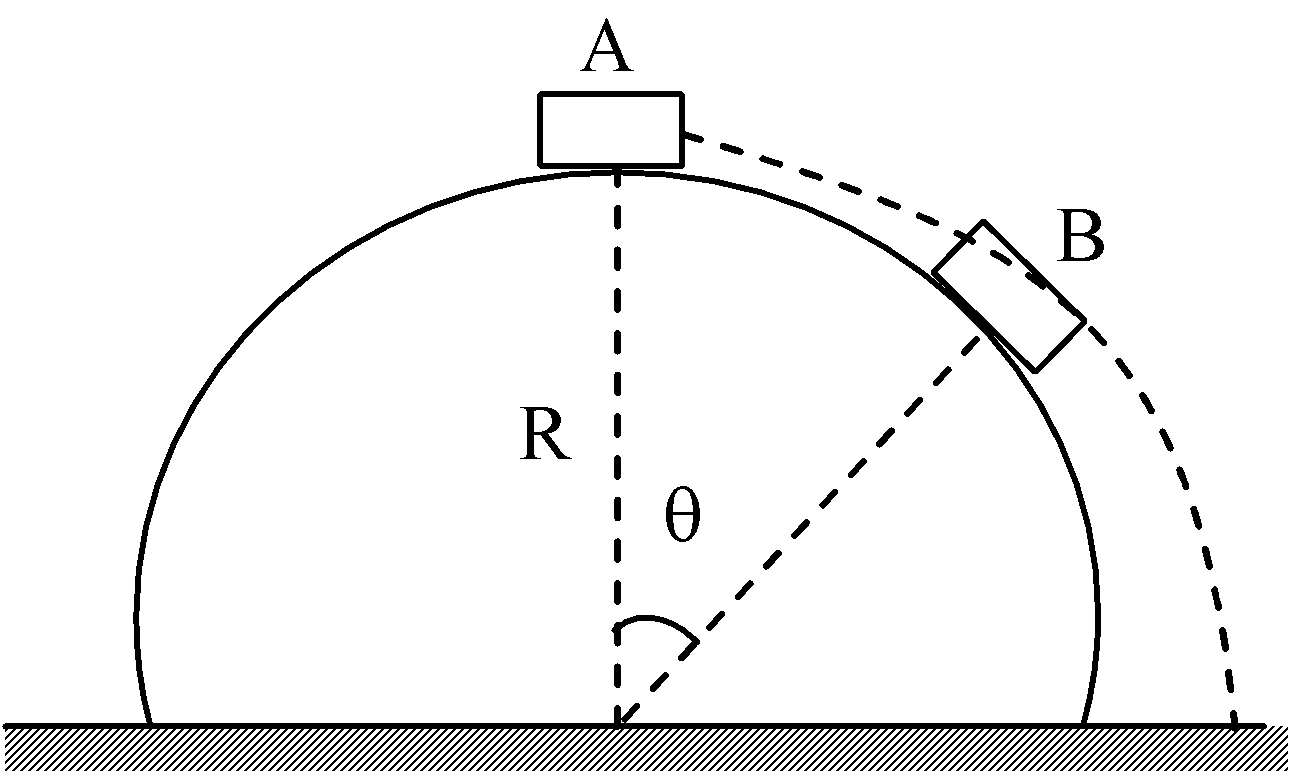
A particle starts sliding down a curved surface of radius R from position A as shown in the figure. At position B it breaks-off, the value of  is .
is .
Text Solution
Verified by ExpertsThe correct answer is:
A
To solve the problem, we can apply the principles of energy conservation and circular motion.
1. As the particle slides down from point A, it converts gravitational potential energy into kinetic energy.
2. The height difference between point A and point B can be found using the radius R and angle θ: height = R(1 - cos(θ)).
3. The potential energy at point A is given by PE = mgh = mgR(1 - cos(θ)).
4. The kinetic energy at point B is KE = \frac{1}{2}mv^2, where v is the velocity at point B.
5. By conservation of energy: \( mgR(1 - cos(θ)) = \frac{1}{2}mv^2 \)
6. Rearranging gives us v = \sqrt{2gR(1 - cos(θ))}.
The angle θ at which the particle breaks off will be determined by the balance of forces acting on it, which includes gravitational and normal forces. Setting up the equations for circular motion leads us to express whether the normal force becomes zero at point B. Thus we can find an expression for θ.
Overall, using these principles should lead to the appropriate computation for angle θ.
1. As the particle slides down from point A, it converts gravitational potential energy into kinetic energy.
2. The height difference between point A and point B can be found using the radius R and angle θ: height = R(1 - cos(θ)).
3. The potential energy at point A is given by PE = mgh = mgR(1 - cos(θ)).
4. The kinetic energy at point B is KE = \frac{1}{2}mv^2, where v is the velocity at point B.
5. By conservation of energy: \( mgR(1 - cos(θ)) = \frac{1}{2}mv^2 \)
6. Rearranging gives us v = \sqrt{2gR(1 - cos(θ))}.
The angle θ at which the particle breaks off will be determined by the balance of forces acting on it, which includes gravitational and normal forces. Setting up the equations for circular motion leads us to express whether the normal force becomes zero at point B. Thus we can find an expression for θ.
Overall, using these principles should lead to the appropriate computation for angle θ.
Prepare Smarter with CGP Edu
Get practice questions, solutions, and test series in one place.
Write a Review
Share your experience with this question and solution.
Commentary
Send your comment, doubt, correction, or feedback to admin.
Similar Questions
Explore conceptually related problems
A body of mass \(\pi\pi\) hangs at one end of a string of length l , the other end of which is fixe…
The tension in the string revolving in a vertical circle with a mass m at the end which is at the l…
A stone of mass m is tied to a string and is moved in a vertical circle of radius r making n revolu…
A tube of length l is filled completely with an incompressible liquid of mass \(\mathbf{M}\) and cl…
The kinetic energy k of a particle moving along a circle of radius R depends on the distance covere…
A car is moving in a circular horizontal track of radius 10 m with a constant speed of 10 m/sec . A…