Why does a coin rolling along a plane in a vertical position (i.e. without tilt), move along a straight line, while one that is tilted follows a curved path?
Text Solution
Verified by ExpertsCHECK THE SOLUTION.
Sol.
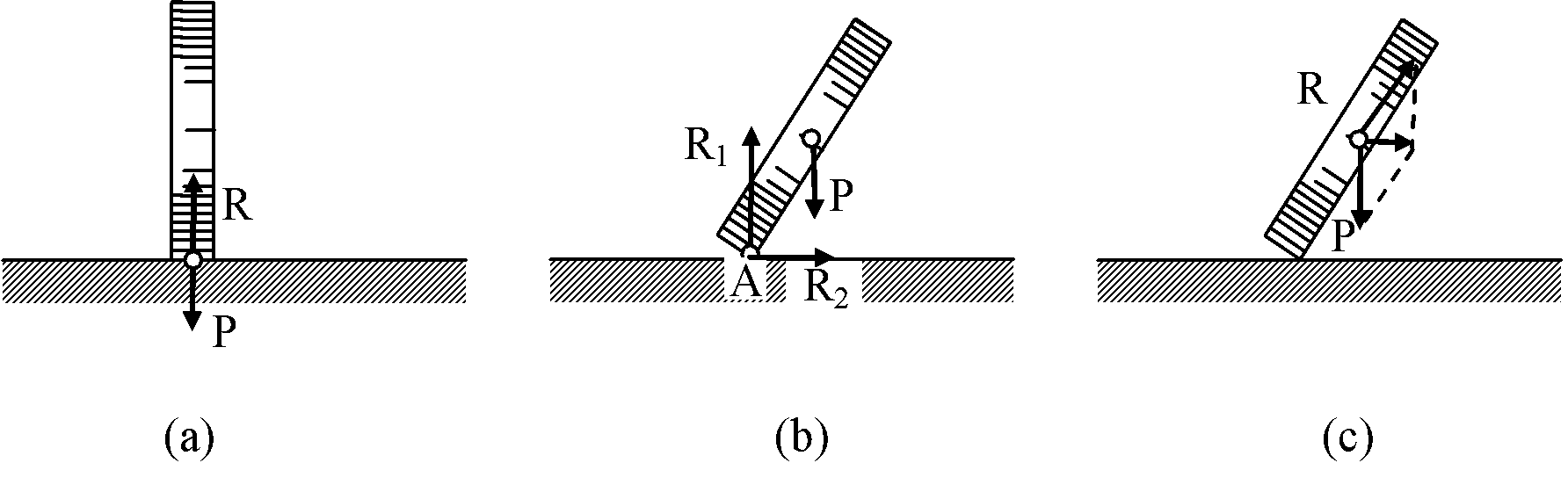
 -particles The force of gravity P acting on a coin rolling in a vertical position and the reaction R of the plane balance one another and therefore they cannot bend the path which the coin follows (Fig.a) When the coin is tilted (Fig.b) the normal reaction R 1 of the plane equals the weight of the coin as before; but in addition to this, the force of friction R 2 comes into play, acting along the plane. Its appearance in the picture can be explained by the fact that in its inclined position the coin will be subject to slipping at point A , to the left. But at the same time the force of friction always opposes the occurrence of this slipping. Thus R, the resultant of the force of reaction R 1 and R 2 of the plane, is inclined to the plane (fig.c). The resultant of the force of gravity and the force of the reaction R acts horizontally in the same direction as the tilt and cause the trajectory of the centre of the coin to curve.
Prepare Smarter with CGP Edu
Get practice questions, solutions, and test series in one place.
Write a Review
Share your experience with this question and solution.
Commentary
Send your comment, doubt, correction, or feedback to admin.
Similar Questions
Explore conceptually related problems