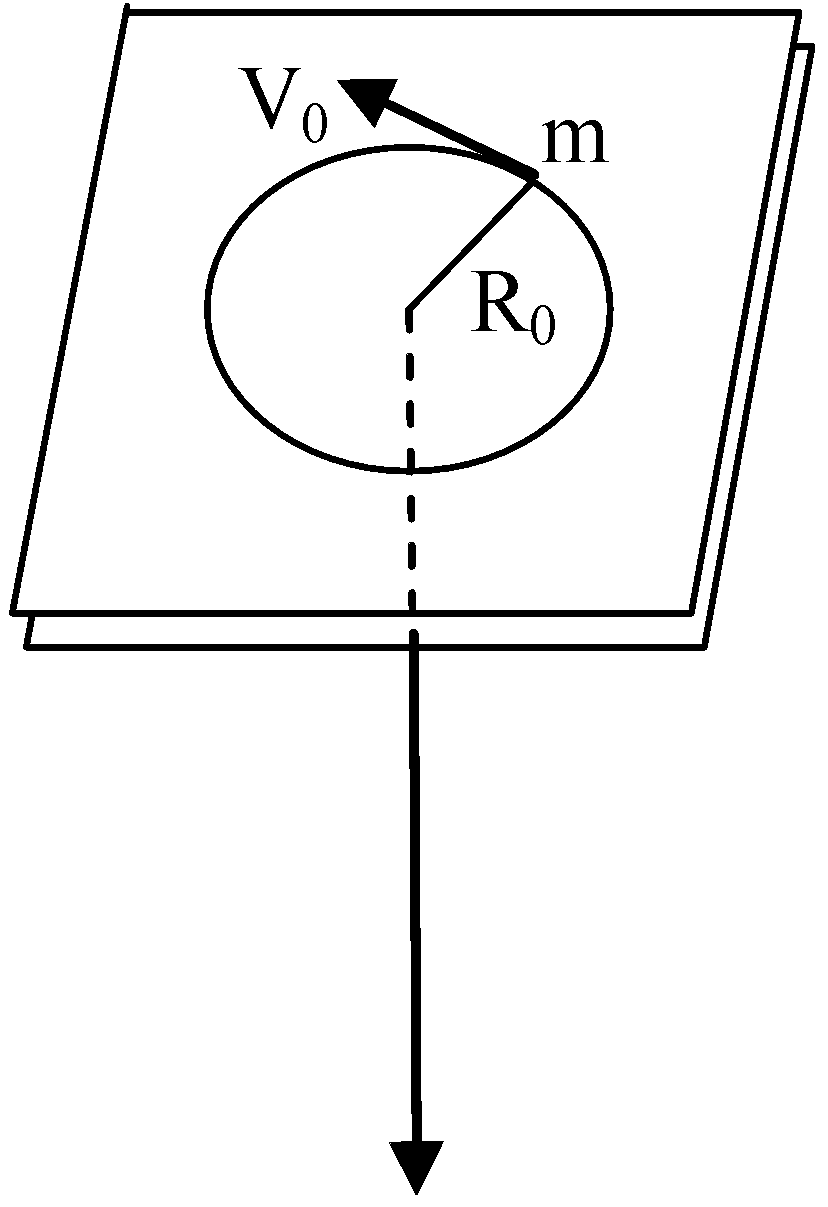
A mass m moves in a circle on a smooth horizontal plane with velocity v 0 at a radius R 0 . The mass is attached to a string which passes through a smooth hole in the plane as shown in figure. (“Smooth” means frictionless).
Text Solution
Verified by ExpertsCHECK THE SOLUTION.
Sol. The tension in the string provides the centripetal force needed for the circular motion, hence F = mv 0 2 /R 0 .
The angular momentum of the mass m is J = mv 0 R 0 .
The kinetic energy of the mass m is T = mv 0 2 /2.
The radius of the circular motion of the mass m decreases when the tension in the string is increased gradually. The angular momentum of the mass m is conserved since it moves under a central force. Thus
mv 0 R 0 = mv 1  ,
,
or v 1 = 2v 0 .
The final kinetic energy is then
T 1 =  =
=  = 2mv 0 2 .
(e) The reason why the pulling of the string should be gradual is that the radial velocity of the mass can be kept small so that the velocity of the mass can be considered tangential. This tangential velocity as function of R can be calculated readily from the conservation of angular momentum.
Prepare Smarter with CGP Edu
Get practice questions, solutions, and test series in one place.
Write a Review
Share your experience with this question and solution.
Commentary
Send your comment, doubt, correction, or feedback to admin.
Similar Questions
Explore conceptually related problems