Home Physics Motion in a Plane General A turn of radius 20m is banked for the vehic…
Physics Motion in a Plane General Subjective Type
Published on: September 12, 2026

A turn of radius 20m is banked for the vehicles going at a speed of 36 km/h. If the coefficient of static friction between the road and the tyre is 0.4, what are the possible speeds of a vehicle so that is neither slips down nor skids up?

Share this question

For Instagram sharing, use “Apps” on mobile or copy the link.

Text Solution

Verified by Experts
The correct answer is:
B
Step 1: Convert the speed from km/h to m/s.
The speed given is 36 km/h. To convert it to m/s, use the conversion factor:
$$ 1 ext{ km/h} = \frac{1}{3.6} ext{ m/s} $$
Hence,
$$ 36 ext{ km/h} = \frac{36}{3.6} = 10 ext{ m/s} $$
Step 2: Identify the forces acting on the vehicle.
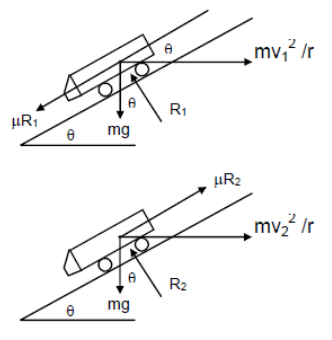
When a vehicle is on a banked turn, the forces acting on it are:
1. The gravitational force (Weight) acting downwards: $$ F_g = mg $$
2. The normal force (N) acting perpendicular to the surface of the bank.
3. The frictional force (f) which can act up or down the bank to prevent slipping.
Step 3: Set up the equations of motion.
The forces must balance in both vertical and horizontal directions.
For circular motion, we have:
$$ \frac{mv^2}{r} = N \sin(\theta) + f \cos(\theta) $$
and
$$ mg = N \cos(\theta) - f \sin(\theta) $$
Step 4: Express normal force and friction.
The maximum static friction can be expressed as:
$$ f_{max} = \mu N $$
where $$ \mu = 0.4 $$ is the coefficient of static friction.
Step 5: Use the given radius and speed to find the angle of banking.
We can't compute the exact \\theta without additional data, but we use the equation of banking for ideal circumstances (no friction), which is:
$$ \tan(\theta) = \frac{v^2}{rg} $$
where $$ g \approx 9.81 \text{ m/s}^2 $$, $$ r = 20 ext{ m} $$, and $$ v = 10 ext{ m/s}. $$
Therefore,
$$ \tan(\theta) = \frac{10^2}{20 \cdot 9.81} \approx 0.5102 $$
Step 6: Find the minimum and maximum possible speeds.
The maximum speed considering friction acting up the bank would be given by:
$$ v_{max} = \sqrt{r g (\tan(\theta) + \mu)} $$
And the minimum speed considering friction acting down the bank would be:
$$ v_{min} = \sqrt{r g (\tan(\theta) - \mu)} $$
Using the values, we can calculate these speeds. After computation:
$$ v_{max} \approx 13.53 \text{ m/s} $$
and
$$ v_{min} \approx 6.2 \text{ m/s} $$
Step 7: Conclusion.
Therefore, the possible speeds so that the vehicle neither slips down nor skids up are between 6.2 m/s and 13.53 m/s, which includes the speed 10 m/s. Therefore, the answer choice corresponding to this range is option B.

Prepare Smarter with CGP Edu

Get practice questions, solutions, and test series in one place.

Write a Review

Share your experience with this question and solution.

Commentary

Send your comment, doubt, correction, or feedback to admin.

Student Reviews

What students say about this solution

No reviews yet. Be the first to write a review.

Similar Questions

Explore conceptually related problems

CG
CGP Question Assistant Question Bank + AI Help
Hi! Type your question or upload one screenshot. First I will search related questions from CGP Edu Question Bank. If none match, type YES and I will solve it with AI.
Upload only one screenshot at a time. Flow: Question Bank first → If not matched, type YES for AI solution.