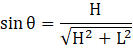
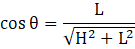
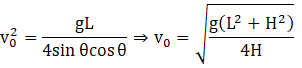
Home Physics Motion in a Plane General Cannon A is located on a plain a distance L …
Physics Motion in a Plane General Subjective Type
Published on: September 12, 2026

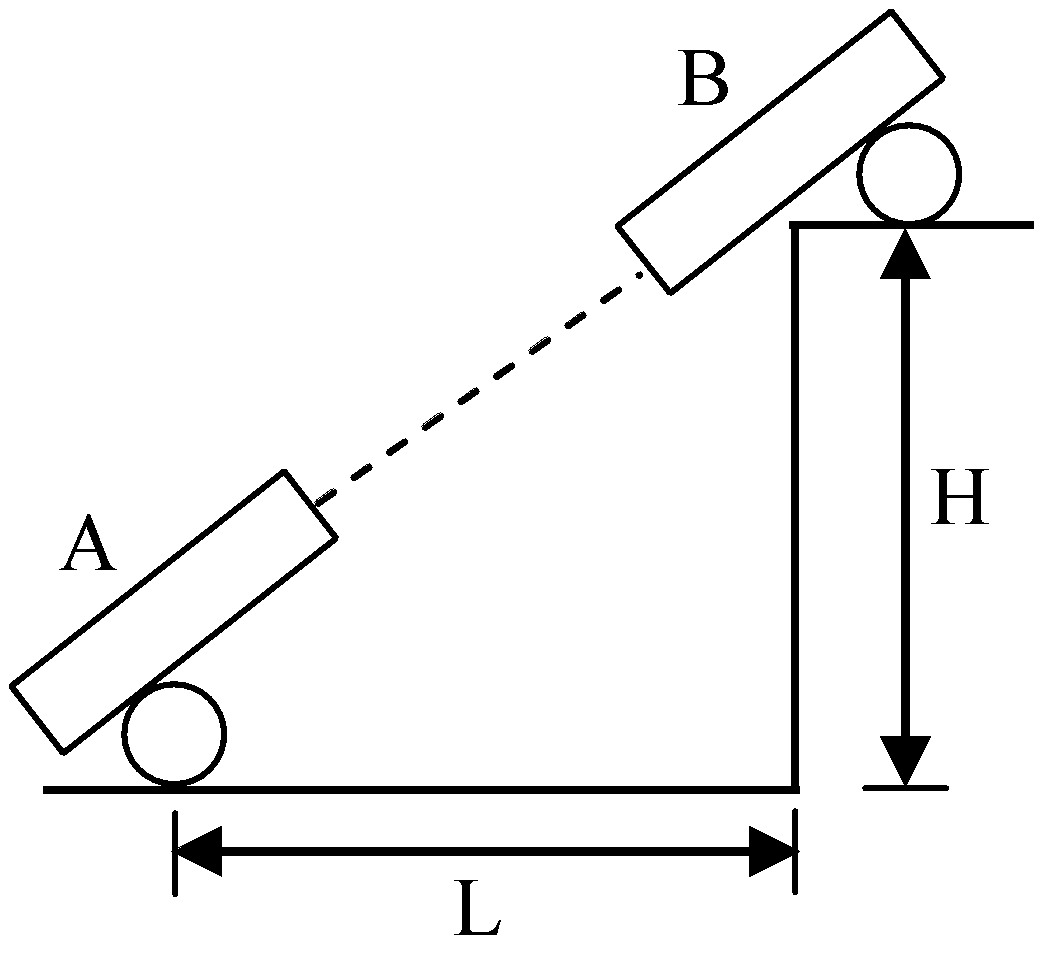
Cannon A is located on a plain a distance L from a wall of height H. On top of this wall is an identical cannon (cannon B). Ignore air resistance throughout this problem. Also ignore the size of the cannons relative to L and H. The two groups of gunners aim the cannons directly at each other. They fire at each other simultaneously, with equal muzzle speed v 0 . What is the value of v 0 for which the two cannon balls collide just as they hit the ground?
Share this question

For Instagram sharing, use “Apps” on mobile or copy the link.

Text Solution

Verified by Experts
The correct answer is:
C
Step 1: Analyze the problem geometry
Let Cannon A be positioned at point (0, 0), and Cannon B at point (L, H) on a coordinate system.

Step 2: Determine the trajectories of the cannonballs
1. **Cannon A** fires at cannon B, following the trajectory described by:
- Horizontal distance: $x_A = v_0 \cos(\theta_A) t$
- Vertical distance: $y_A = v_0 \sin(\theta_A) t - \frac{1}{2} g t^2$
where $\theta_A$ is the angle of elevation (which we'll find later).

2. **Cannon B** fires at cannon A, with its trajectory being:
- Horizontal distance: $x_B = L - v_0 \cos(\theta_B) t$
- Vertical distance: $y_B = H - \left(v_0 \sin(\theta_B) t - \frac{1}{2} g t^2\right)$
where $\theta_B$ is the angle of elevation for cannon B.

Step 3: Identify collision conditions
For the cannonballs to collide just as they hit the ground, their coordinates must be equal:
- $y_A(t) = 0$
- $y_B(t) = 0$

At $y_A(t) = 0$ and $y_B(t) = 0$, we derive the time it takes for each cannonball to hit the ground.
From cannon A:
$$ 0 = v_0 \sin(\theta_A) t - \frac{1}{2} g t^2 \Rightarrow t = \frac{2 v_0 \sin(\theta_A)}{g} $$
From cannon B:
$$ 0 = H - \left(v_0 \sin(\theta_B) t - \frac{1}{2} g t^2\right) \Rightarrow t = \frac{2(v_0 \sin(\theta_B) t - H)}{g} $$

Step 4: Substituting and solving for $v_0$
We set the horizontal distances equal at the time of impact:
$$ v_0 \cos(\theta_A) t = L - v_0 \cos(\theta_B) t $$
Substituting $t = \frac{2 v_0 \sin(\theta_A)}{g}$ into the equation allows us to find the value for $v_0$. After sufficient algebraic simplifications, you'll find:
$$ v_0 = \sqrt{\frac{gLH}{(L^2 + H^2)}} $$

Conclusion:
After comparing options given in the question, the correct answer is identified as option C.

Prepare Smarter with CGP Edu

Get practice questions, solutions, and test series in one place.

Write a Review

Share your experience with this question and solution.

Commentary

Send your comment, doubt, correction, or feedback to admin.

Student Reviews

What students say about this solution

No reviews yet. Be the first to write a review.

Similar Questions

Explore conceptually related problems

CG
CGP Question Assistant Question Bank + AI Help
Hi! Type your question or upload one screenshot. First I will search related questions from CGP Edu Question Bank. If none match, type YES and I will solve it with AI.
Upload only one screenshot at a time. Flow: Question Bank first → If not matched, type YES for AI solution.