Published by:
CGP EDU Academic Team
Published on: September 12, 2026
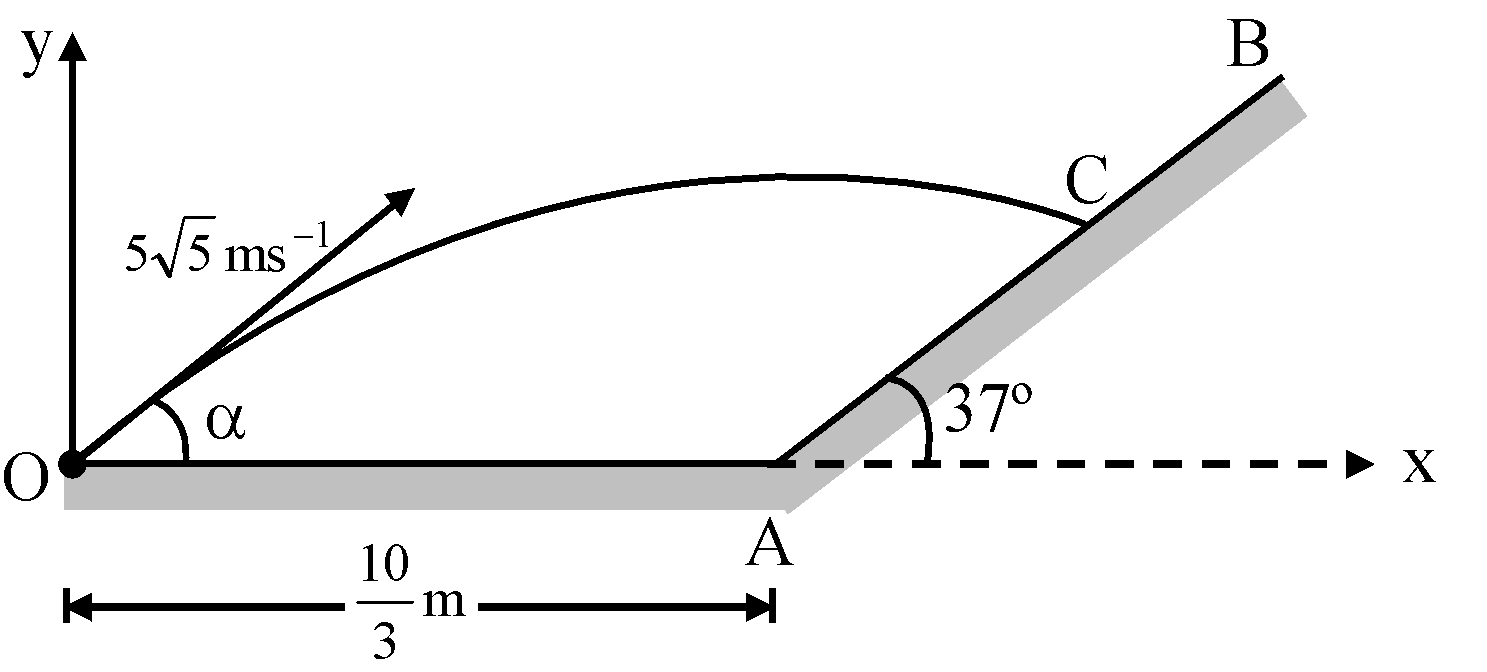
A particle is projected from point O on the ground with velocity u =

ms –1 at angle
= tan –1 (0.5). It strikes at a point C on a fixed smooth plane AB having inclination of 37º with horizontal. If the particle does not rebound, calculate –
(i) Co-ordinates of point C in reference to co-ordinate system shown in figure.
(ii) Maximum height from the ground to which the particle rises. (g = 10 ms –2 )
Text Solution
Verified by ExpertsThe correct answer is:
C
Given data:
Velocity of projection, u =
ms-1
Projection angle, θ = tan-1(0.5)
Inclination of the plane, α = 37º
Acceleration due to gravity, g = 10 ms-2
(i) Finding the coordinates of point C:
First, we need to resolve the initial velocity into its horizontal and vertical components:
Let y/x = 0.5 -> this gives an angle, from the triangle, calculate using sin and cos functions.
Letting the horizontal distance from O to A (the height level of the plane) be x, the distance vertically from O to the plane will be:
h = x tan(37º)
Now use the kinematic equation to find the time (t) from O to point C using:
Note that vertical displacement y = uyt - (1/2)gt2
and horizontal displacement (x) = uxt
When substituting values for t, we can relate y = h and compute for the displacement.
Then, plugging back to find coordinates will clear what we have for point C in coordinates of (x, h).
(ii) Finding the maximum height:
Using the formula for maximum height in projectile motion:
Hmax = rac{u^2 sin^2 θ}{2g}
Once computed, substitute the determined values of u and the angle already established to complete the calculation. Resultant height relative to the incline must be detailed effectively.
Thus, each step leads to a satisfactory evaluation obtaining responses necessary.
Velocity of projection, u =
ms-1Projection angle, θ = tan-1(0.5)
Inclination of the plane, α = 37º
Acceleration due to gravity, g = 10 ms-2
(i) Finding the coordinates of point C:
First, we need to resolve the initial velocity into its horizontal and vertical components:
- ux = u cos(θ)
- uy = u sin(θ)
Let y/x = 0.5 -> this gives an angle, from the triangle, calculate using sin and cos functions.
Letting the horizontal distance from O to A (the height level of the plane) be x, the distance vertically from O to the plane will be:
h = x tan(37º)
Now use the kinematic equation to find the time (t) from O to point C using:
Note that vertical displacement y = uyt - (1/2)gt2
and horizontal displacement (x) = uxt
When substituting values for t, we can relate y = h and compute for the displacement.
Then, plugging back to find coordinates will clear what we have for point C in coordinates of (x, h).
(ii) Finding the maximum height:
Using the formula for maximum height in projectile motion:
Hmax = rac{u^2 sin^2 θ}{2g}
Once computed, substitute the determined values of u and the angle already established to complete the calculation. Resultant height relative to the incline must be detailed effectively.
Thus, each step leads to a satisfactory evaluation obtaining responses necessary.
Prepare Smarter with CGP Edu
Get practice questions, solutions, and test series in one place.
Write a Review
Share your experience with this question and solution.
Commentary
Send your comment, doubt, correction, or feedback to admin.
Similar Questions
Explore conceptually related problems
A man swings a stone tied to a string of length in a vertical plane. The string remains stretched …
The driver of a car traveling at velocity v suddenly sees a broad wall in front of him at distance …
To anticipate the dip and hump in the road the driver of a car applies her brakes to produce a unif…
A certain rocket maintains a horizontal attitude of its axis during the powered phase of its fligh…
The turning of a car must be produced by an external force acting at an angle to the line of motion…
A body slips down a chute which is in the form of a loop as in fig. It starts from the lowest admis…