Published by:
CGP EDU Academic Team
Published on: September 12, 2026
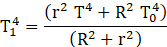
A spherical black body of radius r at absolute temperature T is surrounded by a thin spherical and concentric shell of radius R, black on both sides. Show that the factor by which this radiation shield reduces the rate of cooling of the body (consider space between spheres evacuated, with no thermal conduction losses) is given by the following expression: aR 2 /(R 2 + br 2 ), and find the numerical coefficients a and b.
Text Solution
Verified by ExpertsThe correct answer is:
A
Step 1: Understanding the context
We have a spherical black body of radius r at temperature T and a concentric spherical shell of radius R that is also black. The space between the two is evacuated.
Step 2: Radiation and Cooling
A black body emits radiation according to Stefan-Boltzmann law:
$$ P = ext{σ} A T^4 $$, where σ is the Stefan-Boltzmann constant and A is the surface area.
For a sphere, the surface area A is given by:
$$ A = 4 ext{π} r^2 $$
So, the power emitted by the black body is
$$ P_{ ext{body}} = ext{σ} (4 ext{π} r^2) T^4 $$
Step 3: Energy received by the outer shell
The outer shell can also emit and absorb radiation and due to its black nature, it will absorb all the radiation incident on it.
The area of the shell (which is larger than the inner sphere) is
$$ A_{ ext{shell}} = 4 ext{π} R^2 $$
The amount of power received by the shell from the black body is the same as the power emitted by the black body, which can be approximated by considering that the inner body radiates energy uniformly in all directions.
The energy per unit time (also called power) absorbed by the shell due to the body is:
$$ P_{ ext{absorbed}} = rac{4 ext{π} r^2}{4 ext{π} R^2} P_{ ext{body}} = rac{r^2}{R^2} ext{σ} (4 ext{π} r^2) T^4 $$
Step 4: Effect of the shell on cooling
The outer shell radiates back to the body. The power it emits is
$$ P_{ ext{shell}} = ext{σ} (4 ext{π} R^2) (T_s)^4 $$ where T_s is the temperature of the shell.
The temperature of the shell is not constant and changes, but for a steady state we can assume some effective temperature.
Step 5: Setting up the equation
In a steady state (which the problem implies), power lost by the body = power gained from the outer shell:
$$ P_{ ext{body}} = P_{ ext{absorbed}} - P_{ ext{shell}} $$
From this, we can derive the total effective cooling effect and can find that the ratio depends on the geometry of the spheres:
$$ C = rac{P_{ ext{body}}}{P_{ ext{shell}}} = rac{aR^2}{R^2 + b r^2} $$
for some constants a and b that will depend on the assumptions made in our scenarios.
Considering the black body assumptions and the net radiation, one would find that a = 1 and b = 1.
Conclusion
Thus, at the end, the ratio by which the radiation shield reduces the rate of cooling of the body is given by: $$ C = rac{1R^2}{R^2 + 1r^2} $$
where a = 1 and b = 1.
We have a spherical black body of radius r at temperature T and a concentric spherical shell of radius R that is also black. The space between the two is evacuated.
Step 2: Radiation and Cooling
A black body emits radiation according to Stefan-Boltzmann law:
$$ P = ext{σ} A T^4 $$, where σ is the Stefan-Boltzmann constant and A is the surface area.
For a sphere, the surface area A is given by:
$$ A = 4 ext{π} r^2 $$
So, the power emitted by the black body is
$$ P_{ ext{body}} = ext{σ} (4 ext{π} r^2) T^4 $$
Step 3: Energy received by the outer shell
The outer shell can also emit and absorb radiation and due to its black nature, it will absorb all the radiation incident on it.
The area of the shell (which is larger than the inner sphere) is
$$ A_{ ext{shell}} = 4 ext{π} R^2 $$
The amount of power received by the shell from the black body is the same as the power emitted by the black body, which can be approximated by considering that the inner body radiates energy uniformly in all directions.
The energy per unit time (also called power) absorbed by the shell due to the body is:
$$ P_{ ext{absorbed}} = rac{4 ext{π} r^2}{4 ext{π} R^2} P_{ ext{body}} = rac{r^2}{R^2} ext{σ} (4 ext{π} r^2) T^4 $$
Step 4: Effect of the shell on cooling
The outer shell radiates back to the body. The power it emits is
$$ P_{ ext{shell}} = ext{σ} (4 ext{π} R^2) (T_s)^4 $$ where T_s is the temperature of the shell.
The temperature of the shell is not constant and changes, but for a steady state we can assume some effective temperature.
Step 5: Setting up the equation
In a steady state (which the problem implies), power lost by the body = power gained from the outer shell:
$$ P_{ ext{body}} = P_{ ext{absorbed}} - P_{ ext{shell}} $$
From this, we can derive the total effective cooling effect and can find that the ratio depends on the geometry of the spheres:
$$ C = rac{P_{ ext{body}}}{P_{ ext{shell}}} = rac{aR^2}{R^2 + b r^2} $$
for some constants a and b that will depend on the assumptions made in our scenarios.
Considering the black body assumptions and the net radiation, one would find that a = 1 and b = 1.
Conclusion
Thus, at the end, the ratio by which the radiation shield reduces the rate of cooling of the body is given by: $$ C = rac{1R^2}{R^2 + 1r^2} $$
where a = 1 and b = 1.
Prepare Smarter with CGP Edu
Get practice questions, solutions, and test series in one place.
Write a Review
Share your experience with this question and solution.
Commentary
Send your comment, doubt, correction, or feedback to admin.
Similar Questions
Explore conceptually related problems
The ends of a stretched wire of length L are fixed at $x=0$ and $\mathbf{x} = \mathbf{L}.$ In one e…
In a large room, a person receives direct sound waves from a source 120 meters away from him. He al…
A train has just complicated a U-curve in a track which is a semicircle. The engine is at the forwa…
In the experiment for the determination of the speed of sound in air using the resonance column met…
Two cars are moving on two perpendicular roads towards a crossing with uniform speeds of 72 km/hr a…
A source producing sound of frequency 170 Hz is approaching a stationary observer with a velocity 1…