Published by:
CGP EDU Academic Team
Published on: September 12, 2026
In the given figure, the separation between the plates of C 1 is slowly increased to double of its initial value, then match the following –
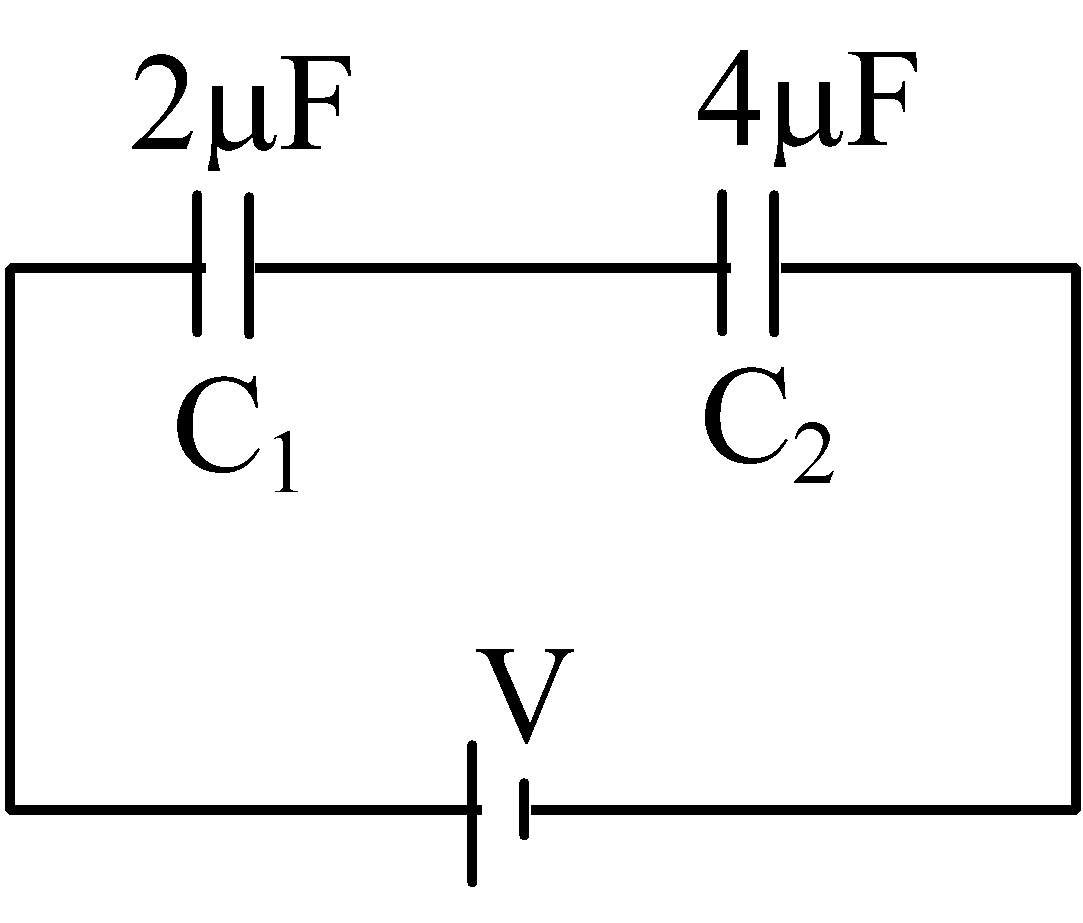
Column-I | Column-II |
(i) The potential difference across C1 | [A] increases |
(ii) The potential difference across C2 | [B] decreases |
(iii) The energy stored in C1 | [C] increases by a factor of |
(iv) The energy stored in C2 | [D]decreases by a factor of |

Correct Matrix Matching
Text Solution
Verified by ExpertsThe correct answer is:
A
Step 1: The potential difference across a capacitor is given by the relationship $V = \frac{Q}{C}$, where $Q$ is the charge and $C$ is the capacitance.
Step 2: The capacitance of a capacitor is given by $C = \frac{\varepsilon A}{d}$, where $\varepsilon$ is the permittivity, $A$ is the area, and $d$ is the separation between the plates. When the separation $d$ is doubled, the new capacitance becomes $C' = \frac{\varepsilon A}{2d} = \frac{C}{2}$.
Step 3: If the charge remains constant, the new potential difference across C1 will be $V' = \frac{Q}{C'} = \frac{Q}{C/2} = 2\frac{Q}{C} = 2V$. Thus, the potential difference increases.
Step 4: For capacitor C2, since the potential difference across parallel capacitors is the same, it will also experience a similar increase in potential drop, depending upon its own capacitance.
Step 5: Finally, the energy stored in a capacitor is given by $U = \frac{1}{2} CV^2$. As capacitance decreases, the energy stored will decrease in C2 but increase in C1 after the distance is doubled.
Thus, the responses can be matched as:
(i) increases [A]
(ii) decreases [B]
(iii) increases by a factor of 2 [C]
(iv) decreases by a factor of 2 [D].
Therefore, the correct option is A.
Step 2: The capacitance of a capacitor is given by $C = \frac{\varepsilon A}{d}$, where $\varepsilon$ is the permittivity, $A$ is the area, and $d$ is the separation between the plates. When the separation $d$ is doubled, the new capacitance becomes $C' = \frac{\varepsilon A}{2d} = \frac{C}{2}$.
Step 3: If the charge remains constant, the new potential difference across C1 will be $V' = \frac{Q}{C'} = \frac{Q}{C/2} = 2\frac{Q}{C} = 2V$. Thus, the potential difference increases.
Step 4: For capacitor C2, since the potential difference across parallel capacitors is the same, it will also experience a similar increase in potential drop, depending upon its own capacitance.
Step 5: Finally, the energy stored in a capacitor is given by $U = \frac{1}{2} CV^2$. As capacitance decreases, the energy stored will decrease in C2 but increase in C1 after the distance is doubled.
Thus, the responses can be matched as:
(i) increases [A]
(ii) decreases [B]
(iii) increases by a factor of 2 [C]
(iv) decreases by a factor of 2 [D].
Therefore, the correct option is A.
Prepare Smarter with CGP Edu
Get practice questions, solutions, and test series in one place.
Write a Review
Share your experience with this question and solution.
Commentary
Send your comment, doubt, correction, or feedback to admin.
Similar Questions
Explore conceptually related problems
Two equal negative charge – q are fixed at the fixed points (0,a) and $(0,-a)$ on the Y-axis. A pos…
An electric line of force in the xy plane is given by equation $x^{2} + y^{2} = 1$ . A particle wit…
A positively charged ball hangs from a silk thread. We put a positive test charge $\alpha_0$ at a p…
If on the concentric hollow spheres of radii r and $R(>r)$ the charge $QED$ is distributed such tha…
Two equal charges of opposite sign separated by a distance constitute an electric dipole of dipol…
A point charge q is placed at a distance a/2 directly above the center of a square of side a. The e…