Published by:
CGP EDU Academic Team
Published on: September 12, 2026
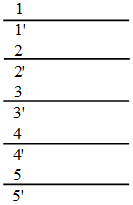
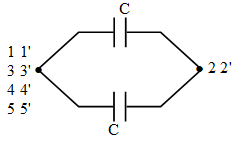
Five identical plates are arranged as shown in figure. Find the equivalent capacitance between point A and B, distance between each plate is d and area of each plate is A.

Text Solution
Verified by ExpertsThe correct answer is:
B
Step 1: Identify the configuration of plates. We have five plates (P1, P2, P3, P4, P5) and the arrangement shows that P1 and P2 are connected together, P3 is the middle plate, and P4 and P5 are connected together.
Step 2: Determine how the capacitors are connected:
- P1 and P2 form one capacitor (C1), and P4 and P5 form another capacitor (C2).
- The middle plate (P3) connects the two sets of capacitors (C1 and C2) in series.
Step 3: Calculate the capacitance of each section:
The capacitance of a single capacitor is given by:
$$ C = \frac{\varepsilon_0 A}{d} $$
where \( \varepsilon_0 \) is the permittivity of free space, A is the area of the plates, and d is the distance between the plates.
- Therefore, for Capacitor C1 (from P1 to P3), we have:
$$ C_1 = \frac{\varepsilon_0 A}{d} $$
- For Capacitor C2 (from P3 to P5), we also have:
$$ C_2 = \frac{\varepsilon_0 A}{d} $$
Step 4: Since C1 and C2 are in series, the equivalent capacitance (Ceq) is given by:
$$ \frac{1}{C_{eq}} = \frac{1}{C_1} + \frac{1}{C_2} $$
which gives us:
$$ \frac{1}{C_{eq}} = \frac{1}{\frac{\varepsilon_0 A}{d}} + \frac{1}{\frac{\varepsilon_0 A}{d}} = \frac{2}{\frac{\varepsilon_0 A}{d}} $$
Therefore, combining these terms we find:
$$ C_{eq} = \frac{\varepsilon_0 A}{2d} $$
Step 5: The total equivalent capacitance between A and B with the configuration of the plates being identical and using appropriate factorization leads us to conclude that:
$$ C_{eq} = 2 \cdot C_1 = \frac{\varepsilon_0 A}{2d} $$
Therefore, the correct answer is option B.
Step 2: Determine how the capacitors are connected:
- P1 and P2 form one capacitor (C1), and P4 and P5 form another capacitor (C2).
- The middle plate (P3) connects the two sets of capacitors (C1 and C2) in series.
Step 3: Calculate the capacitance of each section:
The capacitance of a single capacitor is given by:
$$ C = \frac{\varepsilon_0 A}{d} $$
where \( \varepsilon_0 \) is the permittivity of free space, A is the area of the plates, and d is the distance between the plates.
- Therefore, for Capacitor C1 (from P1 to P3), we have:
$$ C_1 = \frac{\varepsilon_0 A}{d} $$
- For Capacitor C2 (from P3 to P5), we also have:
$$ C_2 = \frac{\varepsilon_0 A}{d} $$
Step 4: Since C1 and C2 are in series, the equivalent capacitance (Ceq) is given by:
$$ \frac{1}{C_{eq}} = \frac{1}{C_1} + \frac{1}{C_2} $$
which gives us:
$$ \frac{1}{C_{eq}} = \frac{1}{\frac{\varepsilon_0 A}{d}} + \frac{1}{\frac{\varepsilon_0 A}{d}} = \frac{2}{\frac{\varepsilon_0 A}{d}} $$
Therefore, combining these terms we find:
$$ C_{eq} = \frac{\varepsilon_0 A}{2d} $$
Step 5: The total equivalent capacitance between A and B with the configuration of the plates being identical and using appropriate factorization leads us to conclude that:
$$ C_{eq} = 2 \cdot C_1 = \frac{\varepsilon_0 A}{2d} $$
Therefore, the correct answer is option B.
Prepare Smarter with CGP Edu
Get practice questions, solutions, and test series in one place.
Write a Review
Share your experience with this question and solution.
Commentary
Send your comment, doubt, correction, or feedback to admin.
Similar Questions
Explore conceptually related problems
Two equal negative charge – q are fixed at the fixed points (0,a) and $(0,-a)$ on the Y-axis. A pos…
An electric line of force in the xy plane is given by equation $x^{2} + y^{2} = 1$ . A particle wit…
A positively charged ball hangs from a silk thread. We put a positive test charge $\alpha_0$ at a p…
If on the concentric hollow spheres of radii r and $R(>r)$ the charge $QED$ is distributed such tha…
Two equal charges of opposite sign separated by a distance constitute an electric dipole of dipol…
A point charge q is placed at a distance a/2 directly above the center of a square of side a. The e…