A uniform solid cube is floating in a liquid as shown in the figure, with part x inside the liquid. Some changes in parameters are mentioned in Column I. Assuming no other changes, match the following –
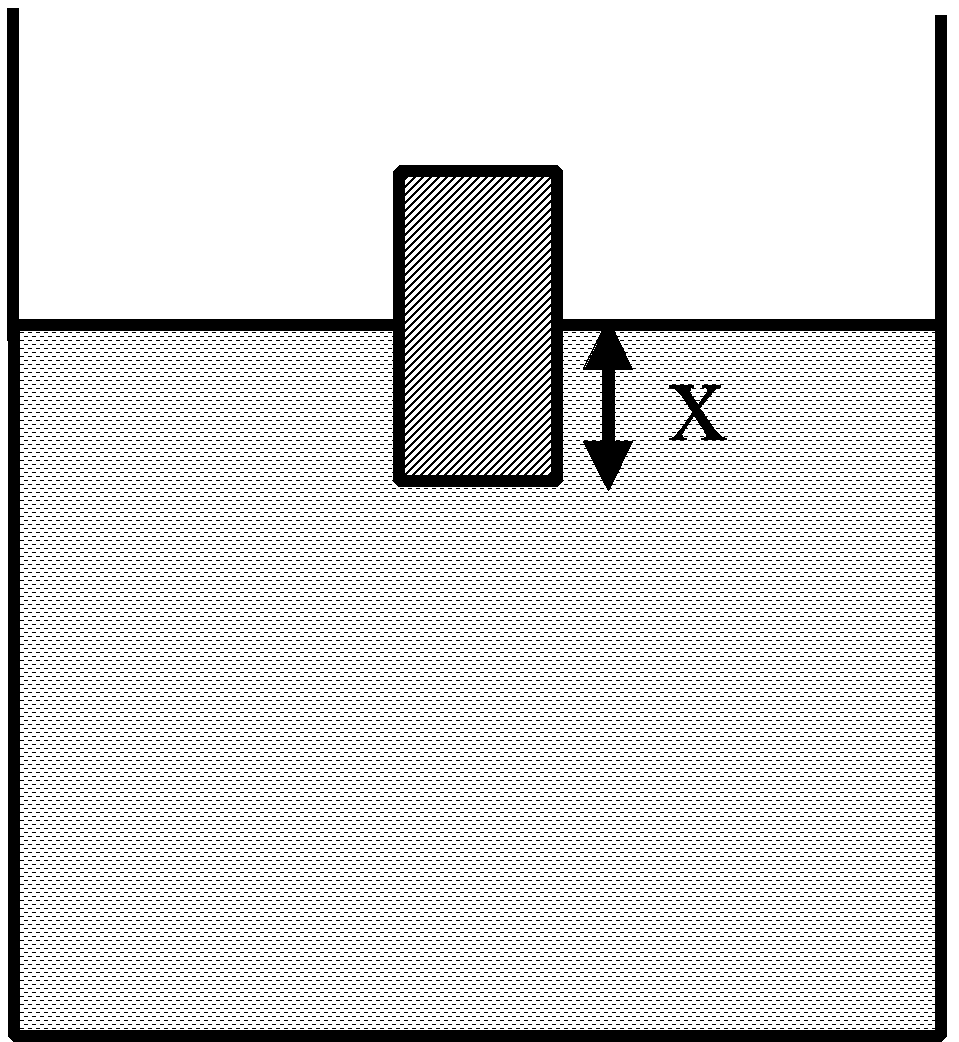
Column-I | Column-I |
(i) If density of the liquid decreases, x will | [A] Increase |
(ii) If height of the cube is increased keeping base area and density same, x will | [B] Decreases |
(iii) If the whole system is accelerated upward, then x will | [C] Remain same |
(iv) If the cube is replaced by another cube of same size but lesser density, x will | [D] May increase or decrease |
Text Solution
Verified by ExpertsA
Step 1: Examine each scenario in Column I.
(i) If the density of the liquid decreases: When the density of the liquid decreases, the weight of the liquid displaced decreases, which means the buoyant force acting on the cube is less. To balance the cube's weight, it will have to increase its submerged depth (x) to displace more liquid and thus, increase the buoyant force.
Thus, x will increase.
(ii) If the height of the cube is increased while keeping its base area and density constant: An increase in the height of the cube, while maintaining the same base area, will lead to a greater overall weight of the cube. Since the area of base doesn’t change, it would lead to a decrease in the submerged depth (x) because the cube will require less density displacement to balance its weight. Hence, x will decrease.
(iii) If the system is accelerated upward: When the whole system is accelerated upwards, the effective gravitational force acting on the cube increases. However, since this affects all forces equally and does not change the buoyant force dynamics, x remains the same.
(iv) If the cube is replaced by another cube of the same size but with lesser density: If the new cube has lesser density, it will effectively be less dense than the liquid. Therefore, it will float higher or may even not float at all if the density is too low compared to the liquid. Therefore, x can either increase or decrease based on the density of the new cube in comparison to the liquid.
After analyzing each scenario, the matching will be:
(i) A (Increase)
(ii) B (Decreases)
(iii) C (Remain same)
(iv) D (May increase or decrease).
Therefore, the correct matches are (i) - A, (ii) - B, (iii) - C, (iv) - D.
Prepare Smarter with CGP Edu
Get practice questions, solutions, and test series in one place.
Write a Review
Share your experience with this question and solution.
Commentary
Send your comment, doubt, correction, or feedback to admin.
Similar Questions
Explore conceptually related problems