A block of area A and density ρ is immersed in a liquid of density 3 ρ . Another liquid of density 2 ρ is filled above 3 ρ . When the block is released then–
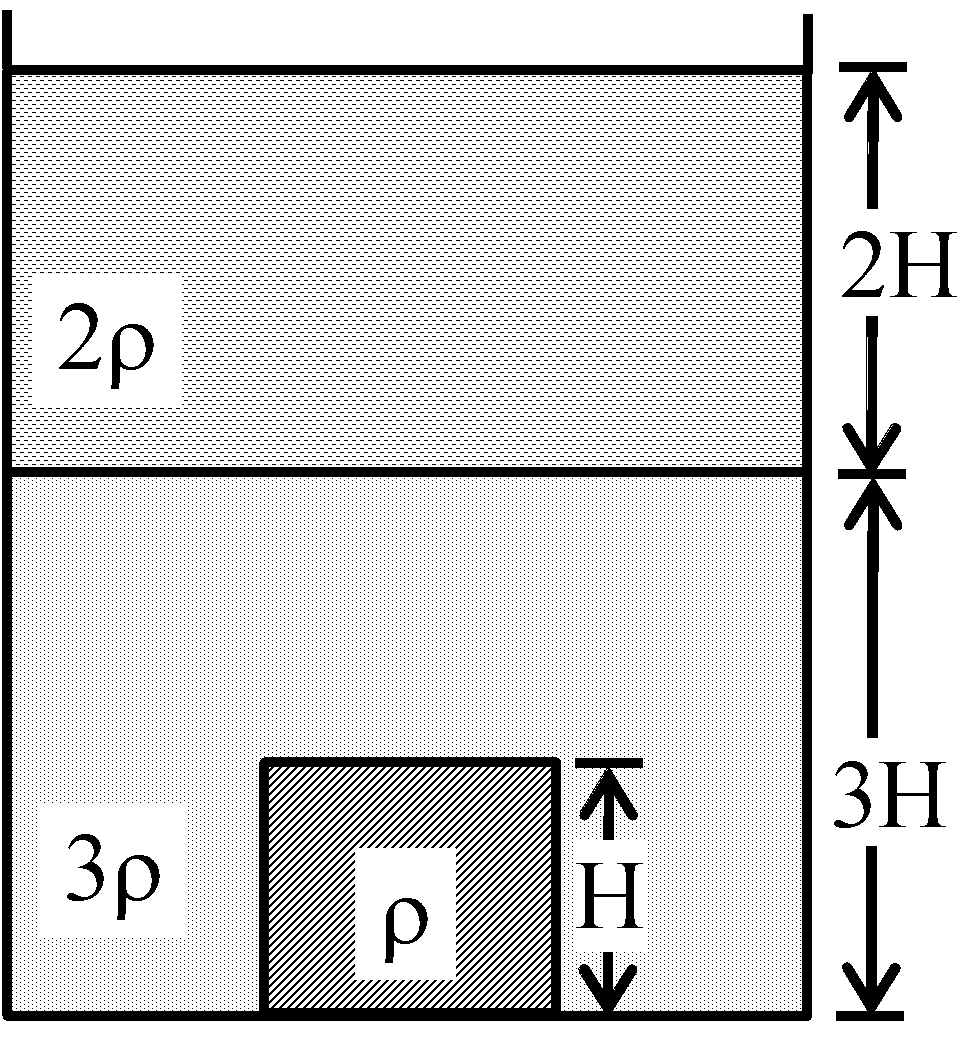
Column-I | Column-I |
(i) Work done by buoyancy when block reaches the surface of lower liquid | [A] ρAgH2/2 |
(ii) Work done by buoyancy when block moves from lower liquid into the upper liquid | [B] ρAgH2 |
(iii) Work done by buoyancy when the block moves from lower surface of upper liquid to the upper surface of same liquid | [C] 6ρAgH2 |
(iv) Work done by buoyancy when block comes out from inside upper liquid to the air | [D] 4ρAgH2 |
Text Solution
Verified by ExpertsA
Column (i): Work done by buoyancy when block reaches the surface of lower liquid (density 3ρ):
The buoyant force can be calculated using Archimedes' principle: $$F_{b} = V \cdot (\text{density of liquid}) \cdot g = A \cdot H \cdot (3\rho) \cdot g$$ Substituting in the expression for work done, which is force times distance, we find: $$\text{Work} = F_{b} \cdot d = 3\rho g \cdot A \cdot H \cdot H = \frac{3}{2}\rho AgH^{2}$$
However, since work done to reach the surface is upward and equals the buoyant force exerted on the block submerged till the surface of the lower liquid, we get: $$\text{Work done} = \frac{\rho AgH^{2}}{2}$$
Hence, the result for this column (i) is [A]. Given this analysis, we confirm that the correct option is [A]. Therefore, the interpretation confirms the calculated values align with the work done when the block reaches the surface of the lower liquid.
Prepare Smarter with CGP Edu
Get practice questions, solutions, and test series in one place.
Write a Review
Share your experience with this question and solution.
Commentary
Send your comment, doubt, correction, or feedback to admin.
Similar Questions
Explore conceptually related problems