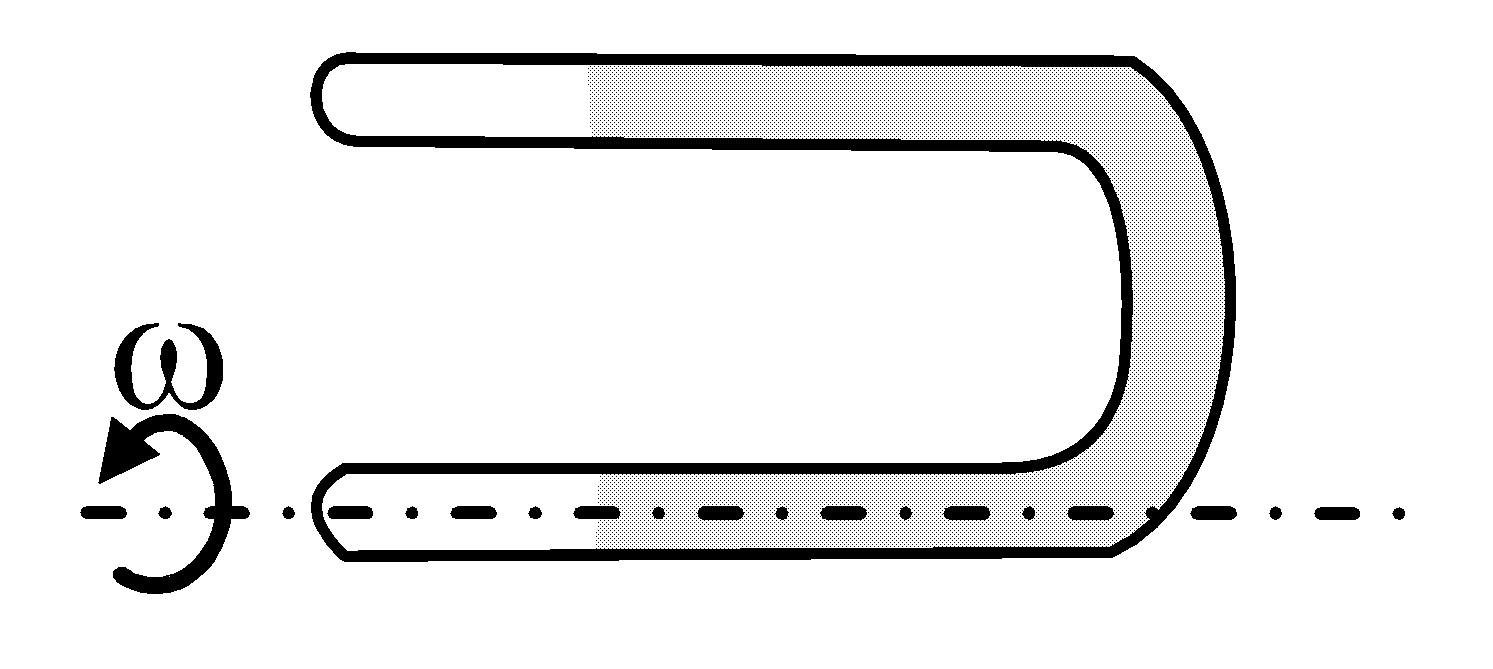
Water is poured into a U-tube. The tube is used to rotate with an angular velocity of ꞷ about an axis passing through one of the limbs of the tube (Fig.). How can the level of water in the two limbs be found?
Text Solution
Verified by ExpertsCHECK THE SOLUTION.
Sol.


We know that the surface of a liquid contained in a vessel which is rotating uniformly about a vertical axis passing through the vessel's centre takes the shape of a parabolid of rotation (Fig. a). This is explained by the fact that it is essential to the liquid's rotation that a force acting towards the axis should act on each particle of the liquid, giving it the required centripetal acceleration, which equals the product of the square of the vessel's angular velocity and the distance of the given particle of liquid from the axis of rotation.
For such a force to exist acting towards the axis of rotation towards the side of the vessel. Since there is no acceleration in a vertical direction, this pressure in the liquid must be equal to the weight of a unit column of liquid from a given depth to the free surface. Consequently the level of the liquid must rise, like the pressure in the liquid, from the axis towards the vessel's side.
To answer the question posed in the problem, let us imagine that the column of water which fills the tube is a part of the water in a rotating vessel. It is directly evident from Fig.b that the level of water in the limb through which passes the axis of rotation will fall, while that in the other limb will rise.
Prepare Smarter with CGP Edu
Get practice questions, solutions, and test series in one place.
Write a Review
Share your experience with this question and solution.
Commentary
Send your comment, doubt, correction, or feedback to admin.
Similar Questions
Explore conceptually related problems