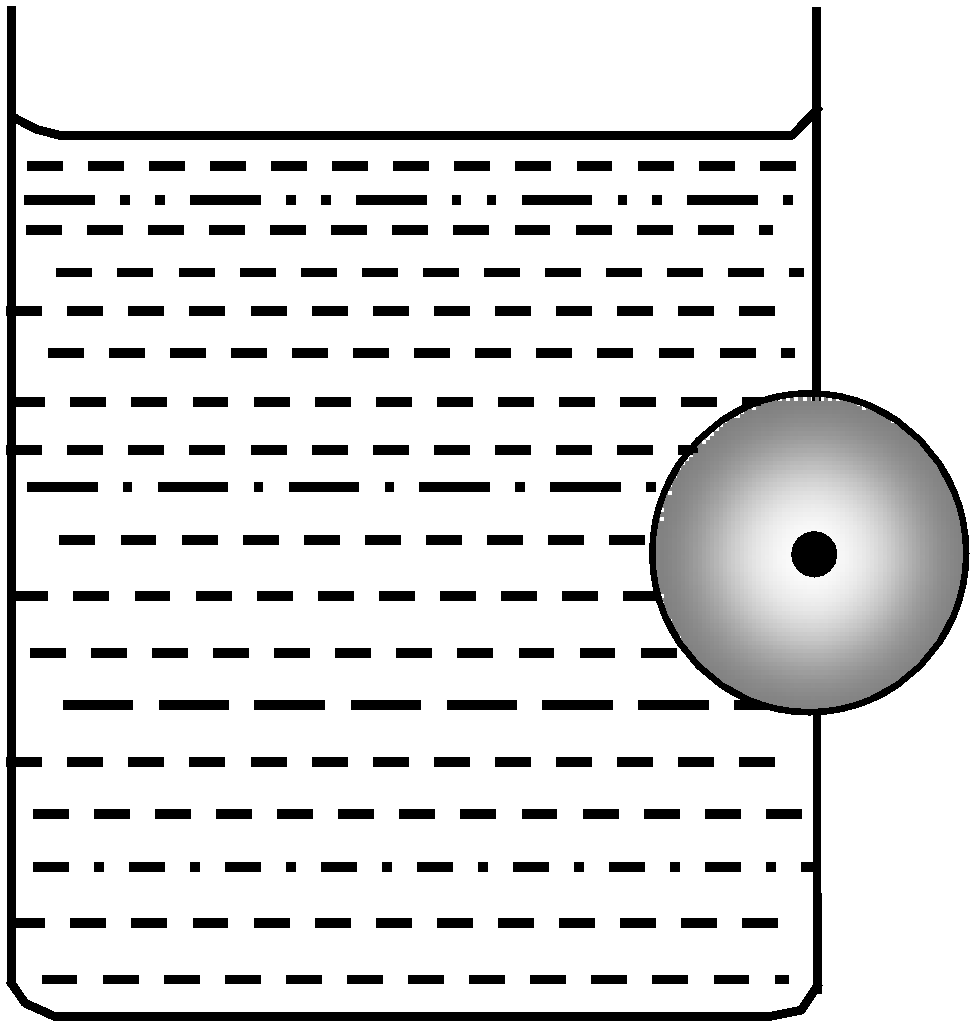
One of the many fallacious designs for a perpetuum mobile consisted in the following: a shaft is set in a slit in the side of a vessel containing liquid, the shaft's axis lying in the same plane as the vessel's side (Fig.); the shaft completely fills the slit so that no liquid runs out. The shaft can rotate about its own axis. An upthrust acts on the half of the shaft which is immersed in water (according to Archimede's principle) which ought, it would appear, to cause the shaft to rotate in a counter-clockwise direction. This rotation, if it arose, ought to continue perpetually. Where is the fallacy here?
Text Solution
Verified by ExpertsCHECK THE SOLUTION.
Sol. Rotation of the shaft does not take place since the water exerts pressure upon the curved surface at all points in a direction perpendicular to the surface, i.e. in the line of the radius produced. Since these forces pass through the centre of the shaft, they cannot cause the shaft to rotate. All these forces have a resultant, which acts outwards and in a slightly upwards direction, but which passes through the axis of the shaft and which therefore only tends to push the shaft out of the side of the vessel and not to make it rotate about its own axis.
Prepare Smarter with CGP Edu
Get practice questions, solutions, and test series in one place.
Write a Review
Share your experience with this question and solution.
Commentary
Send your comment, doubt, correction, or feedback to admin.
Similar Questions
Explore conceptually related problems