Published by:
CGP EDU Academic Team
Published on: September 13, 2026
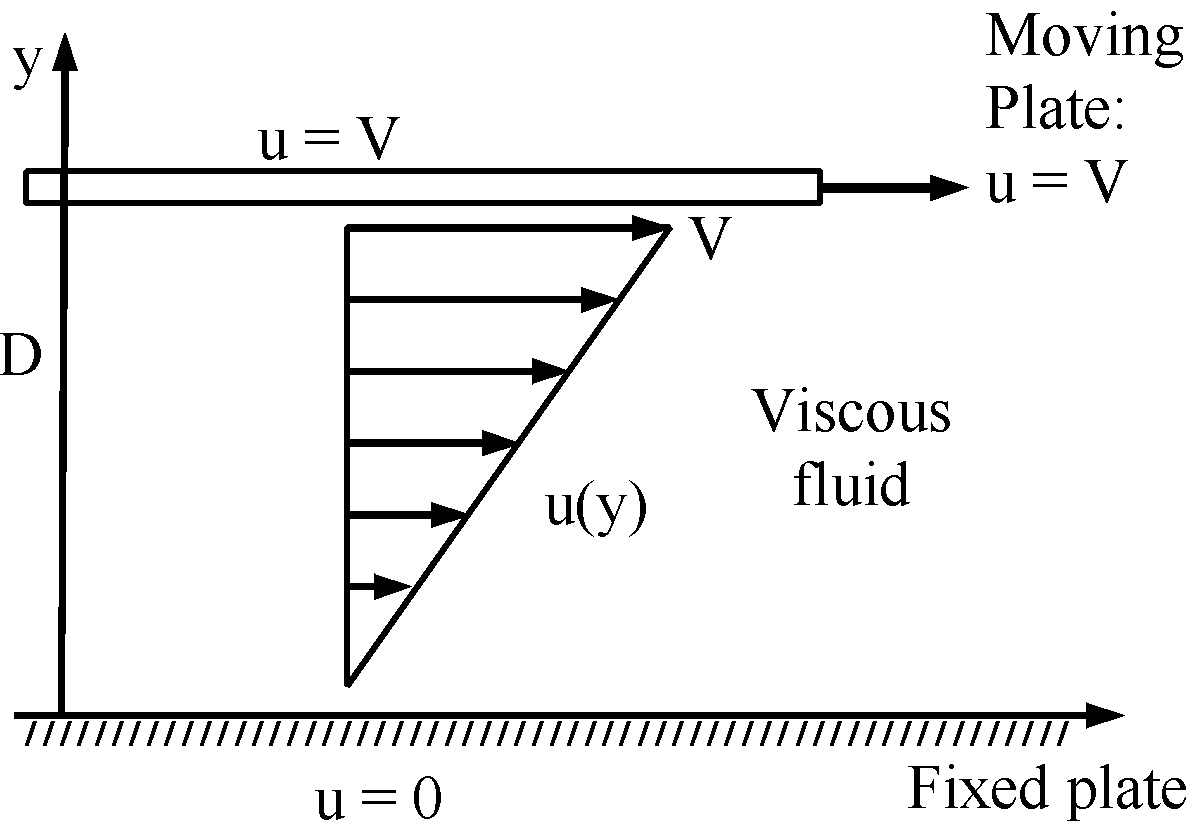
In Fig., if the fluid is oil of viscosity 0.440 Nm –2 S at 20ºC and D = 7 mm, what shear stress is required to move the upper plate at 3.5 m/s? Compute the Reynolds number based on D.
Text Solution
Verified by ExpertsThe correct answer is:
A
Step 1: Understanding Shear Stress
Shear stress ($\tau$) is defined by the equation:
$$ \tau = \mu \frac{du}{dy} $$
where:
– $\tau$ is the shear stress,
– $\mu$ is the viscosity of the fluid,
– $\frac{du}{dy}$ is the velocity gradient.
Step 2: Calculate the velocity gradient
In this scenario, the upper plate moves at a velocity ($u$) of 3.5 m/s, and the distance over which this velocity change happens ($D$) is 7 mm (or 0.007 m). The velocity gradient can be approximated as:
$$ \frac{du}{dy} = \frac{u}{D} = \frac{3.5 \text{ m/s}}{0.007 \text{ m}} = 500 \text{ s}^{-1} $$
Step 3: Calculate the shear stress
Substituting the values into the shear stress formula:
$$ \tau = 0.440 \text{ Nm}^{-2} \text{ s} \times 500 \text{ s}^{-1} = 220 \text{ N/m}^{2} $$
Step 4: Calculate the Reynolds number
The Reynolds number ($Re$) is given by:
$$ Re = \frac{\rho u D}{\mu} $$
We need the density of oil. For typical oil at 20ºC, $\rho \approx 800 \text{ kg/m}^{3}$. Therefore:
$$ Re = \frac{800 \text{ kg/m}^{3} \times 3.5 \text{ m/s} \times 0.007 \text{ m}}{0.440 \text{ Nm}^{-2} \text{ s}} = \frac{19.6}{0.440} \approx 44.5 $$
Conclusion
Thus, the required shear stress is approximately 220 N/m² and the Reynolds number is approximately 44.5.
Shear stress ($\tau$) is defined by the equation:
$$ \tau = \mu \frac{du}{dy} $$
where:
– $\tau$ is the shear stress,
– $\mu$ is the viscosity of the fluid,
– $\frac{du}{dy}$ is the velocity gradient.
Step 2: Calculate the velocity gradient
In this scenario, the upper plate moves at a velocity ($u$) of 3.5 m/s, and the distance over which this velocity change happens ($D$) is 7 mm (or 0.007 m). The velocity gradient can be approximated as:
$$ \frac{du}{dy} = \frac{u}{D} = \frac{3.5 \text{ m/s}}{0.007 \text{ m}} = 500 \text{ s}^{-1} $$
Step 3: Calculate the shear stress
Substituting the values into the shear stress formula:
$$ \tau = 0.440 \text{ Nm}^{-2} \text{ s} \times 500 \text{ s}^{-1} = 220 \text{ N/m}^{2} $$
Step 4: Calculate the Reynolds number
The Reynolds number ($Re$) is given by:
$$ Re = \frac{\rho u D}{\mu} $$
We need the density of oil. For typical oil at 20ºC, $\rho \approx 800 \text{ kg/m}^{3}$. Therefore:
$$ Re = \frac{800 \text{ kg/m}^{3} \times 3.5 \text{ m/s} \times 0.007 \text{ m}}{0.440 \text{ Nm}^{-2} \text{ s}} = \frac{19.6}{0.440} \approx 44.5 $$
Conclusion
Thus, the required shear stress is approximately 220 N/m² and the Reynolds number is approximately 44.5.
Prepare Smarter with CGP Edu
Get practice questions, solutions, and test series in one place.
Write a Review
Share your experience with this question and solution.
Commentary
Send your comment, doubt, correction, or feedback to admin.
Similar Questions
Explore conceptually related problems
A U-tube in which the cross-sectional area of the limb on the left is one quarter, the limb on the …
A wooden block, with a coin placed on its top, floats in water as shown in fig. the distance l and …
A body floats in a liquid contained in a beaker. The whole system as shown falls freely under gravi…
A liquid is kept in a cylindrical vessel which is being rotated about a vertical axis through the c…
Water is filled in a cylindrical container to a height of 3m. The ratio of the cross-sectional area…
A large open tank has two holes in the wall. One is a square hole of side L at a depth y from the t…