Published by:
CGP EDU Academic Team
Published on: September 12, 2026
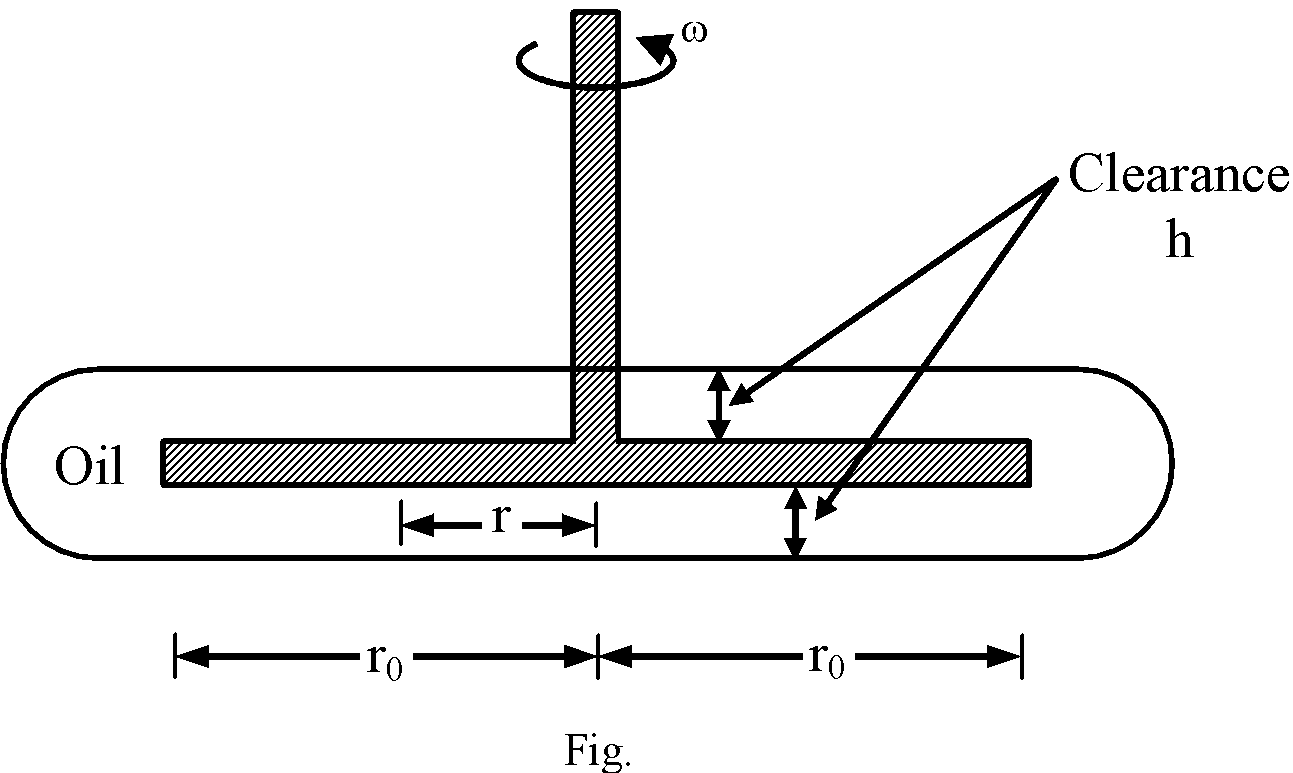
A disk of radius r 0 rotates at angular velocity ꞷ inside an oil bath of viscosity µ, as shown in Fig. Assuming a linear velocity profile and neglecting shear on the outer disk edges, derive an expression for the viscous torque on the disk.
Text Solution
Verified by ExpertsThe correct answer is:
A
Step 1: Define the parameters. The disk has a radius \( r_0 \) and rotates with an angular velocity \( \omega \). The viscosity of the fluid is \( \mu \).
Step 2: The linear velocity \( v \) at a radius \( r \) from the center of the disk is given by \( v = r \omega \).
Step 3: Consider a differential element of the disk at radius \( r \) with thickness \( dr \) and width \( h \) (the height of the cylinder). The area of the differential element is \( dA = h \, dr \).
Step 4: The shear stress \( \tau \) acting on this element due to viscosity is given by \( \tau = \mu \frac{du}{dy} \), where \( u \) is the velocity and \( y \) is the distance. The velocity gradient, in this case, is \( \frac{du}{dy} \approx \frac{v}{h} = \frac{r \omega}{h} \).
Step 5: Therefore, the shear stress can be expressed as \( \tau = \mu \frac{r \omega}{h} \).
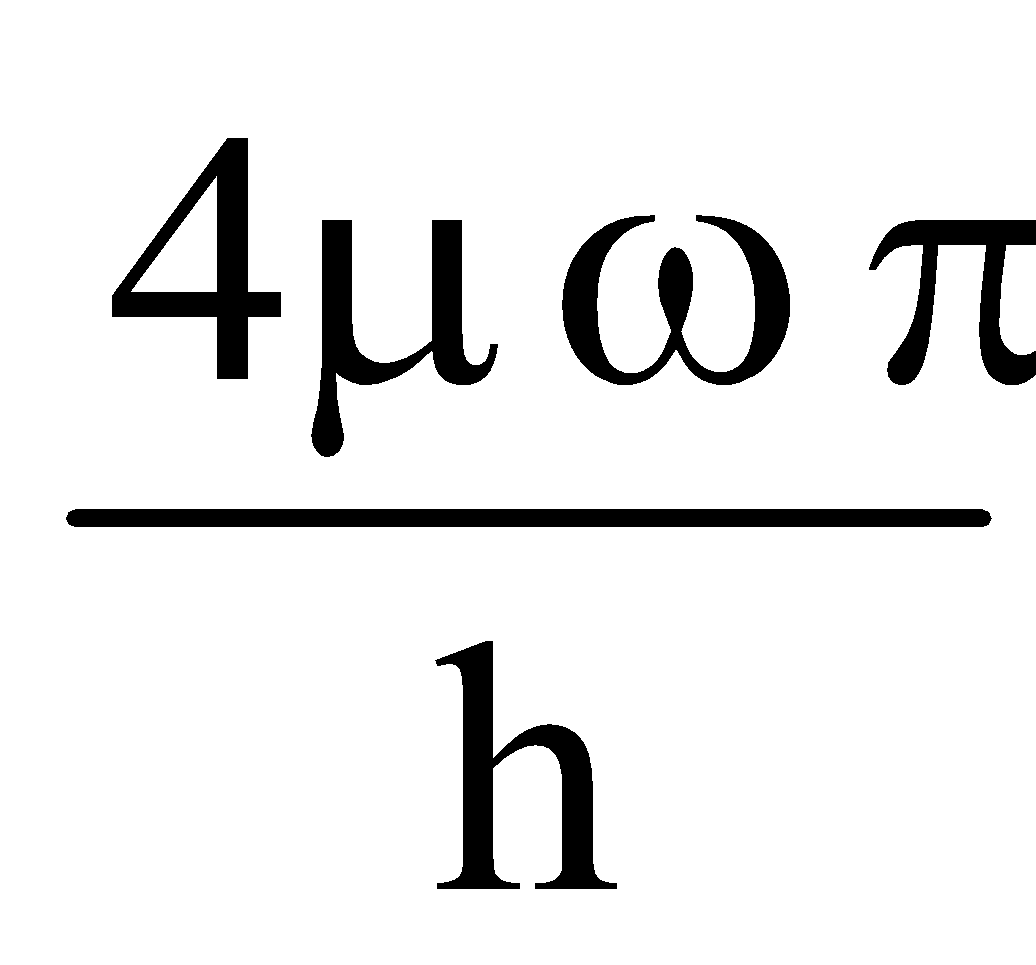
Step 6: The differential torque \( dT \) contributed by this element is given by \( dT = \tau \, dA \, r = \left( \mu \frac{r \omega}{h} \right) (h \, dr) \cdot r = \mu \frac{r^2 \omega}{h} dr\).
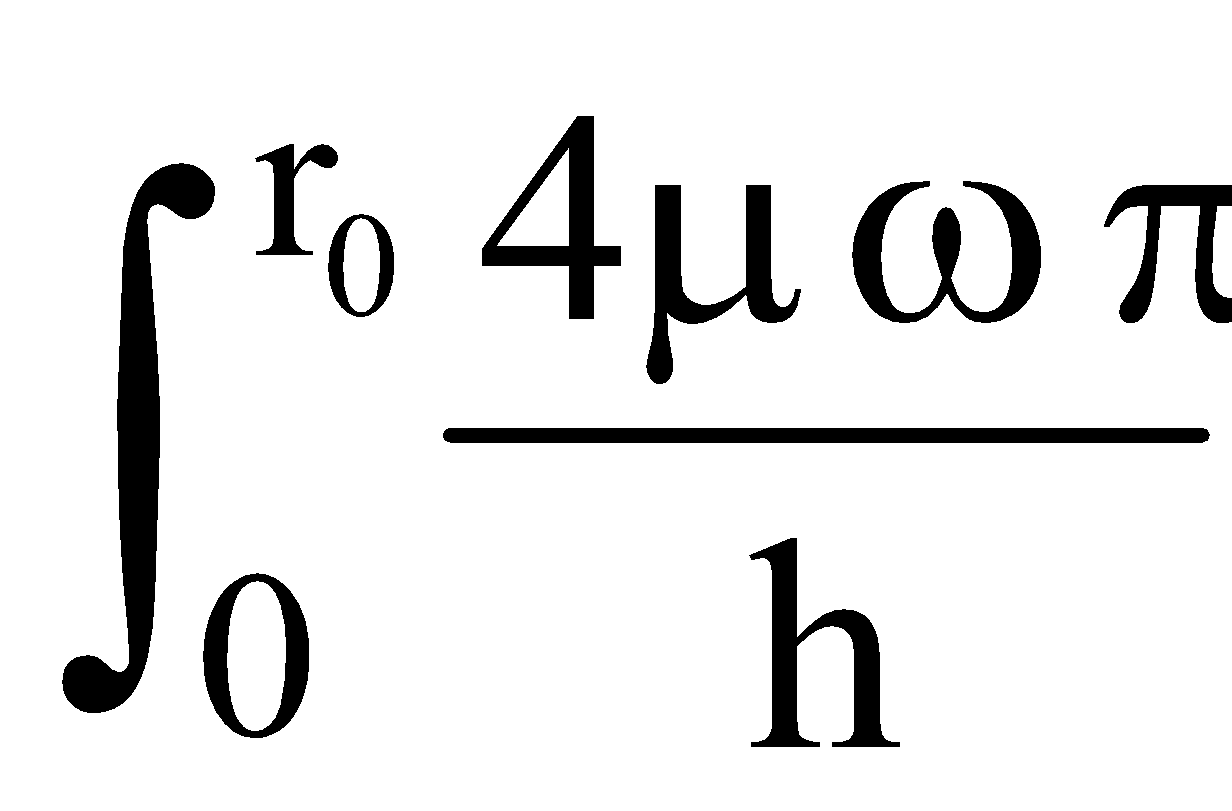
Step 7: To obtain the total torque \( T \), integrate \( dT \) from 0 to \( r_0 \):
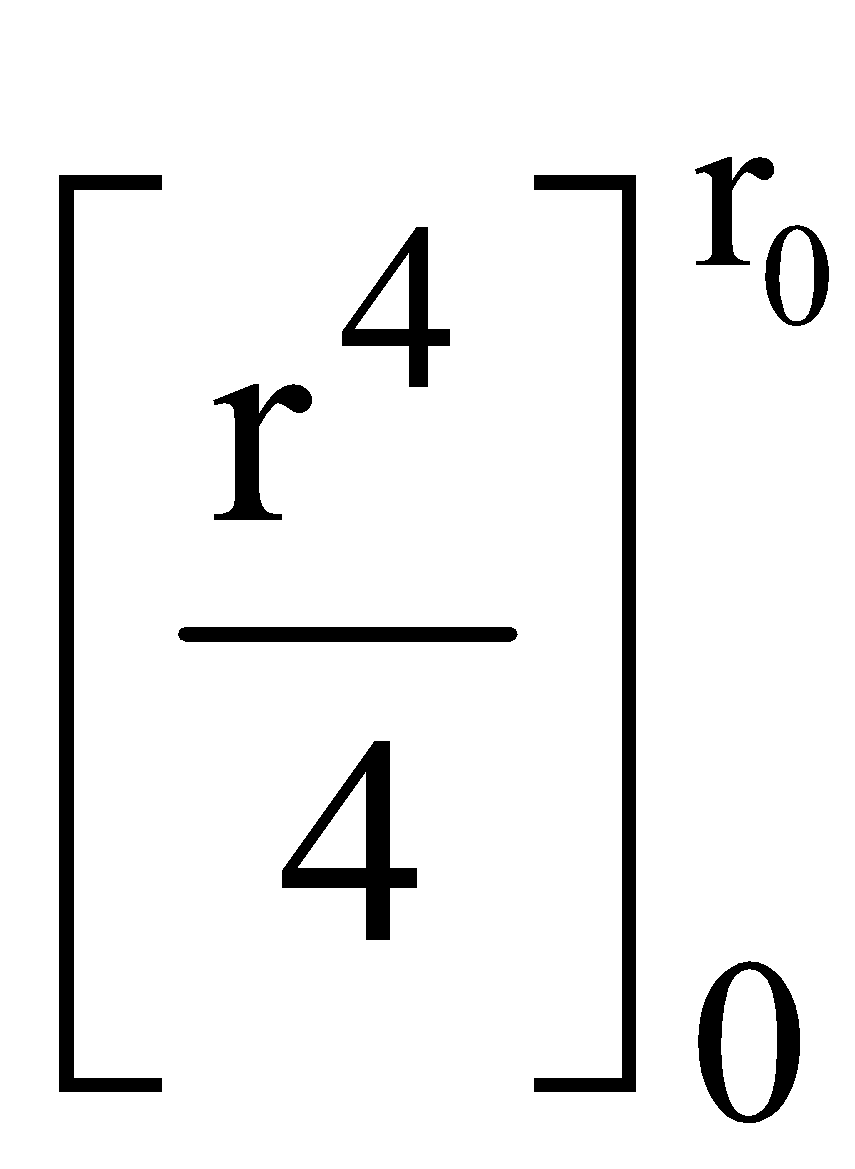
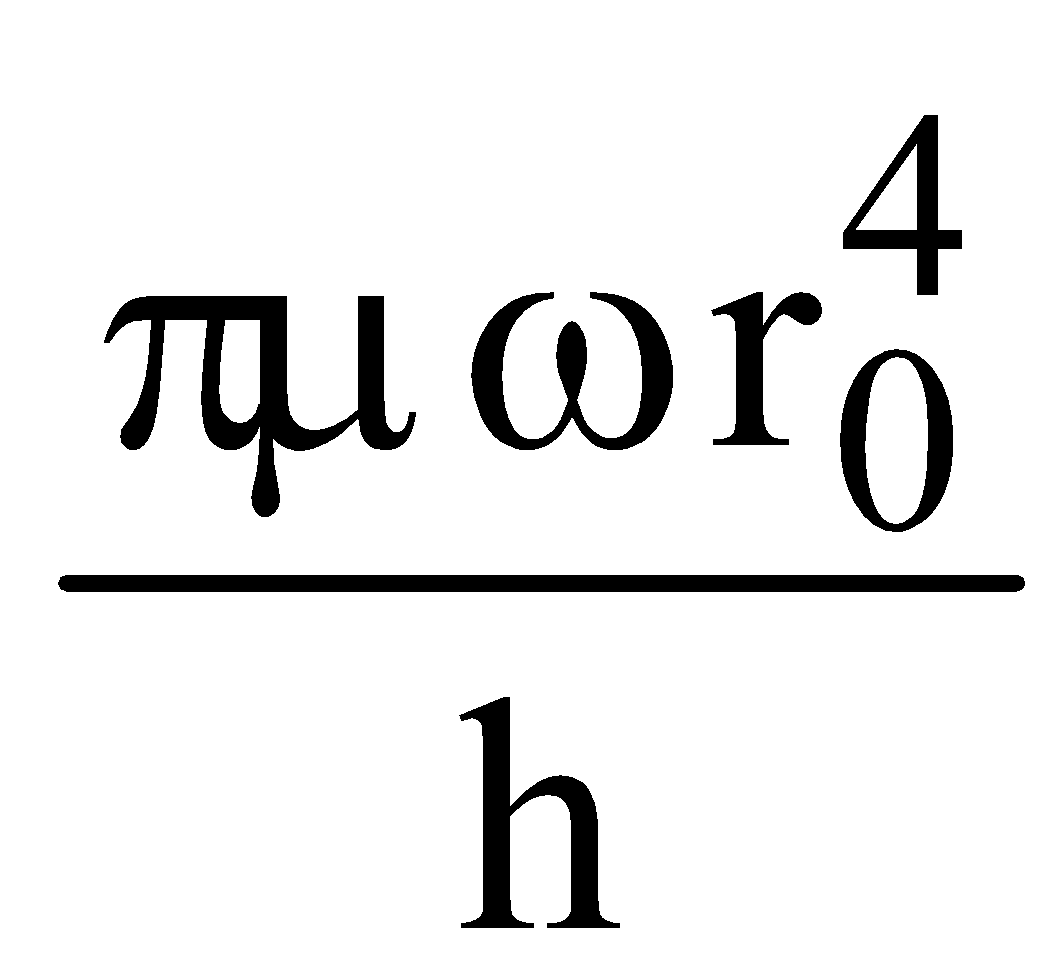
\[ T = \int_0^{r_0} \mu \frac{r^2 \omega}{h} dr = \mu \frac{\omega}{h} \int_0^{r_0} r^2 dr = \mu \frac{\omega}{h} \left( \frac{r_0^3}{3} \right)\].
Therefore, the total viscous torque on the disk is \( T = \frac{\mu \omega r_0^3}{3h} \).
This expression represents the viscous torque on the disk due to the fluid's viscosity.
Step 2: The linear velocity \( v \) at a radius \( r \) from the center of the disk is given by \( v = r \omega \).
Step 3: Consider a differential element of the disk at radius \( r \) with thickness \( dr \) and width \( h \) (the height of the cylinder). The area of the differential element is \( dA = h \, dr \).
Step 4: The shear stress \( \tau \) acting on this element due to viscosity is given by \( \tau = \mu \frac{du}{dy} \), where \( u \) is the velocity and \( y \) is the distance. The velocity gradient, in this case, is \( \frac{du}{dy} \approx \frac{v}{h} = \frac{r \omega}{h} \).
Step 5: Therefore, the shear stress can be expressed as \( \tau = \mu \frac{r \omega}{h} \).
Step 6: The differential torque \( dT \) contributed by this element is given by \( dT = \tau \, dA \, r = \left( \mu \frac{r \omega}{h} \right) (h \, dr) \cdot r = \mu \frac{r^2 \omega}{h} dr\).
Step 7: To obtain the total torque \( T \), integrate \( dT \) from 0 to \( r_0 \):
\[ T = \int_0^{r_0} \mu \frac{r^2 \omega}{h} dr = \mu \frac{\omega}{h} \int_0^{r_0} r^2 dr = \mu \frac{\omega}{h} \left( \frac{r_0^3}{3} \right)\].
Therefore, the total viscous torque on the disk is \( T = \frac{\mu \omega r_0^3}{3h} \).
This expression represents the viscous torque on the disk due to the fluid's viscosity.
Prepare Smarter with CGP Edu
Get practice questions, solutions, and test series in one place.
Write a Review
Share your experience with this question and solution.
Commentary
Send your comment, doubt, correction, or feedback to admin.
Similar Questions
Explore conceptually related problems
A U-tube in which the cross-sectional area of the limb on the left is one quarter, the limb on the …
A wooden block, with a coin placed on its top, floats in water as shown in fig. the distance l and …
A body floats in a liquid contained in a beaker. The whole system as shown falls freely under gravi…
A liquid is kept in a cylindrical vessel which is being rotated about a vertical axis through the c…
Water is filled in a cylindrical container to a height of 3m. The ratio of the cross-sectional area…
A large open tank has two holes in the wall. One is a square hole of side L at a depth y from the t…