Published by:
CGP EDU Academic Team
Published on: September 12, 2026
0.020 kg of ice and 0.10 kg of water at 0 ºC are in a container. Steam at 100 ºC is passed until all the ice is just melted. How much water is now in the container? (Specific latent heat of steam = 2.3 × 10 6 J kg –1 ; latent heat of ice= 3.4 × 10 5 J kg –1 ; specific heat capacity of water = 4.2 × 10 3 J kg –1 ºC –1 )
Text Solution
Verified by ExpertsThe correct answer is:
A
Step 1: Calculate the heat required to melt the ice. The latent heat of ice is given as $L_{ice} = 3.4 \times 10^5 \text{ J/kg}$. For 0.020 kg of ice, the heat required ($Q_{melt}$) is:
$Q_{melt} = m_{ice} \times L_{ice} = 0.020 \text{ kg} \times 3.4 \times 10^5 \text{ J/kg} = 6800 \text{ J}$.
Step 2: Calculate the heat released by the steam when it condenses. The specific latent heat of steam is $L_{steam} = 2.3 \times 10^6 \text{ J/kg}$. Let $m_{steam}$ be the mass of steam needed. Therefore, the heat released by the steam when it condenses is:
$Q_{steam} = m_{steam} \times L_{steam}$.
Step 3: Since all the ice melts, we have:
$Q_{steam} = Q_{melt}$. So, we set them equal:
$m_{steam} \times 2.3 \times 10^6 \text{ J/kg} = 6800 \text{ J}$.
Solving for $m_{steam}$ gives:
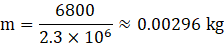
$m_{steam} = \frac{6800 \text{ J}}{2.3 \times 10^6 \text{ J/kg}} \approx 0.00296 \text{ kg}$.
Step 4: Now, calculate the total mass of water in the container after all the ice has melted. Initially, we have:
0.10 kg of water + 0.020 kg of ice (which becomes water) + m_{steam} (the condensed steam).
Thus, the total mass is:
$m_{water} = 0.10 \text{ kg} + 0.020 \text{ kg} + 0.00296 \text{ kg} \approx 0.12296 \text{ kg}$.
Hence, the total amount of water in the container is approximately 0.123 kg.
$Q_{melt} = m_{ice} \times L_{ice} = 0.020 \text{ kg} \times 3.4 \times 10^5 \text{ J/kg} = 6800 \text{ J}$.
Step 2: Calculate the heat released by the steam when it condenses. The specific latent heat of steam is $L_{steam} = 2.3 \times 10^6 \text{ J/kg}$. Let $m_{steam}$ be the mass of steam needed. Therefore, the heat released by the steam when it condenses is:
$Q_{steam} = m_{steam} \times L_{steam}$.
Step 3: Since all the ice melts, we have:
$Q_{steam} = Q_{melt}$. So, we set them equal:
$m_{steam} \times 2.3 \times 10^6 \text{ J/kg} = 6800 \text{ J}$.
Solving for $m_{steam}$ gives:
$m_{steam} = \frac{6800 \text{ J}}{2.3 \times 10^6 \text{ J/kg}} \approx 0.00296 \text{ kg}$.
Step 4: Now, calculate the total mass of water in the container after all the ice has melted. Initially, we have:
0.10 kg of water + 0.020 kg of ice (which becomes water) + m_{steam} (the condensed steam).
Thus, the total mass is:
$m_{water} = 0.10 \text{ kg} + 0.020 \text{ kg} + 0.00296 \text{ kg} \approx 0.12296 \text{ kg}$.
Hence, the total amount of water in the container is approximately 0.123 kg.
Prepare Smarter with CGP Edu
Get practice questions, solutions, and test series in one place.
Write a Review
Share your experience with this question and solution.
Commentary
Send your comment, doubt, correction, or feedback to admin.
Similar Questions
Explore conceptually related problems
An ideal gas having molar specific heat capacity at constant volume is R, the molar specific heat …
Mayer’s formula for the relation between two principal specific heats C P and C V of a gas is given…
For a gas of molecular weight M specific heat capacity at constant pressure is
One mole of an ideal monoatomic gas at temperature expands slowly according to the law constant. …
The specific heat of air at constant volume is 0.172 Cal g –1 °C –1 . The change in internal energy…
A geyser heats water flowing at the rate of 4 liter per minute from 30°C to 80°C. If the geyser ope…