Published by:
CGP EDU Academic Team
Published on: September 12, 2026
Arrange the order of power dissipated in the given circuits, if the same current is passing through the system. The resistance of each resistor is ' r '.
(i) 
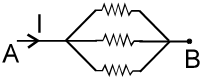
(ii) 
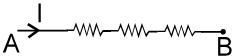
(iii) 
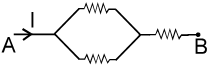
(iv) 
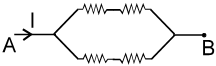
Text Solution
Verified by ExpertsThe correct answer is:
A
To determine the power dissipated in each circuit with the same current, we apply the formula for power:
$$ P = I^2 R $$
Since the current (I) is constant in all circuits, we need to calculate the equivalent resistance (R) for each configuration to compare the power.
1. **Circuit (i)**: Two resistors in series. The equivalent resistance \( R_1 \) is:
$$ R_1 = r + r = 2r $$
Power: $$ P_1 = I^2 R_1 = I^2 (2r) = 2I^2 r $$
2. **Circuit (ii)**: Four resistors in series. The equivalent resistance \( R_2 \) is:
$$ R_2 = r + r + r + r = 4r $$
Power: $$ P_2 = I^2 R_2 = I^2 (4r) = 4I^2 r $$
3. **Circuit (iii)**: Two pairs of resistors in parallel, where each pair is in series. Each pair's resistance is \( r \), and they are in parallel:
$$ R_3 = \frac{r}{2} $$
Power: $$ P_3 = I^2 R_3 = I^2 \left( \frac{r}{2} \right) = \frac{I^2 r}{2} $$
4. **Circuit (iv)**: Two resistors in parallel. Equivalent resistance \( R_4 \) is:
$$ R_4 = \frac{r}{2} $$
Power: $$ P_4 = I^2 R_4 = I^2 \left( \frac{r}{2} \right) = \frac{I^2 r}{2} $$
Now we compare the powers:
- \( P_2 = 4I^2 r \) (highest)
- \( P_1 = 2I^2 r \)
- \( P_4 = \frac{I^2 r}{2} \)
- \( P_3 = \frac{I^2 r}{2} \)
Therefore, the order of power dissipated is:
**P2 > P1 > P4 = P3**, which corresponds to Option A.
$$ P = I^2 R $$
Since the current (I) is constant in all circuits, we need to calculate the equivalent resistance (R) for each configuration to compare the power.
1. **Circuit (i)**: Two resistors in series. The equivalent resistance \( R_1 \) is:
$$ R_1 = r + r = 2r $$
Power: $$ P_1 = I^2 R_1 = I^2 (2r) = 2I^2 r $$
2. **Circuit (ii)**: Four resistors in series. The equivalent resistance \( R_2 \) is:
$$ R_2 = r + r + r + r = 4r $$
Power: $$ P_2 = I^2 R_2 = I^2 (4r) = 4I^2 r $$
3. **Circuit (iii)**: Two pairs of resistors in parallel, where each pair is in series. Each pair's resistance is \( r \), and they are in parallel:
$$ R_3 = \frac{r}{2} $$
Power: $$ P_3 = I^2 R_3 = I^2 \left( \frac{r}{2} \right) = \frac{I^2 r}{2} $$
4. **Circuit (iv)**: Two resistors in parallel. Equivalent resistance \( R_4 \) is:
$$ R_4 = \frac{r}{2} $$
Power: $$ P_4 = I^2 R_4 = I^2 \left( \frac{r}{2} \right) = \frac{I^2 r}{2} $$
Now we compare the powers:
- \( P_2 = 4I^2 r \) (highest)
- \( P_1 = 2I^2 r \)
- \( P_4 = \frac{I^2 r}{2} \)
- \( P_3 = \frac{I^2 r}{2} \)
Therefore, the order of power dissipated is:
**P2 > P1 > P4 = P3**, which corresponds to Option A.
Prepare Smarter with CGP Edu
Get practice questions, solutions, and test series in one place.
Write a Review
Share your experience with this question and solution.
Commentary
Send your comment, doubt, correction, or feedback to admin.
Similar Questions
Explore conceptually related problems
A wire has a resistance of 12 ohms. If it is bent in the form of a circle. The effective resistance…
A wire has a resistance 12 ohms. if it is bent in the form of a equilateral triangle. The resistanc…
There are five resistances of 1 ohm each. If the initial three resistance are joined in parallel an…
For the network of resistance shown in the figure the equivalent resistance of the network between …
If 2 bulbs rated 2.5 W – 110 V and 100 W – 110 V are connected in series to a 220 V supply then
A 50 W bulb is in series with a room heater and the combination is connected across the mains. To g…