Parallel rays striking a spherical mirror far from the optic axis are focussed at a different point than are rays near the axis thereby the focus moves toward the mirror as the parallel rays move toward the outer edge of the mirror. What value of incidence angle θ produces a 2 % change in the location of the focus, compared to the location for θ very close to zero?
Text Solution
Verified by ExpertsThe correct answer is:
D
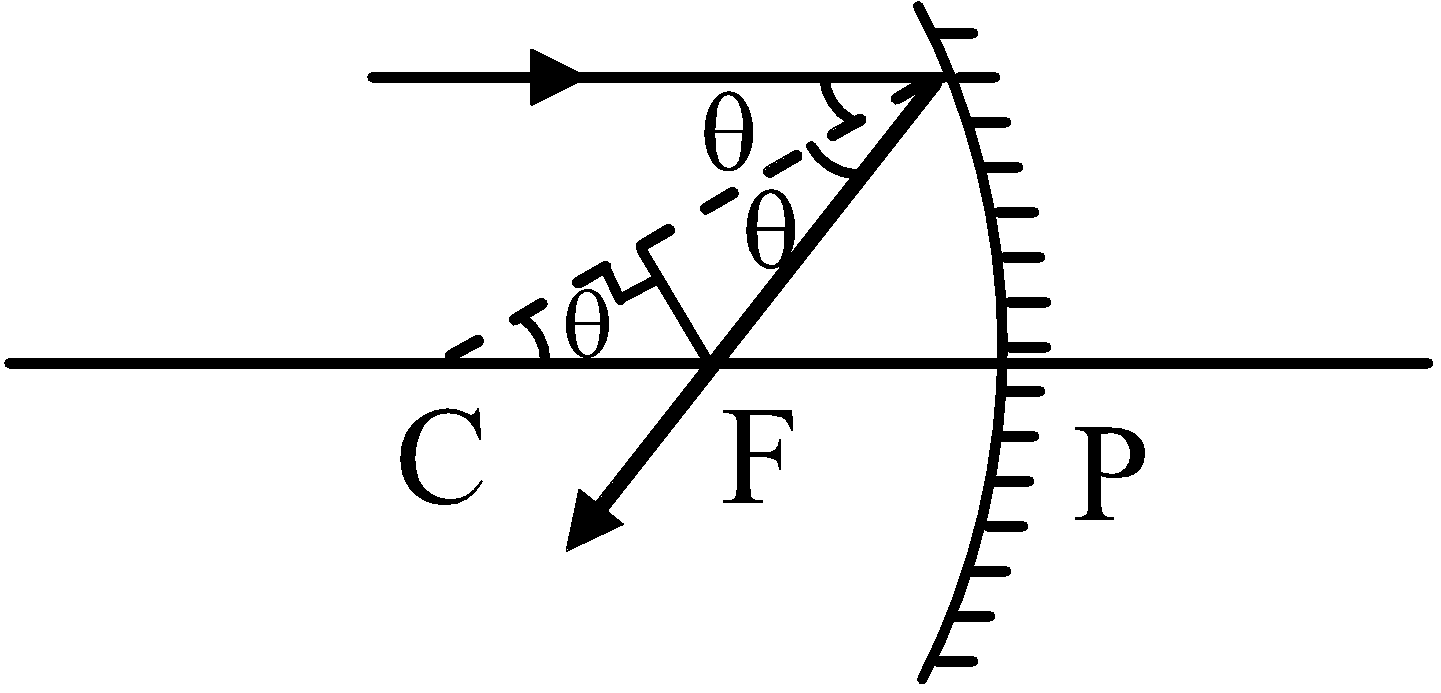
f = PF = R –  sec θ
sec θ
for θ = 0, f = 
0.98 f = 
⇒ 0.98 f =  (2 – sec θ )
⇒ 0.98 = 2 – sec θ
⇒ sec θ = 1.02
⇒ cos θ  0.98
0.98
⇒ 1 –  = 0.98
⇒ θ = 0.2 radian
= 
 11.5 0
Prepare Smarter with CGP Edu
Get practice questions, solutions, and test series in one place.
Write a Review
Share your experience with this question and solution.
Commentary
Send your comment, doubt, correction, or feedback to admin.
Similar Questions
Explore conceptually related problems
An object 5cm tall is placed 1m from a concave spherical mirror which has a radius of curvature of …
An object is 30.0 cm from a spherical mirror, on the centre axis. The absolute value of Lateral mag…
A solid glass sphere of radius R ( μ = 1.5) is silvered over one hemisphere as shown in figure. A p…
A ray of light is incident on a glass sphere from water as shown. If μ glass = and μ water = . Th…
The greatest thickness of a plano-convex glass lens appears to be 2 cm when observed normally throu…