Published by:
CGP EDU Academic Team
Published on: September 12, 2026
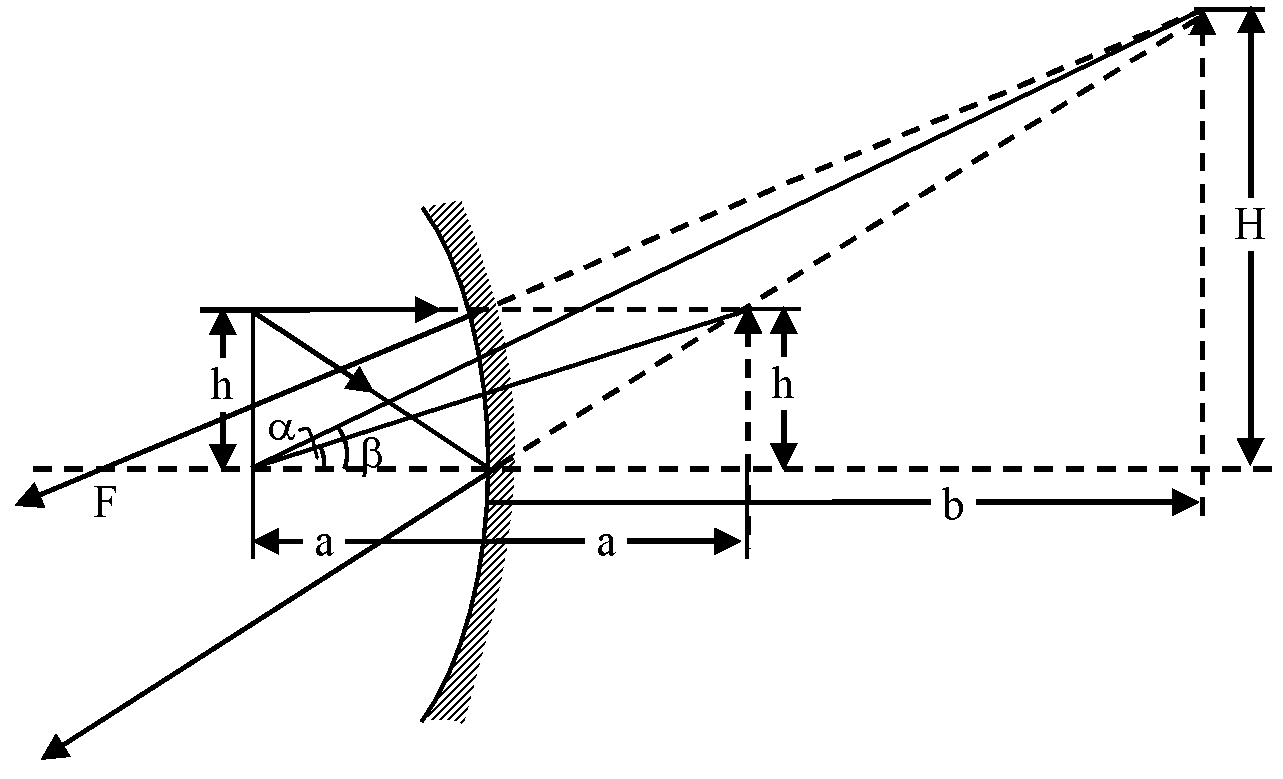
What is the radius R of a concave spherical mirror at a distance of a = 2 metres from the face of a man if he sees in it his image that is one and a half times greater than on a flat mirror placed at the same distance from the face?
Text Solution
Verified by ExpertsThe correct answer is:
A
Step 1: Identify the magnification (m) for the concave mirror. For the flat mirror, the image size is the same as the object, thus m = 1. Since the image in the concave mirror is 1.5 times larger, we have m = -1.5 (the negative sign indicates a real image formed by a concave mirror).
Step 2: Use the magnification formula for mirrors: m = -\frac{v}{u}, where v is the image distance and u is the object distance. Since the object distance (u) is -2 m (negative as per the mirror sign convention), we can rearrange the equation to find v:
m = -\frac{v}{-2} = \frac{v}{2} ⇒ v = 2m\
v = 2(-1.5) = -3 m (the negative sign indicates the image is on the same side as the object).
Step 3: Now, apply the mirror formula: \frac{1}{f} = \frac{1}{v} + \frac{1}{u}. Substitute the values:
\frac{1}{f} = \frac{1}{-3} + \frac{1}{-2} = -\frac{2}{6} - \frac{3}{6} = -\frac{5}{6}.
Therefore, f = -\frac{6}{5} m = -1.2 m.
Step 4: The radius of curvature (R) is related to the focal length (f) by the equation R = 2f.
R = 2(-1.2) = -2.4 m. The radius is a scalar quantity, thus we say R = 2.4 m (the negative sign indicates it is a concave mirror).
Therefore, the radius of the concave mirror is 2.4 m.
Step 2: Use the magnification formula for mirrors: m = -\frac{v}{u}, where v is the image distance and u is the object distance. Since the object distance (u) is -2 m (negative as per the mirror sign convention), we can rearrange the equation to find v:
m = -\frac{v}{-2} = \frac{v}{2} ⇒ v = 2m\
v = 2(-1.5) = -3 m (the negative sign indicates the image is on the same side as the object).
Step 3: Now, apply the mirror formula: \frac{1}{f} = \frac{1}{v} + \frac{1}{u}. Substitute the values:
\frac{1}{f} = \frac{1}{-3} + \frac{1}{-2} = -\frac{2}{6} - \frac{3}{6} = -\frac{5}{6}.
Therefore, f = -\frac{6}{5} m = -1.2 m.
Step 4: The radius of curvature (R) is related to the focal length (f) by the equation R = 2f.
R = 2(-1.2) = -2.4 m. The radius is a scalar quantity, thus we say R = 2.4 m (the negative sign indicates it is a concave mirror).
Therefore, the radius of the concave mirror is 2.4 m.
Prepare Smarter with CGP Edu
Get practice questions, solutions, and test series in one place.
Write a Review
Share your experience with this question and solution.
Commentary
Send your comment, doubt, correction, or feedback to admin.
Similar Questions
Explore conceptually related problems
A student can distinctly see the object upto a distance 15 cm . He wants to see the black board at …
Two plane mirrors. A and B are aligned parallel to each other, as shown in the figure. A light ray …
A concave mirror of focal length is used to obtain the image of the sun which subtends an angle of…
A square of side is placed at a distance of from a concave mirror of focal length The centre of …
A thin rod of length lies along the axis of a concave mirror of focal length One end of its magni…
A ray of light falls on the surface of a spherical glass paper weight making an angle with the nor…