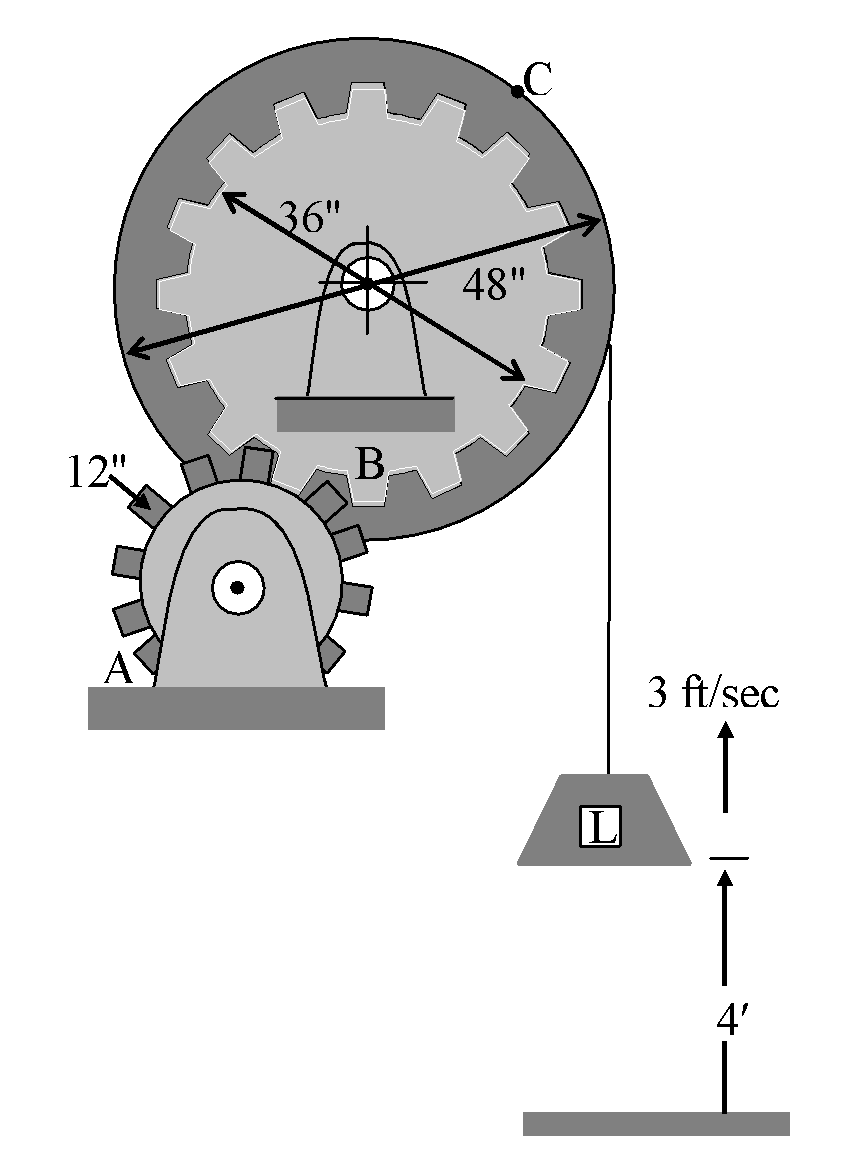
The pinion A of the hoist motor drives gear B, which is attached to the hoisting drum. The load L is lifted from its rest position and acquires an upwards velocity of 3ft/sec in a vertical rise of 4 ft with constant acceleration. As the load passes this position, compute
Text Solution
Verified by ExpertsCHECK THE SOLUTION.
Sol.
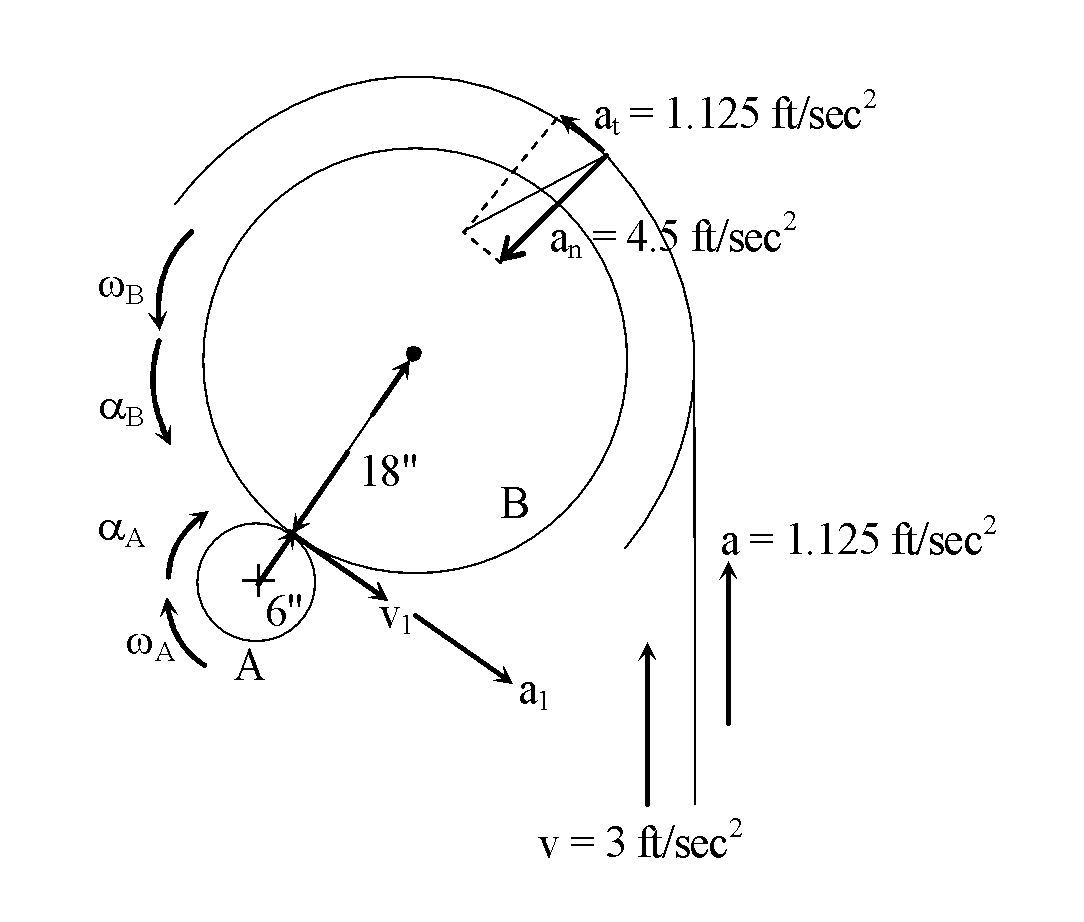
If the cable does not slip on, the drum, the vertical velocity and acceleration of the load L are, of necessity, the same as the tangential velocity v and tangential acceleration a t of point C. For the rectilinear motion of L with constant acceleration, the n- and t-components of the acceleration of C become
[v 2 = 2as] a=a t = v 2 /2s = 3 2 /[2(4))]=1.125 ft/sec 2 [a n = v
2 /r] a n = 3 2 /(24/12) = 4.5 ft/sec 2 [a =  ] a c =
= 4.64 ft/sec
2 . Ans.
The angular motion of gear A is determined from the angular motion of gear B by the velocity v 1 and tangential acceleration a 1 of their common point of contact. First, the angular motion of gear B is determined from the motion of point C on the attached drum. Thus,
[v = r ω ] ω B = v/r = 3/(24/12) = 1.5 rad/sec
[a t = r α ] α B = α t /r= 1.125/(24/12) =0.562 rad/sec 2 Then from v 1 = r A ω A = r B ω B and a 1 = r A α A
= r B α B , we have
ω A =  ω B =
ω B =  1.5 = 4.5 rad/sec CW Ans.
α A =  α B =
α B =  0.562 = 1.688 rad/sec
2 CW Ans.
Helpful Hint:
Recognize that a point on the cable changes the direction of its velocity after it contacts the drum and acquires a normal component of acceleration.
Prepare Smarter with CGP Edu
Get practice questions, solutions, and test series in one place.
Write a Review
Share your experience with this question and solution.
Commentary
Send your comment, doubt, correction, or feedback to admin.
Similar Questions
Explore conceptually related problems