Published by:
CGP EDU Academic Team
Published on: September 12, 2026
Two uniform discs in a vertical plane of masses M 1 and M 2 with radii R 1 , R 2 respectively have a thread wound about their circumferences, and are thus connected as shown in Fig.
The first disc has fixed frictionless horizontal axis of rotation through its center. Set up the equations to determine the acceleration of the center of mass of the second disc if it falls freely.
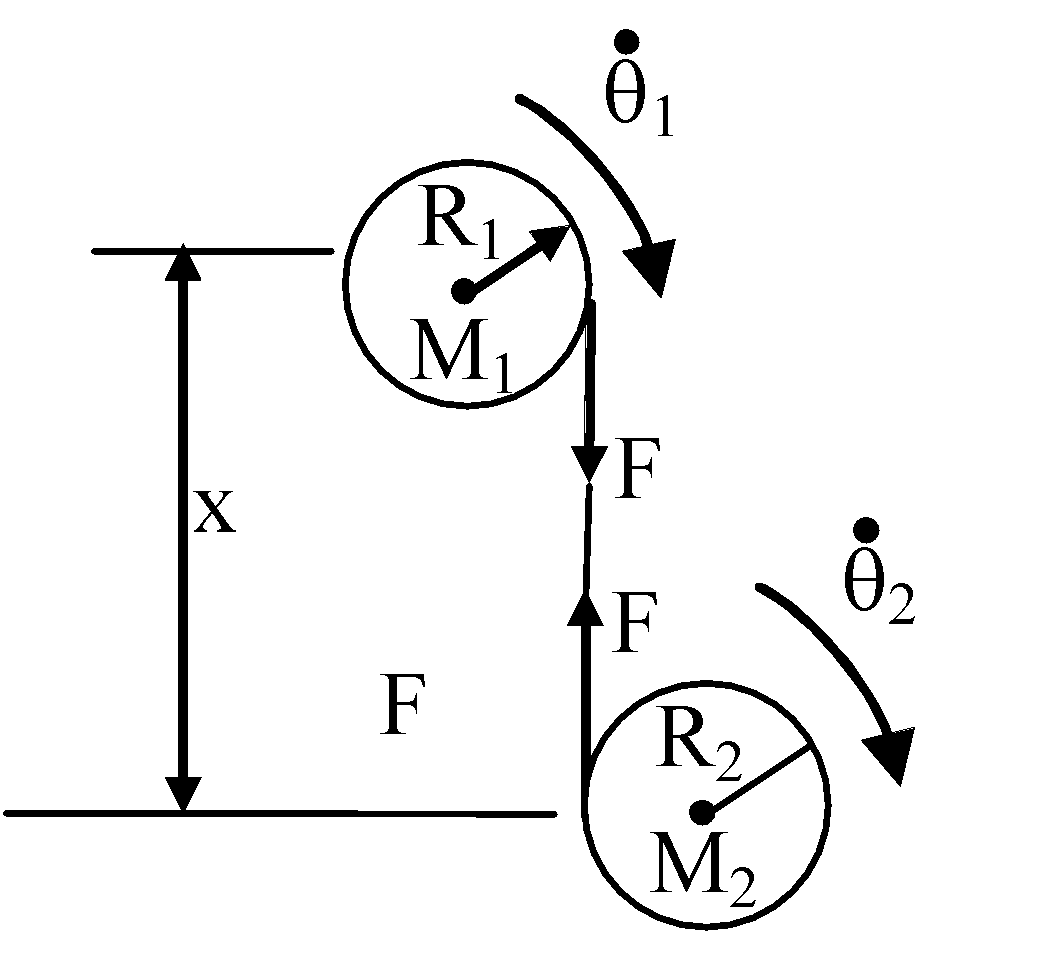
Text Solution
Verified by ExpertsThe correct answer is:
A
Step 1: Identify the forces acting on the system. For the falling disc (mass M2), the gravitational force is acting downwards (F = M2*g) and the tension T in the string acts upwards.
Step 2: Apply Newton's Second Law (F = ma) to the falling disc:
$$M_2 g - T = M_2 a_2$$ where a_2 is the acceleration of mass M2 downward.
Step 3: For the rotating disc (mass M1), its rotational dynamics can be described by the torque due to the tension in the string:
$$T R_1 = I_1 \alpha$$ where I_1 is the moment of inertia of disc M1 and \alpha (angular acceleration) relates to the linear acceleration a_1 of the center of mass of M1 as follows: \( a_1 = R_1 \alpha \).
Step 4: The moment of inertia for a disc is given by \( I_1 = \frac{1}{2} M_1 R_1^2 \). Substituting I into the torque equation:
$$T R_1 = \frac{1}{2} M_1 R_1^2 \alpha$$
Step 5: Relating angular acceleration to linear acceleration, we have \( \alpha = \frac{a_1}{R_1} \) where \( a_1 = -a_2 \) (since they are connected by the thread). Combining these equations to eliminate T leads to:
$$M_2 g - (\frac{M_1 a_2}{2 R_1}) = M_2 a_2$$
Step 6: Rearranging gives a combined equation in a_2 to find its value:
$$a_2 = \frac{g M_2}{M_2 + \frac{M_1}{2}}$$
Therefore, the acceleration of the center of mass of the second disc is determined by the above relationship depending on the masses involved.
Step 2: Apply Newton's Second Law (F = ma) to the falling disc:
$$M_2 g - T = M_2 a_2$$ where a_2 is the acceleration of mass M2 downward.
Step 3: For the rotating disc (mass M1), its rotational dynamics can be described by the torque due to the tension in the string:
$$T R_1 = I_1 \alpha$$ where I_1 is the moment of inertia of disc M1 and \alpha (angular acceleration) relates to the linear acceleration a_1 of the center of mass of M1 as follows: \( a_1 = R_1 \alpha \).
Step 4: The moment of inertia for a disc is given by \( I_1 = \frac{1}{2} M_1 R_1^2 \). Substituting I into the torque equation:
$$T R_1 = \frac{1}{2} M_1 R_1^2 \alpha$$
Step 5: Relating angular acceleration to linear acceleration, we have \( \alpha = \frac{a_1}{R_1} \) where \( a_1 = -a_2 \) (since they are connected by the thread). Combining these equations to eliminate T leads to:
$$M_2 g - (\frac{M_1 a_2}{2 R_1}) = M_2 a_2$$
Step 6: Rearranging gives a combined equation in a_2 to find its value:
$$a_2 = \frac{g M_2}{M_2 + \frac{M_1}{2}}$$
Therefore, the acceleration of the center of mass of the second disc is determined by the above relationship depending on the masses involved.
Prepare Smarter with CGP Edu
Get practice questions, solutions, and test series in one place.
Write a Review
Share your experience with this question and solution.
Commentary
Send your comment, doubt, correction, or feedback to admin.
Similar Questions
Explore conceptually related problems
A uniform disc of mass 2kg and radius 1m is mounted on an axle supported on fixed frictionless bear…
A solid sphere is resting over a rough horizontal floor. A sharp impulse is applied on it along its…
Select the wrong statement –
Statement-I : A body may be in pure rotation under the action of singl…
A ring of mass M and radius R sliding with a velocity v 0 suddenly enters into rough surface where …
A cylinder of mass m is kept on a inclined plane having angle of inclination 30 0 Axis of cylinder …
A uniform rod of mass 1 kg and length 1 m is kept vertical on the edge of a horizontal table. The r…