Published by:
CGP EDU Academic Team
Published on: September 12, 2026
A flat disc of mass m = 1.8 kg radius r = 0.2m lies on a frictionless horizontal table. A string wound around the cylindrical surface of the disc exerts a force of 3 Newtons in the northerly direction (Fig.). Find the acceleration (magnitude and direction) of the center of mass a and the angular acceleration α about the center of mass. Is a = r α ? Explain.
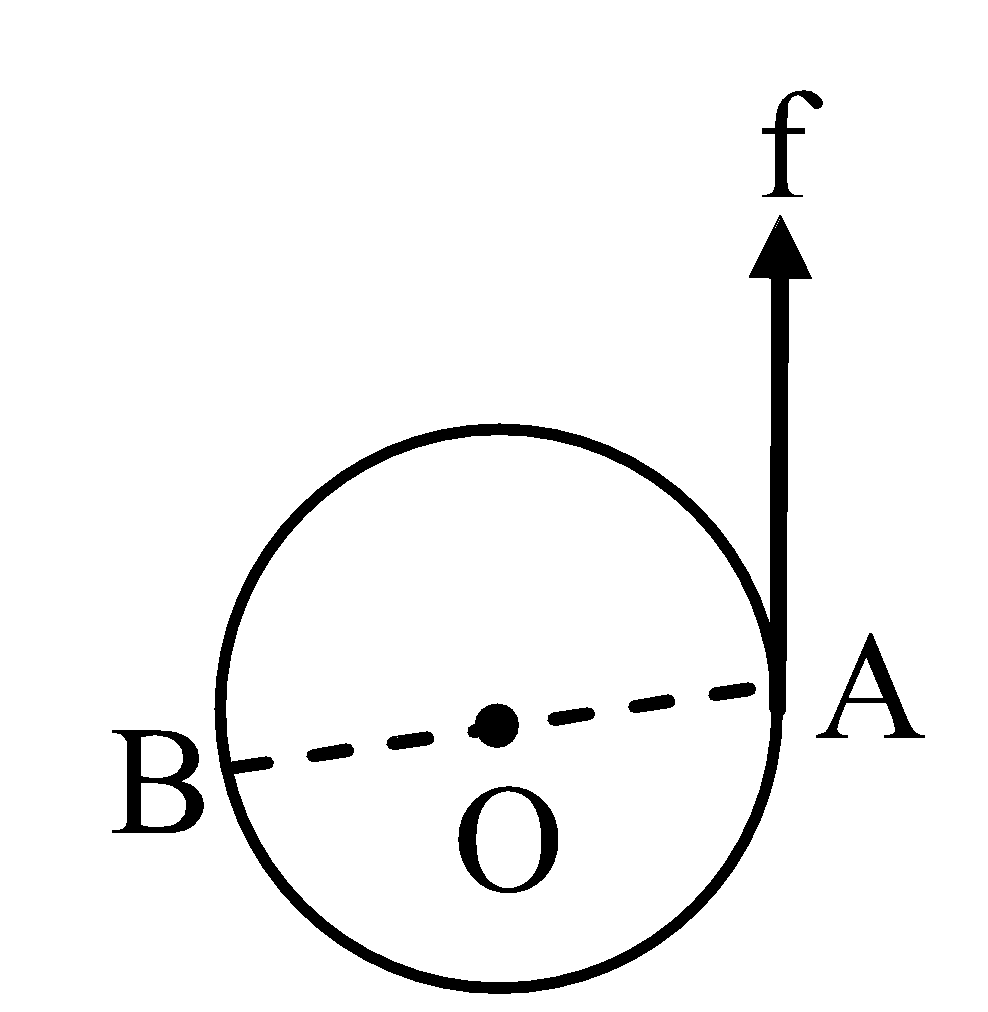
Text Solution
Verified by ExpertsThe correct answer is:
A
Given:
Mass of the disc (m) = 1.8 kg
Radius of the disc (r) = 0.2 m
Force exerted by the string (F) = 3 N
Step 1: Calculate the angular acceleration (\alpha):
Using Newton's second law for rotational motion:
\[ \tau = I \alpha \]
Where \( \tau \) is the torque, \( I \) is the moment of inertia.
The moment of inertia for a disc about its center is given by:
\[ I = \frac{1}{2} m r^2 \]
Substituting the values:
\[ I = \frac{1}{2} \times 1.8 \times (0.2)^2 = 0.036 \, \text{kg m}^2 \]
Now, the torque (\( \tau \)) caused by the force is:
\[ \tau = r \times F = 0.2 \times 3 = 0.6 \, \text{N m} \]
Substituting \( \tau \) and \( I \) into the torque equation gives us:
\[ 0.6 = 0.036 \alpha \]
Solving for \( \alpha \):
\[ \alpha = \frac{0.6}{0.036} \approx 16.67 \, \text{rad/s}^2 \]
Step 2: Calculate the linear acceleration (a):
Using the relationship between linear acceleration and angular acceleration:
\[ a = r \alpha \]
Substituting the values:
\[ a = 0.2 \times 16.67 \approx 3.33 \, \text{m/s}^2 \]
Step 3: Direction of acceleration:
The force applied is in the northerly direction, hence the acceleration of the center of mass (a) is also directed north.
Conclusion:
Thus, the linear acceleration \( a \) is approximately 3.33 m/s² to the north, and \( \alpha \) is approximately 16.67 rad/s².
Yes, it is valid that \( a = r \alpha \).
Mass of the disc (m) = 1.8 kg
Radius of the disc (r) = 0.2 m
Force exerted by the string (F) = 3 N
Step 1: Calculate the angular acceleration (\alpha):
Using Newton's second law for rotational motion:
\[ \tau = I \alpha \]
Where \( \tau \) is the torque, \( I \) is the moment of inertia.
The moment of inertia for a disc about its center is given by:
\[ I = \frac{1}{2} m r^2 \]
Substituting the values:
\[ I = \frac{1}{2} \times 1.8 \times (0.2)^2 = 0.036 \, \text{kg m}^2 \]
Now, the torque (\( \tau \)) caused by the force is:
\[ \tau = r \times F = 0.2 \times 3 = 0.6 \, \text{N m} \]
Substituting \( \tau \) and \( I \) into the torque equation gives us:
\[ 0.6 = 0.036 \alpha \]
Solving for \( \alpha \):
\[ \alpha = \frac{0.6}{0.036} \approx 16.67 \, \text{rad/s}^2 \]
Step 2: Calculate the linear acceleration (a):
Using the relationship between linear acceleration and angular acceleration:
\[ a = r \alpha \]
Substituting the values:
\[ a = 0.2 \times 16.67 \approx 3.33 \, \text{m/s}^2 \]
Step 3: Direction of acceleration:
The force applied is in the northerly direction, hence the acceleration of the center of mass (a) is also directed north.
Conclusion:
Thus, the linear acceleration \( a \) is approximately 3.33 m/s² to the north, and \( \alpha \) is approximately 16.67 rad/s².
Yes, it is valid that \( a = r \alpha \).
Prepare Smarter with CGP Edu
Get practice questions, solutions, and test series in one place.
Write a Review
Share your experience with this question and solution.
Commentary
Send your comment, doubt, correction, or feedback to admin.
Similar Questions
Explore conceptually related problems
A uniform disc of mass 2kg and radius 1m is mounted on an axle supported on fixed frictionless bear…
A solid sphere is resting over a rough horizontal floor. A sharp impulse is applied on it along its…
Select the wrong statement –
Statement-I : A body may be in pure rotation under the action of singl…
A ring of mass M and radius R sliding with a velocity v 0 suddenly enters into rough surface where …
A cylinder of mass m is kept on a inclined plane having angle of inclination 30 0 Axis of cylinder …
A uniform rod of mass 1 kg and length 1 m is kept vertical on the edge of a horizontal table. The r…