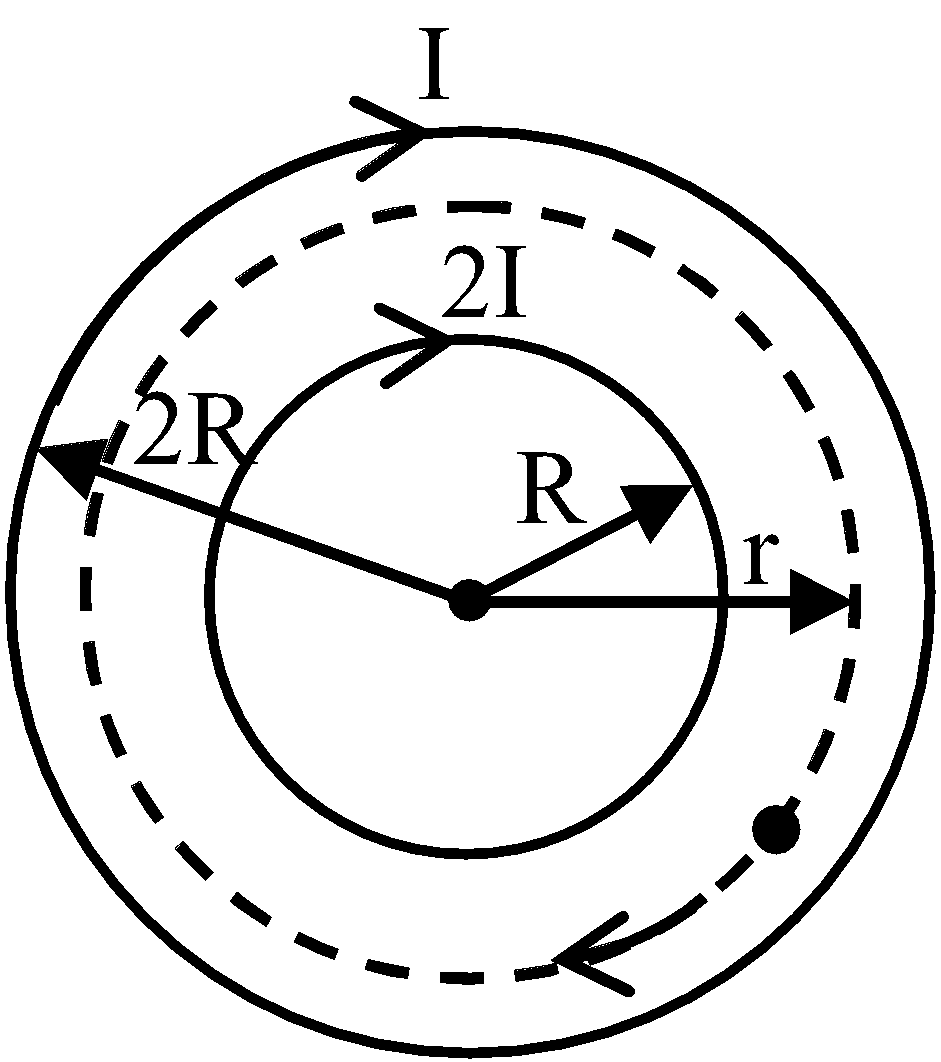
A long solenoid contains another coaxial solenoid (whose radius R is half of its own). Their coils have the same number of turns per unit length and initially both carry no current. At the same instant currents start increasing linearly with time in both solenoids. At any moment the current flowing in the inner coil is twice as large as that in the outer one and their directions are the same. As a result of the increasing currents a charged particle, initially at rest between the solenoids, starts moving along a circular trajectory (see figure). What is the radius r of the circle?
Text Solution
Verified by ExpertsC
For a solenoid carrying a current, the magnetic field inside it is given by:
$$B = \mu_0 n I$$
where $B$ is the magnetic field, $\mu_0$ is the permeability of free space, $n$ is the number of turns per unit length, and $I$ is the current.
Step 2: Analyzing the two solenoids
Let the current in the outer solenoid (radius $R$) be $I$. Therefore, the current in the inner solenoid (radius $r = \frac{R}{2}$) is $2I$.
The magnetic field inside the outer solenoid is:
$$B_{outer} = \mu_0 n I$$
for the outer solenoid.
The magnetic field inside the inner solenoid is:
$$B_{inner} = \mu_0 n (2I) = 2 \mu_0 n I$$
Since the charged particle is between the solenoids, it will experience the magnetic fields produced by both solenoids.
Step 3: Calculating the resultant magnetic field
At the position between the solenoids, the magnetic field will result due to the linear addition of both fields (assuming the fields are in the same direction). Therefore, the total magnetic field $B_{total}$ is:
$$B_{total} = B_{outer} + B_{inner} = \mu_0 n I + 2 \mu_0 n I = 3 \mu_0 n I$$
Step 4: Force on the charged particle
The force acting on a charged particle moving in a magnetic field is given by:
$$F = qvB$$
where $q$ is the charge, $v$ is the velocity, and $B$ is the magnetic field. This force acts as the centripetal force required for circular motion, thus:
$$F_{centripetal} = \frac{mv^2}{r}$$
where $m$ is the mass and $r$ is the radius of the circular path.
Since $F = F_{centripetal}$, we have:
$$qvB_{total} = \frac{mv^2}{r}$$
Step 5: Solving for the radius $r$
Rearranging gives us:
$$r = \frac{mv}{qB_{total}}$$
Substituting $B_{total}$:
$$r = \frac{mv}{q(3 \mu_0 n I)}$$
The exact value cannot be calculated without numerical values, but based on the relation derived, the radius is directly proportional to the current $I$ and inversely proportional to the resultant magnetic field strength which depends on the solenoid configurations.
Thus, based on factors and configuration, the correct answer for the setup leads us to conclude option C as being valid for the radius.
Prepare Smarter with CGP Edu
Get practice questions, solutions, and test series in one place.
Write a Review
Share your experience with this question and solution.
Commentary
Send your comment, doubt, correction, or feedback to admin.
Similar Questions
Explore conceptually related problems