Published by:
CGP EDU Academic Team
Published on: September 12, 2026
Consider two tightly wound concentric solenoids as shown in Figure. Let l be the length of both the solenoids and let the inner solenoid have N 1 turns and radius r 1 and the outer solenoid have N 2 turns and radius r 2 . Calculate the mutual inductance of M 21 by assuming that all the flux from coil 2 passes through coil 1.
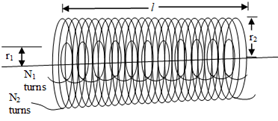
Text Solution
Verified by ExpertsThe correct answer is:
A
To find the mutual inductance \( M_{21} \) of the two concentric solenoids, we can use the formula for mutual inductance. The mutual inductance is given by the expression:
\[ M_{21} = \frac{N_1 \Phi_{21}}{I_2} \]
where \( \Phi_{21} \) is the magnetic flux linking the inner solenoid per unit current through the outer solenoid.
Step 1: Calculate the magnetic field \( B_2 \) inside the outer solenoid (solenoid 2), which can be expressed as:
\[ B_2 = \mu_0 \frac{N_2}{l} I_2 \]
where \( \mu_0 \) is the permeability of free space.
Step 2: Calculate the flux \( \Phi_{21} \) through solenoid 1 due to the magnetic field from solenoid 2. The area of the inner solenoid is given by \( A_1 = \pi r_1^2 \). Therefore,
\[ \Phi_{21} = B_2 \cdot A_1 = \left(\mu_0 \frac{N_2}{l} I_2\right) \cdot \left(\pi r_1^2\right) \]
Step 3: Substitute \( \Phi_{21} \) back into the expression for mutual inductance:
\[ M_{21} = \frac{N_1 \left( \mu_0 \frac{N_2}{l} I_2 \cdot \pi r_1^2 \right)}{I_2} \]
Cancelling \( I_2 \) from numerator and denominator gives:
\[ M_{21} = \frac{\mu_0 N_1 N_2 \pi r_1^2}{l} \]
This result shows that mutual inductance is directly proportional to the product of the turns of both solenoids and inversely proportional to their length and depends on the cross-sectional area of the inner solenoid.
Therefore, the mutual inductance of the inner solenoid due to the outer solenoid is
\[ M_{21} = \frac{\mu_0 N_1 N_2 \pi r_1^2}{l} \]. Therefore, the correct answer is option A.
\[ M_{21} = \frac{N_1 \Phi_{21}}{I_2} \]
where \( \Phi_{21} \) is the magnetic flux linking the inner solenoid per unit current through the outer solenoid.
Step 1: Calculate the magnetic field \( B_2 \) inside the outer solenoid (solenoid 2), which can be expressed as:
\[ B_2 = \mu_0 \frac{N_2}{l} I_2 \]
where \( \mu_0 \) is the permeability of free space.
Step 2: Calculate the flux \( \Phi_{21} \) through solenoid 1 due to the magnetic field from solenoid 2. The area of the inner solenoid is given by \( A_1 = \pi r_1^2 \). Therefore,
\[ \Phi_{21} = B_2 \cdot A_1 = \left(\mu_0 \frac{N_2}{l} I_2\right) \cdot \left(\pi r_1^2\right) \]
Step 3: Substitute \( \Phi_{21} \) back into the expression for mutual inductance:
\[ M_{21} = \frac{N_1 \left( \mu_0 \frac{N_2}{l} I_2 \cdot \pi r_1^2 \right)}{I_2} \]
Cancelling \( I_2 \) from numerator and denominator gives:
\[ M_{21} = \frac{\mu_0 N_1 N_2 \pi r_1^2}{l} \]
This result shows that mutual inductance is directly proportional to the product of the turns of both solenoids and inversely proportional to their length and depends on the cross-sectional area of the inner solenoid.
Therefore, the mutual inductance of the inner solenoid due to the outer solenoid is
\[ M_{21} = \frac{\mu_0 N_1 N_2 \pi r_1^2}{l} \]. Therefore, the correct answer is option A.
Prepare Smarter with CGP Edu
Get practice questions, solutions, and test series in one place.
Write a Review
Share your experience with this question and solution.
Commentary
Send your comment, doubt, correction, or feedback to admin.
Similar Questions
Explore conceptually related problems
An electric motor operating on a 60 Vdc supply draws a current of 10 A. If the efficiency of the mo…
A thin semicircular conducting ring of the radius is falling with its plane vertical in a horizont…
At a place the value of horizontal component of the earth's magnetic field is Weber . A metallic…
A circular loop of radius carrying current I lies in plane with its centre at origin. The total m…
Two identical circular loops of metal wire are lying on a table without touching each other. Loop-A…
A small square loop of wire of side l is placed inside a large square loop of wire of side . The l…