Published by:
CGP EDU Academic Team
Published on: September 13, 2026
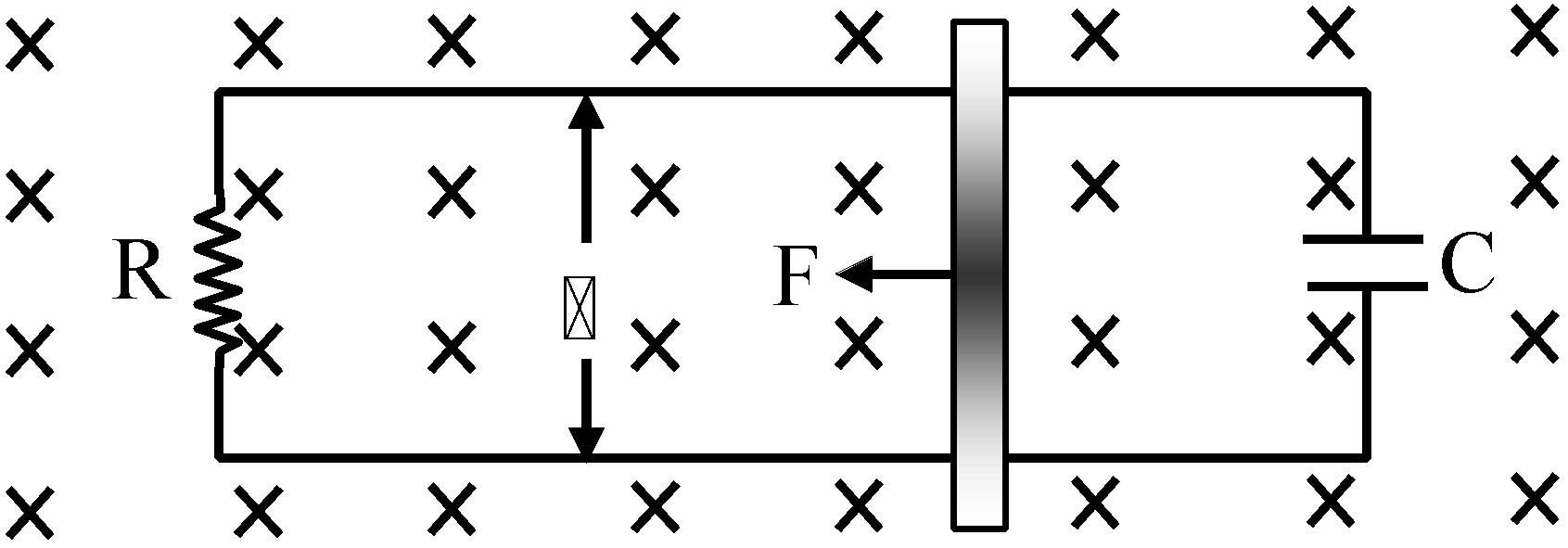
Two parallel long smooth conducting rails separated by a distance λ are connected by a movable conducting connector of mass m. Terminals of the rails are connected by the resistor R and the capacitor C as shown in figure. A uniform magnetic field B perpendicular to the plane of the rail is switched on. The connector is dragged by a constant force F. Find the speed of the connector as a function of time if the force F is applied at t = 0. Also find the terminal velocity of the connector.
Text Solution
Verified by ExpertsThe correct answer is:
A
Step 1: Understand the setup
In this arrangement, we have a movable conducting connector of mass m on parallel conducting rails, which is being pulled by a constant force F. A uniform magnetic field B is applied perpendicular to the plane of the rails. When the connector moves, it cuts through the magnetic field lines, inducing an emf in the circuit.
Step 2: Apply Faraday's Law of Electromagnetic Induction
The induced emf ($ ext{E}$) can be expressed as:
$$ ext{E} = B imes v$$
where v is the velocity of the connector. This induced emf creates a current ($I$) in the circuit, which is connected to a resistor $R$ and a capacitor $C$. The current is given by:
$$I = \frac{ ext{E}}{R} = \frac{Bv}{R}$$
Step 3: Determine the forces acting on the connector
The total force acting on the connector can be expressed as:
$$F - F_L = ma$$
where $F_L$ is the magnetic force acting on the connector due to the induced current, given as:
$$F_L = B imes I imes ext{l}$$
Here, l is the length of the connector between the rails.
Substituting for $I$ in $F_L$ gives:
$$F_L = B \times \frac{Bv}{R} \times ext{l} = \frac{B^2lv}{R}$$
Now, the equation of motion becomes:
$$F - \frac{B^2lv}{R} = ma$$
Step 4: Rearranging
We can express acceleration ($a$) as $ rac{dv}{dt}$, leading to:
$$F - \frac{B^2lv}{R} = m \frac{dv}{dt}$$
Step 5: Solve for velocity as a function of time
Rearranging gives:
$$\frac{dv}{dt} = \frac{F}{m} - \frac{B^2l}{mR}v$$
This is a first-order linear differential equation. We can separate variables to solve it:
$$\frac{dv}{\frac{F}{m} - \frac{B^2l}{mR}v} = dt$$
Integrating both sides leads to:
$$\ln\left| \frac{F}{m} - \frac{B^2l}{mR}v \right| = -\frac{B^2l}{mR}t + C$$
After solving the integration and exponentiating, we can find v(t).
Step 6: Terminal velocity
This occurs when $ rac{dv}{dt} = 0$, which means:
$$F - \frac{B^2l v_{terminal}}{R} = 0$$
So, terminal velocity ($v_{terminal}$) can be expressed as:
$$v_{terminal} = \frac{FR}{B^2l}$$
Conclusion
The speed of the connector as a function of time can be deduced in a more detailed solution, and the terminal velocity is given by:
$$v_{terminal} = \frac{FR}{B^2l}$$
In this arrangement, we have a movable conducting connector of mass m on parallel conducting rails, which is being pulled by a constant force F. A uniform magnetic field B is applied perpendicular to the plane of the rails. When the connector moves, it cuts through the magnetic field lines, inducing an emf in the circuit.
Step 2: Apply Faraday's Law of Electromagnetic Induction
The induced emf ($ ext{E}$) can be expressed as:
$$ ext{E} = B imes v$$
where v is the velocity of the connector. This induced emf creates a current ($I$) in the circuit, which is connected to a resistor $R$ and a capacitor $C$. The current is given by:
$$I = \frac{ ext{E}}{R} = \frac{Bv}{R}$$
Step 3: Determine the forces acting on the connector
The total force acting on the connector can be expressed as:
$$F - F_L = ma$$
where $F_L$ is the magnetic force acting on the connector due to the induced current, given as:
$$F_L = B imes I imes ext{l}$$
Here, l is the length of the connector between the rails.
Substituting for $I$ in $F_L$ gives:
$$F_L = B \times \frac{Bv}{R} \times ext{l} = \frac{B^2lv}{R}$$
Now, the equation of motion becomes:
$$F - \frac{B^2lv}{R} = ma$$
Step 4: Rearranging
We can express acceleration ($a$) as $ rac{dv}{dt}$, leading to:
$$F - \frac{B^2lv}{R} = m \frac{dv}{dt}$$
Step 5: Solve for velocity as a function of time
Rearranging gives:
$$\frac{dv}{dt} = \frac{F}{m} - \frac{B^2l}{mR}v$$
This is a first-order linear differential equation. We can separate variables to solve it:
$$\frac{dv}{\frac{F}{m} - \frac{B^2l}{mR}v} = dt$$
Integrating both sides leads to:
$$\ln\left| \frac{F}{m} - \frac{B^2l}{mR}v \right| = -\frac{B^2l}{mR}t + C$$
After solving the integration and exponentiating, we can find v(t).
Step 6: Terminal velocity
This occurs when $ rac{dv}{dt} = 0$, which means:
$$F - \frac{B^2l v_{terminal}}{R} = 0$$
So, terminal velocity ($v_{terminal}$) can be expressed as:
$$v_{terminal} = \frac{FR}{B^2l}$$
Conclusion
The speed of the connector as a function of time can be deduced in a more detailed solution, and the terminal velocity is given by:
$$v_{terminal} = \frac{FR}{B^2l}$$
Prepare Smarter with CGP Edu
Get practice questions, solutions, and test series in one place.
Write a Review
Share your experience with this question and solution.
Commentary
Send your comment, doubt, correction, or feedback to admin.
Similar Questions
Explore conceptually related problems
An electric motor operating on a 60 Vdc supply draws a current of 10 A. If the efficiency of the mo…
A thin semicircular conducting ring of the radius is falling with its plane vertical in a horizont…
At a place the value of horizontal component of the earth's magnetic field is Weber . A metallic…
A circular loop of radius carrying current I lies in plane with its centre at origin. The total m…
Two identical circular loops of metal wire are lying on a table without touching each other. Loop-A…
A small square loop of wire of side l is placed inside a large square loop of wire of side . The l…