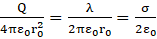
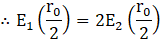
Let E 1 (r), E 2 (r) and E 3 (r) be the respective electric fields at a distance r from a point charge Q, an infinitely long wire with constant linear charge density λ, and an infinite plane with uniform surface charge density σ. if E 1 (r 0 ) = E 2 (r 0 ) = E 3 (r 0 ) at a given distance r0, then
A

B

C
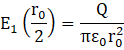
E 1 (r 0 /2) = 2E 2 (r 0 /2)
D
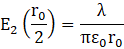
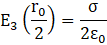
E 2 (r0/2) = 4E 3 (r 0 /2)
Text Solution
Verified by ExpertsThe correct answer is:
C
Prepare Smarter with CGP Edu
Get practice questions, solutions, and test series in one place.
Write a Review
Share your experience with this question and solution.
Commentary
Send your comment, doubt, correction, or feedback to admin.
Similar Questions
Explore conceptually related problems
Two equal negative charge – q are fixed at the fixed points and on the Y-axis. A positive charge …
An electric line of force in the xy plane is given by equation . A particle with unit positive cha…
A positively charged ball hangs from a silk thread. We put a positive test charge at a point and m…
If on the concentric hollow spheres of radii r and the charge is distributed such that their surf…
Two equal charges of opposite sign separated by a distance constitute an electric dipole of dipol…
A point charge q is placed at a distance a/2 directly above the center of a square of side a. The e…