Published by:
CGP EDU Academic Team
Published on: September 12, 2026
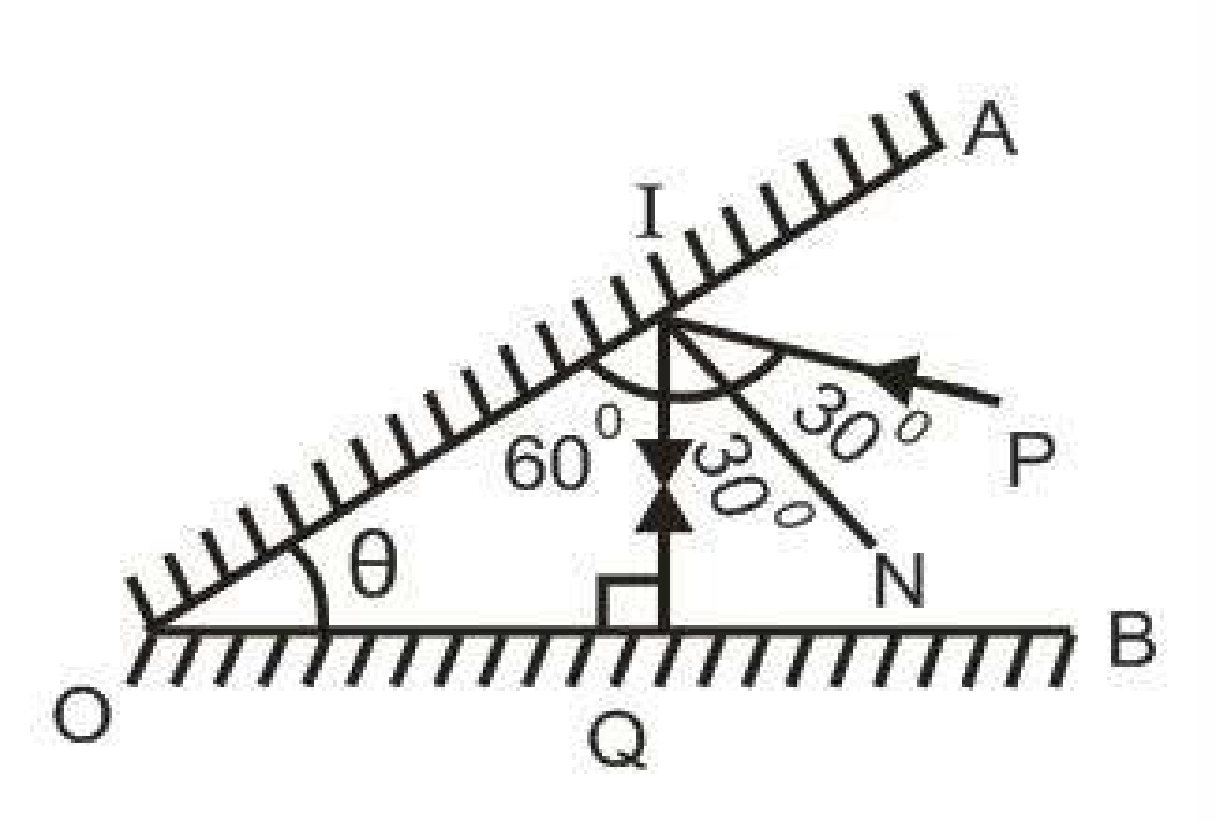
Two plane mirrors are inclined to each other at some angle. A ray of light incident at an angle of 30° on one of the mirrors, after reflection from the other, retraces its path. The angle (in degree) between the mirrors
Text Solution
Verified by ExpertsThe correct answer is:
120
Step 1: Let's denote the angle between the two mirrors as \( \theta \). According to the problem, a ray of light makes an incident angle of 30° with one mirror and retraces its path after reflecting off the other mirror.
Step 2: When the light reflects off the first mirror, it will reflect at the same angle of incidence (30°). Therefore, the angle of reflection is also 30°. This means that the angle between the incident ray and the normal to the first mirror is 30°, which means that the ray makes an angle of \( 90° - 30° = 60° \) with the surface of the mirror.
Step 3: When the light hits the second mirror, it will also reflect off at the same angle with respect to the normal to this mirror. You can visualize that since the ray retraces its path, the angle formed between the incident ray and the reflected ray would be 180°. Therefore, we need to account for the angles between the two mirrors now.
Step 4: The total angles when a ray reflects off both mirrors sums up to be equal to 180°. Hence, subtracting the two angles of reflection from 180° gives:
\[ 180° = \text{Angle between the mirrors} + 30° + 30° \]
\[ \text{Angle between the mirrors} = 180° - 60° = 120° \]
Step 5: Therefore, the angle between the mirrors is \( 120° \).
Conclusion: Thus, the angle between the two mirrors is 120°.
Step 2: When the light reflects off the first mirror, it will reflect at the same angle of incidence (30°). Therefore, the angle of reflection is also 30°. This means that the angle between the incident ray and the normal to the first mirror is 30°, which means that the ray makes an angle of \( 90° - 30° = 60° \) with the surface of the mirror.
Step 3: When the light hits the second mirror, it will also reflect off at the same angle with respect to the normal to this mirror. You can visualize that since the ray retraces its path, the angle formed between the incident ray and the reflected ray would be 180°. Therefore, we need to account for the angles between the two mirrors now.
Step 4: The total angles when a ray reflects off both mirrors sums up to be equal to 180°. Hence, subtracting the two angles of reflection from 180° gives:
\[ 180° = \text{Angle between the mirrors} + 30° + 30° \]
\[ \text{Angle between the mirrors} = 180° - 60° = 120° \]
Step 5: Therefore, the angle between the mirrors is \( 120° \).
Conclusion: Thus, the angle between the two mirrors is 120°.
Prepare Smarter with CGP Edu
Get practice questions, solutions, and test series in one place.
Write a Review
Share your experience with this question and solution.
Commentary
Send your comment, doubt, correction, or feedback to admin.
Similar Questions
Explore conceptually related problems
A large temple has a depression in one wall. On the floor plan, it appears as an indentation having…
A point object is placed on the principal axis of a concave mirror, at a distance of 15 cm from the…
A point source of light is placed at a distance h below the surface of a large deep lake. Neglectin…
A lens forms a real image of an object at a distance of 20 cm. It is observed that on placing anoth…
An object is placed at a distance of 40 cm from a convex lens of focal length 20 cm. On the far sid…
A glass prism is immersed in water as shown in the figure. When a beam of light incident is inciden…