Published by:
CGP EDU Academic Team
Published on: September 11, 2026
The mass per unit length of a uniform wire is
. A transverse wave of the form
is produced in it, where
is in meter and
is in second. Then, the expected value oftension in the wire is
. Value of
is____ . (Round-off to the nearest integer)
Text Solution
Verified by ExpertsThe correct answer is:
D
Step 1: Convert the mass per unit length from g/cm to kg/m.
Mass per unit length = 0.135 g/cm = 0.135 imes 10^{-3} kg/0.01 m = 0.0135 kg/m.
Step 2: Identify the wave equation, y = -0.21 sin(x + 30t).
The angular frequency \( \omega = 30 \) rad/s.
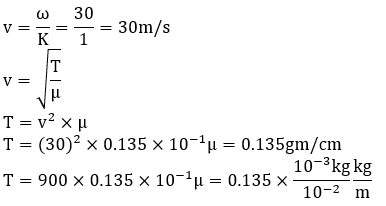
Step 3: Calculate the tension in the wire using the formula for wave speed: \( v = \sqrt{\frac{T}{\mu}} \), where \( T \) is the tension and \( \mu \) is the mass per unit length.
Step 4: The relationship between wave speed, angular frequency, and wave number is given by \( v = \frac{\omega}{k} \). Here, wave number \( k = 1 \) (from the equation structure).
Step 5: Therefore, the speed of the wave is \( v = \frac{30}{1} = 30 \) m/s.
Step 6: Substitute \( v \) and \( \mu \) into the tension formula: `v = sqrt(T/0.0135)`.
Step 7: Rearranging gives \( T = \mu v^2 = 0.0135 (30)^2 = 12.15 N \approx 12 N\).
Thus, the answer is approximately 12 N (rounded to the nearest integer). Therefore, D.
Mass per unit length = 0.135 g/cm = 0.135 imes 10^{-3} kg/0.01 m = 0.0135 kg/m.
Step 2: Identify the wave equation, y = -0.21 sin(x + 30t).
The angular frequency \( \omega = 30 \) rad/s.
Step 3: Calculate the tension in the wire using the formula for wave speed: \( v = \sqrt{\frac{T}{\mu}} \), where \( T \) is the tension and \( \mu \) is the mass per unit length.
Step 4: The relationship between wave speed, angular frequency, and wave number is given by \( v = \frac{\omega}{k} \). Here, wave number \( k = 1 \) (from the equation structure).
Step 5: Therefore, the speed of the wave is \( v = \frac{30}{1} = 30 \) m/s.
Step 6: Substitute \( v \) and \( \mu \) into the tension formula: `v = sqrt(T/0.0135)`.
Step 7: Rearranging gives \( T = \mu v^2 = 0.0135 (30)^2 = 12.15 N \approx 12 N\).
Thus, the answer is approximately 12 N (rounded to the nearest integer). Therefore, D.
Prepare Smarter with CGP Edu
Get practice questions, solutions, and test series in one place.
Write a Review
Share your experience with this question and solution.
Commentary
Send your comment, doubt, correction, or feedback to admin.
Similar Questions
Explore conceptually related problems
A particle of mass m is fixed to one end of light spring having force constant k and unstretched le…
An object of mass m is suspended at the end of a massless wire of length L and area of cross-sectio…
Two identical strings and made of same material have tension and in them. If their fundamental …
For a transverse wave travelling along a straight line, the distance between two peaks (crests) is …
Assume that the displacement of air is proportional to the pressure difference created by a sound…
A wire of length and mass per unit length is put under tension of . Two consecutive frequencies …