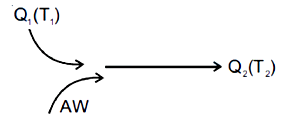
If minimum possible work is done by a refrigerator in converting  grams of water at
  to ice, how much heat (in calories) is released to the surroundings at temperature
  (Latent heat of ice
  Callgram) to the nearest integer?
Text Solution
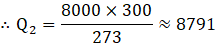
Verified by ExpertsThe correct answer is:
CHECK THE SOLUTION.
(8791 JEE Main 2020)


Prepare Smarter with CGP Edu
Get practice questions, solutions, and test series in one place.
Write a Review
Share your experience with this question and solution.
Commentary
Send your comment, doubt, correction, or feedback to admin.
Similar Questions
Explore conceptually related problems
A carnot engine operates between two reservoirs of temperatures and . The engine performs of wor…
An engine takes in moles of air at and , and compresses it adiabatically to of the original vol…
An engine operates by taking a monatomic ideal gas through the cycle shown in the figure. The perce…
1 mole of rigid diatomic gas performs a work of when heat Q is supplied to it. The molar heat capa…