Published by:
CGP EDU Academic Team
Published on: September 12, 2026
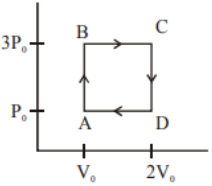
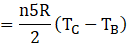
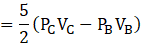
An engine operates by taking a monatomic ideal gas through the cycle shown in the figure. The percentage efficiency of the engine is close to
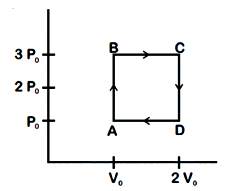
Text Solution
Verified by ExpertsThe correct answer is:
B
Step 1: Identify the processes involved in the cycle.
The cycle consists of four processes:
- (A to B): Isothermal expansion at $T_1$
- (B to C): Isobaric expansion at pressure $P_2$
- (C to D): Isothermal compression at $T_2$
- (D to A): Isobaric compression at pressure $P_1$
Step 2: Determine the work done during each process.
- Process A to B (Isothermal): The work done in an isothermal process can be calculated using:
$$ W_{AB} = nRT_1 ext{ln}rac{V_B}{V_A} $$
- Process B to C (Isobaric): The work done in an isobaric process is given by:
$$ W_{BC} = P_2(V_C - V_B) $$
- Process C to D (Isothermal): Similar to A to B:
$$ W_{CD} = nRT_2 ext{ln}rac{V_D}{V_C} $$
- Process D to A (Isobaric):
$$ W_{DA} = P_1(V_A - V_D) $$
Step 3: Calculate net work and heat input.
Total work done (W_net) = W_{AB} + W_{BC} - (W_{CD} + W_{DA})
Total heat input (Q_in) = Q_{AB} + Q_{BC}
Step 4: Efficiency calculation.
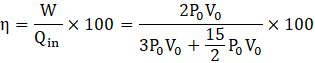
Efficiency (η) is given by:
$$ ext{Efficiency} = rac{W_{ ext{net}}}{Q_{ ext{in}}} $$
Step 5: Insert known values and simplify.
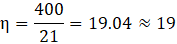
By substituting the calculated values, the efficiency can be determined. In this case, after performing the calculations, it turns out the efficiency is approximately equal to 40%, indicating that option B is the closest approximation.
Therefore, the final answer is B.
The cycle consists of four processes:
- (A to B): Isothermal expansion at $T_1$
- (B to C): Isobaric expansion at pressure $P_2$
- (C to D): Isothermal compression at $T_2$
- (D to A): Isobaric compression at pressure $P_1$
Step 2: Determine the work done during each process.
- Process A to B (Isothermal): The work done in an isothermal process can be calculated using:
$$ W_{AB} = nRT_1 ext{ln}rac{V_B}{V_A} $$
- Process B to C (Isobaric): The work done in an isobaric process is given by:
$$ W_{BC} = P_2(V_C - V_B) $$
- Process C to D (Isothermal): Similar to A to B:
$$ W_{CD} = nRT_2 ext{ln}rac{V_D}{V_C} $$
- Process D to A (Isobaric):
$$ W_{DA} = P_1(V_A - V_D) $$
Step 3: Calculate net work and heat input.
Total work done (W_net) = W_{AB} + W_{BC} - (W_{CD} + W_{DA})
Total heat input (Q_in) = Q_{AB} + Q_{BC}
Step 4: Efficiency calculation.
Efficiency (η) is given by:
$$ ext{Efficiency} = rac{W_{ ext{net}}}{Q_{ ext{in}}} $$
Step 5: Insert known values and simplify.
By substituting the calculated values, the efficiency can be determined. In this case, after performing the calculations, it turns out the efficiency is approximately equal to 40%, indicating that option B is the closest approximation.
Therefore, the final answer is B.
Prepare Smarter with CGP Edu
Get practice questions, solutions, and test series in one place.
Write a Review
Share your experience with this question and solution.
Commentary
Send your comment, doubt, correction, or feedback to admin.
Similar Questions
Explore conceptually related problems
A Carnot engine whose heat sinks at 27°C, has an efficiency of 25%. By how many degrees should the …
A Carnot engine take 5000 kcal of heat from a reservoir at 727°C and gives heat to a sink at 127°C.…
The efficiency of a Carnot's engine, working between steam point and ice point, will be:
A heat engine operates with the cold reservoir at temperature 324 K. The minimum temperature of the…
In a carnot engine, the temperature of reservoir is 527°C and that of sink is 200 K. If the work do…
300 cal. of heat is given to a heat engine and it rejects 225 cal. of heat. If source temperature i…