Published by:
CGP EDU Academic Team
Published on: September 12, 2026
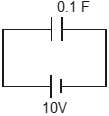
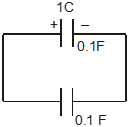
A battery of 10 volt is connected to a capacitor of capacity 0.1 F. The battery is now removed and this capacitor is connected to a second uncharged capacitor. If the charge distributes equally on these two capacitors, find the total energy stored in the two capacitors. Further, compare this energy with the initial energy stored in the first capacitor.
Text Solution
Verified by ExpertsThe correct answer is:
C
Step 1: Calculate Initial Energy in the First Capacitor
The initial charge ($Q_1$) on the first capacitor can be calculated using the formula:
$$Q_1 = C_1 imes V = 0.1 imes 10 = 1 ext{ C}$$
The initial energy ($U_1$) stored in the first capacitor can be calculated using the formula:
$$U_1 = \frac{1}{2} C_1 V^2 = \frac{1}{2} \times 0.1 \times 10^2 = 5 ext{ J}$$
Step 2: Charge Distribution on the Two Capacitors
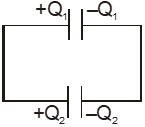
When the charged capacitor is connected to an uncharged capacitor (let's call it $C_2$), the total charge remains conserved.
Therefore, the total charge ($Q_{total}$) on both capacitors after connecting them is:
$$Q_{total} = Q_1 = 1 ext{ C}$$
Since both capacitors are of the same capacity ($C_1 = C_2 = 0.1 ext{ F}$), the voltage across both will equalize.
The total capacitance ($C_{total}$) for two capacitors in parallel is:
$$C_{total} = C_1 + C_2 = 0.1 + 0.1 = 0.2 ext{ F}$$
Using this total capacitance, we can find the new voltage ($V_f$) across the combined capacitors:
$$V_f = \frac{Q_{total}}{C_{total}} = \frac{1}{0.2} = 5 ext{ V}$$
Step 3: Calculate the Energy Stored in the Two Capacitors
The energy ($U_{total}$) stored in the two capacitors after the charge redistributes can be calculated using the formula:
$$U_{total} = \frac{1}{2} C_{total} V_f^2 = \frac{1}{2} \times 0.2 \times 5^2 = \frac{1}{2} \times 0.2 imes 25 = 2.5 ext{ J}$$
Step 4: Compare the Energies
The initial energy ($U_1$) was 5 J, and the final energy after connecting the two capacitors ($U_{total}$) is 2.5 J.
Therefore, the energy is reduced after connecting the second capacitor.
The total energy stored in the two capacitors is 2.5 J, which is half of the initial energy stored in the first capacitor.
Thus, the correct answer for the total energy stored in the two capacitors is 2.5 J.
The initial charge ($Q_1$) on the first capacitor can be calculated using the formula:
$$Q_1 = C_1 imes V = 0.1 imes 10 = 1 ext{ C}$$
The initial energy ($U_1$) stored in the first capacitor can be calculated using the formula:
$$U_1 = \frac{1}{2} C_1 V^2 = \frac{1}{2} \times 0.1 \times 10^2 = 5 ext{ J}$$
Step 2: Charge Distribution on the Two Capacitors
When the charged capacitor is connected to an uncharged capacitor (let's call it $C_2$), the total charge remains conserved.
Therefore, the total charge ($Q_{total}$) on both capacitors after connecting them is:
$$Q_{total} = Q_1 = 1 ext{ C}$$
Since both capacitors are of the same capacity ($C_1 = C_2 = 0.1 ext{ F}$), the voltage across both will equalize.
The total capacitance ($C_{total}$) for two capacitors in parallel is:
$$C_{total} = C_1 + C_2 = 0.1 + 0.1 = 0.2 ext{ F}$$
Using this total capacitance, we can find the new voltage ($V_f$) across the combined capacitors:
$$V_f = \frac{Q_{total}}{C_{total}} = \frac{1}{0.2} = 5 ext{ V}$$
Step 3: Calculate the Energy Stored in the Two Capacitors
The energy ($U_{total}$) stored in the two capacitors after the charge redistributes can be calculated using the formula:
$$U_{total} = \frac{1}{2} C_{total} V_f^2 = \frac{1}{2} \times 0.2 \times 5^2 = \frac{1}{2} \times 0.2 imes 25 = 2.5 ext{ J}$$
Step 4: Compare the Energies
The initial energy ($U_1$) was 5 J, and the final energy after connecting the two capacitors ($U_{total}$) is 2.5 J.
Therefore, the energy is reduced after connecting the second capacitor.
The total energy stored in the two capacitors is 2.5 J, which is half of the initial energy stored in the first capacitor.
Thus, the correct answer for the total energy stored in the two capacitors is 2.5 J.
Prepare Smarter with CGP Edu
Get practice questions, solutions, and test series in one place.
Write a Review
Share your experience with this question and solution.
Commentary
Send your comment, doubt, correction, or feedback to admin.
Similar Questions
Explore conceptually related problems
Assume that an electric field exists in space. Then the potential difference V A – V O , where V O…
A long cylindrical shell carries positive surface charge σ in the upper half and negative surface c…
An electric dipole has a fixed dipole moment , which makes angle θ with respect to x-axis. When su…
<p>Three concentric metal shells A, B and C of respective radii a, b and c (a < b < c) have s…
Assume that an electric field exists in space. Then the potential difference V A – V O , where V O…
An electric dipole has a fixed dipole moment , which makes angle θ with respect to x-axis. When su…