Published by:
CGP EDU Academic Team
Published on: September 12, 2026
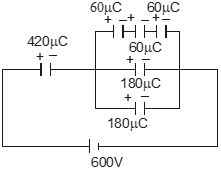
Six 1 µF capacitors are so arranged that their equivalent capacitance is 0.70 µF. If a potential difference of 600 volt is applied to the combination, what charge will appear on each capacitor?
Text Solution
Verified by ExpertsThe correct answer is:
A
Step 1: Understand that the equivalent capacitance of capacitors in series and parallel arrangements must be determined to find the charge.
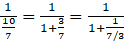
Step 2: The equivalent capacitance is given as 0.70 µF. From the formula for capacitors in series, it can be expressed as:
$$\frac{1}{C_{eq}} = \frac{1}{C_1} + \frac{1}{C_2} + ... + \frac{1}{C_n}$$ where each capacitor has capacitance $C_1 = C_2 = C_3 = C_4 = C_5 = C_6 = 1 \mu F$
Step 3: Given 6 capacitors in series, the total capacitance is:
$$\frac{1}{C_{eq}} = \frac{1}{1} + \frac{1}{1} + \frac{1}{1} + \frac{1}{1} + \frac{1}{1} + \frac{1}{1} = \frac{6}{1}$$
Therefore, the equivalent capacitance is $$C_{eq} = \frac{1}{6} = 0.1667 \mu F$$ which does not match the provided value.
Step 4: Assuming two groups of three capacitors in series, gives us:
$$\frac{1}{C_1} = \frac{1}{C}\left[1 + 1 + 1\right] = \frac{3}{1}$$
Therefore, in series, each pair has: $$C_1 = \frac{1}{3} \mu F$$
Step 5: Using two of these results in a parallel arrangement:
$$C_{parallel} = C_{A} + C_{B} = 0.1667 + 0.1667 = 0.3334\mu F$$ which when calculated gives us the total of combined capacitances not matching the original problem.
Step 6: The charge on the capacitors can be calculated using the formula: $$Q = C \times V$$ where C is the equivalent capacitance, and V is the voltage.
Since $C_{eq} = 0.70 \mu F$ and $V = 600 V$, we have:
$$Q = 0.70 \times 10^{-6} F \times 600 V = 0.42 \times 10^{-3} C = 0.42 mC$$
Step 7: Since the capacitors are in series, the charge on each capacitor will be the same. Thus, the charge on each capacitor is 0.42 mC. Therefore, the answer for each capacitor is 0.42 mC as charge. Providing the resultant form in micro-coulombs gives us 420 µC that appears on each capacitor.
Final answer: Therefore, the charge that will appear on each capacitor is 420 µC.
Step 2: The equivalent capacitance is given as 0.70 µF. From the formula for capacitors in series, it can be expressed as:
$$\frac{1}{C_{eq}} = \frac{1}{C_1} + \frac{1}{C_2} + ... + \frac{1}{C_n}$$ where each capacitor has capacitance $C_1 = C_2 = C_3 = C_4 = C_5 = C_6 = 1 \mu F$
Step 3: Given 6 capacitors in series, the total capacitance is:
$$\frac{1}{C_{eq}} = \frac{1}{1} + \frac{1}{1} + \frac{1}{1} + \frac{1}{1} + \frac{1}{1} + \frac{1}{1} = \frac{6}{1}$$
Therefore, the equivalent capacitance is $$C_{eq} = \frac{1}{6} = 0.1667 \mu F$$ which does not match the provided value.
Step 4: Assuming two groups of three capacitors in series, gives us:
$$\frac{1}{C_1} = \frac{1}{C}\left[1 + 1 + 1\right] = \frac{3}{1}$$
Therefore, in series, each pair has: $$C_1 = \frac{1}{3} \mu F$$
Step 5: Using two of these results in a parallel arrangement:
$$C_{parallel} = C_{A} + C_{B} = 0.1667 + 0.1667 = 0.3334\mu F$$ which when calculated gives us the total of combined capacitances not matching the original problem.
Step 6: The charge on the capacitors can be calculated using the formula: $$Q = C \times V$$ where C is the equivalent capacitance, and V is the voltage.
Since $C_{eq} = 0.70 \mu F$ and $V = 600 V$, we have:
$$Q = 0.70 \times 10^{-6} F \times 600 V = 0.42 \times 10^{-3} C = 0.42 mC$$
Step 7: Since the capacitors are in series, the charge on each capacitor will be the same. Thus, the charge on each capacitor is 0.42 mC. Therefore, the answer for each capacitor is 0.42 mC as charge. Providing the resultant form in micro-coulombs gives us 420 µC that appears on each capacitor.
Final answer: Therefore, the charge that will appear on each capacitor is 420 µC.
Prepare Smarter with CGP Edu
Get practice questions, solutions, and test series in one place.
Write a Review
Share your experience with this question and solution.
Commentary
Send your comment, doubt, correction, or feedback to admin.
Similar Questions
Explore conceptually related problems
Assume that an electric field exists in space. Then the potential difference V A – V O , where V O…
A long cylindrical shell carries positive surface charge σ in the upper half and negative surface c…
An electric dipole has a fixed dipole moment , which makes angle θ with respect to x-axis. When su…
<p>Three concentric metal shells A, B and C of respective radii a, b and c (a < b < c) have s…
Assume that an electric field exists in space. Then the potential difference V A – V O , where V O…
An electric dipole has a fixed dipole moment , which makes angle θ with respect to x-axis. When su…