Published by:
CGP EDU Academic Team
Published on: September 12, 2026
A circular disc of mass M and radius R is rotating about its axis with angular speed
. If R another stationary disc having radius and same mass M is dropped co-axially on to the rotating disc. Gradually both discs attain constant angular speed
. The energy lost in the process is p% of the initial energy. Value of p is:
Text Solution
Verified by ExpertsThe correct answer is:
B
Step 1: Calculate the initial moment of inertia of the rotating disc (I1) using the formula for a circular disc:
\[ I_1 = \frac{1}{2}MR^2 \]
Step 2: The initial angular momentum (L1) of the first disc is given by:
\[ L_1 = I_1 \omega_1 = \frac{1}{2}MR^2 \omega_1 \]
Step 3: The moment of inertia of the second disc (stationary) is the same:
\[ I_2 = \frac{1}{2}MR^2 \]
Total moment of inertia after they stick together (I_total) is:
\[ I_{total} = I_1 + I_2 = \frac{1}{2}MR^2 + \frac{1}{2}MR^2 = MR^2 \]
Step 4: The final angular momentum (L_total) is equal to the initial angular momentum, so:
\[ L_{total} = (I_{total}) \omega_2 = MR^2 \omega_2 \]
Setting the angular momenta equal:
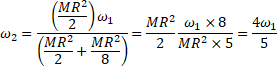
\[ \frac{1}{2}MR^2 \omega_1 = MR^2 \omega_2 \]
Step 5: Solve for \( \omega_2 \):
\[ \omega_2 = \frac{1}{2} \omega_1 \]
Step 6: Calculate the initial energy (E1):
\[ E_1 = \frac{1}{2} I_1 \omega_1^2 = \frac{1}{2} \left(\frac{1}{2}MR^2\right) \omega_1^2 = \frac{1}{4}MR^2 \omega_1^2 \]
Step 7: Calculate the final energy (E2):
\[ E_2 = \frac{1}{2} I_{total} \omega_2^2 = \frac{1}{2} (MR^2) \left(\frac{1}{2} \omega_1\right)^2 = \frac{1}{2} \cdot MR^2 \cdot \frac{1}{4} \omega_1^2 = \frac{1}{8}MR^2 \omega_1^2 \]
Step 8: Calculate energy lost:
\[ \Delta E = E_1 - E_2 = \frac{1}{4}MR^2 \omega_1^2 - \frac{1}{8}MR^2 \omega_1^2 = \frac{1}{8}MR^2 \omega_1^2 \]
Step 9: Calculate percentage of energy lost:
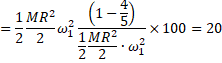
\[ p = \frac{\Delta E}{E_1} \times 100 = \frac{\frac{1}{8}MR^2 \omega_1^2}{\frac{1}{4}MR^2 \omega_1^2} \times 100 = \frac{1}{2} \times 100 = 50 \% \]
Therefore, the value of p is 50.
\[ I_1 = \frac{1}{2}MR^2 \]
Step 2: The initial angular momentum (L1) of the first disc is given by:
\[ L_1 = I_1 \omega_1 = \frac{1}{2}MR^2 \omega_1 \]
Step 3: The moment of inertia of the second disc (stationary) is the same:
\[ I_2 = \frac{1}{2}MR^2 \]
Total moment of inertia after they stick together (I_total) is:
\[ I_{total} = I_1 + I_2 = \frac{1}{2}MR^2 + \frac{1}{2}MR^2 = MR^2 \]
Step 4: The final angular momentum (L_total) is equal to the initial angular momentum, so:
\[ L_{total} = (I_{total}) \omega_2 = MR^2 \omega_2 \]
Setting the angular momenta equal:
\[ \frac{1}{2}MR^2 \omega_1 = MR^2 \omega_2 \]
Step 5: Solve for \( \omega_2 \):
\[ \omega_2 = \frac{1}{2} \omega_1 \]
Step 6: Calculate the initial energy (E1):
\[ E_1 = \frac{1}{2} I_1 \omega_1^2 = \frac{1}{2} \left(\frac{1}{2}MR^2\right) \omega_1^2 = \frac{1}{4}MR^2 \omega_1^2 \]
Step 7: Calculate the final energy (E2):
\[ E_2 = \frac{1}{2} I_{total} \omega_2^2 = \frac{1}{2} (MR^2) \left(\frac{1}{2} \omega_1\right)^2 = \frac{1}{2} \cdot MR^2 \cdot \frac{1}{4} \omega_1^2 = \frac{1}{8}MR^2 \omega_1^2 \]
Step 8: Calculate energy lost:
\[ \Delta E = E_1 - E_2 = \frac{1}{4}MR^2 \omega_1^2 - \frac{1}{8}MR^2 \omega_1^2 = \frac{1}{8}MR^2 \omega_1^2 \]
Step 9: Calculate percentage of energy lost:
\[ p = \frac{\Delta E}{E_1} \times 100 = \frac{\frac{1}{8}MR^2 \omega_1^2}{\frac{1}{4}MR^2 \omega_1^2} \times 100 = \frac{1}{2} \times 100 = 50 \% \]
Therefore, the value of p is 50.
Prepare Smarter with CGP Edu
Get practice questions, solutions, and test series in one place.
Write a Review
Share your experience with this question and solution.
Commentary
Send your comment, doubt, correction, or feedback to admin.
Similar Questions
Explore conceptually related problems
A uniform rod of length ‘ is pivoted at one of its ends on a vertical shaft of negligible radius. …
Four point masses, each of mass m, are fixed at the corners of a square of side . The square is ro…
As shown in the figure, a bob a mass m is tied by a massless string whose other end portion is woun…
The position vector of 1 kg object is and its velocity . The magnitude of its angular momentum is…
A stone tide to a string of length L is whirled in a vertical circle with the other end of the stri…
One end of a massless spring of spring constant k and natural length is fixed while the other end …