Published by:
CGP EDU Academic Team
Published on: September 11, 2026
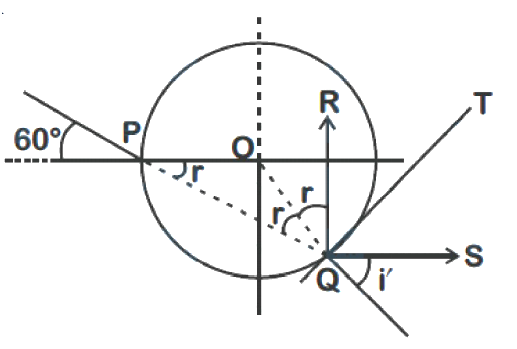
A light ray enters a solid glass sphere of refractive index
at an angle of incidence
. The ray is both reflected and refracted at the farther surface of the sphere. The angle (in degrees) between the reflected and refracted rays at this surface is
Text Solution
Verified by ExpertsThe correct answer is:
A
Step 1: Given the refractive index \( \mu = \sqrt{3} \) and the angle of incidence \( \theta_1 = 60^{\circ} \).
Step 2: Use Snell's law at the interface between air and glass for refraction:
\[ \mu_1 \sin(\theta_1) = \mu_2 \sin(\theta_2) \]
Here, \( \mu_1 = 1 \) (air) and \( \mu_2 = \sqrt{3} \).
\[ 1 \cdot \sin(60^{\circ}) = \sqrt{3} \cdot \sin(\theta_2) \]
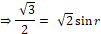
Step 3: Calculate \( \sin(60^{\circ}) = \frac{\sqrt{3}}{2} \):
\[ \frac{\sqrt{3}}{2} = \sqrt{3} \cdot \sin(\theta_2) \]
Step 4: Rearranging gives:
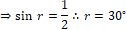
\[ \sin(\theta_2) = \frac{1}{2} \]
Thus, \( \theta_2 = 30^{\circ} \).
Step 5: At the farther surface of the sphere, the angle of incidence is \( \theta_2 = 30^{\circ} \) and the angle of reflection (by the law of reflection) is also \( \theta_r = 30^{\circ} \).
Step 6: The angle between the reflected and refracted rays is given by:
\[ \theta_{r} + \theta_{t} = 30^{\circ} + \theta_{3} \] where \( \theta_{t} \) is the angle of refraction into the external medium (assumed to be air).
Step 7: Now, calculating the angle of refraction back to air using Snell's Law again gives us \( \theta_{3} = \text{arcsin}(\frac{1}{\sqrt{3}}) \approx 60^{\circ} \).
The angle between the reflected ray (30 degrees) and the refracted ray (60 degrees) is:
\[ 60^{\circ} - 30^{\circ} = 30^{\circ} \]
Therefore, the total angle between the reflected and refracted rays is \( 30^{\circ} + 30^{\circ} = 60^{\circ} \).
Thus the final answer is 60 degrees.
Step 2: Use Snell's law at the interface between air and glass for refraction:
\[ \mu_1 \sin(\theta_1) = \mu_2 \sin(\theta_2) \]
Here, \( \mu_1 = 1 \) (air) and \( \mu_2 = \sqrt{3} \).
\[ 1 \cdot \sin(60^{\circ}) = \sqrt{3} \cdot \sin(\theta_2) \]
Step 3: Calculate \( \sin(60^{\circ}) = \frac{\sqrt{3}}{2} \):
\[ \frac{\sqrt{3}}{2} = \sqrt{3} \cdot \sin(\theta_2) \]
Step 4: Rearranging gives:
\[ \sin(\theta_2) = \frac{1}{2} \]
Thus, \( \theta_2 = 30^{\circ} \).
Step 5: At the farther surface of the sphere, the angle of incidence is \( \theta_2 = 30^{\circ} \) and the angle of reflection (by the law of reflection) is also \( \theta_r = 30^{\circ} \).
Step 6: The angle between the reflected and refracted rays is given by:
\[ \theta_{r} + \theta_{t} = 30^{\circ} + \theta_{3} \] where \( \theta_{t} \) is the angle of refraction into the external medium (assumed to be air).
Step 7: Now, calculating the angle of refraction back to air using Snell's Law again gives us \( \theta_{3} = \text{arcsin}(\frac{1}{\sqrt{3}}) \approx 60^{\circ} \).
The angle between the reflected ray (30 degrees) and the refracted ray (60 degrees) is:
\[ 60^{\circ} - 30^{\circ} = 30^{\circ} \]
Therefore, the total angle between the reflected and refracted rays is \( 30^{\circ} + 30^{\circ} = 60^{\circ} \).
Thus the final answer is 60 degrees.
Prepare Smarter with CGP Edu
Get practice questions, solutions, and test series in one place.
Write a Review
Share your experience with this question and solution.
Commentary
Send your comment, doubt, correction, or feedback to admin.
Similar Questions
Explore conceptually related problems
The difference of speed of light in the two media A and B (v A – v B ) is 2.6 x 10 7 m/s. If the re…
A light whose electric field vectors arc completely removed by using a good Polaroid, allowed to in…
Consider a light ray travelling in air is incident into a medium of refractive index . The inciden…
A ray of ligh is incident at an angle of incidence 60° on the glass slab of refractive index . Aft…
A light ray is incident, at an incident angle , on the system of two plane mirrors M 1 and M 2 hav…
A parallel beam of light is allowed to fall on a transparent spherical globe of diameter 30 cm and …