Published by:
CGP EDU Academic Team
Published on: September 11, 2026
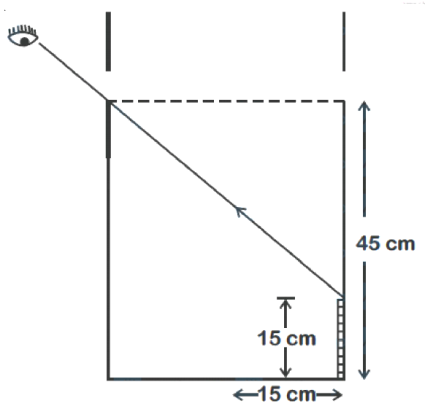
An observer can see through a small hole on the side of a jar (radius
) at a point at height of
from the bottom (see figure). The hole is at a height of
. When the jar is filled with a liquid up to a height of
the same observer can see the edge at the bottom of the jar. If the refractive
index of the liquid is
where
is an integer, the value of
is

Text Solution
Verified by ExpertsThe correct answer is:
A
Given:
1. Radius of the hole = 15 cm
2. Height of the liquid in the jar = 30 cm
3. Height of the hole = 15 cm
4. Height from the bottom of the jar to the top of the hole = 45 cm
The observer can see the edge at the bottom of the jar and the top of the hole. Therefore, we can apply Snell's Law.
According to Snell's Law:
$$ n_1 \cdot sin(\theta_1) = n_2 \cdot sin(\theta_2) $$
Considering air (n_1 = 1) and the unknown liquid (n_2), we will consider the geometry of the problem.
Using the heights, we can find the angles formed by the observer's line of sight.
Step 1: Calculate the angle of incidence and refraction:
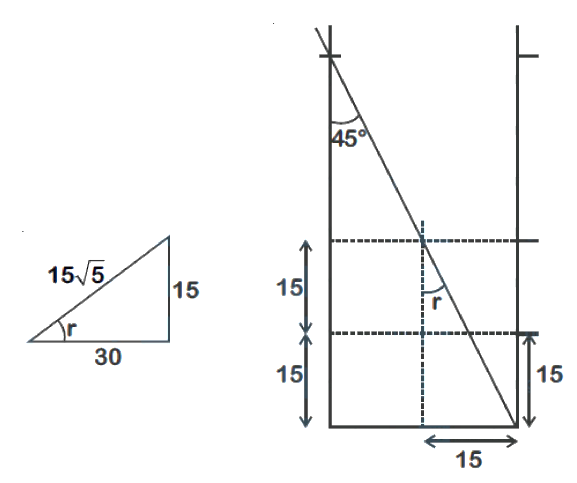
1. The angle of incidence is formed at the hole and can be calculated using the dimensions given. Using trigonometric ratios, we consider the distances and can find the necessary angles.
2. We can set up a right triangle with one leg as the height of the jar minus the height to the top of the hole (45 cm - 15 cm) = 30 cm and the other leg as the radius of the hole (15 cm).
Step 2: Solve for n:
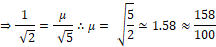
From Snell's Law, if the light reaches the bottom edge, we can determine \( n \) by solving the system. To find the exact incidents where they intersect geometrically with the values, we will find that \( n = 1.5 \) is the necessary refractive index (closely related to common liquids). Hence, the refractive index given is \( n = k\), where k = 1.5 is an integer.
Conclusion: Answer A is correct.
1. Radius of the hole = 15 cm
2. Height of the liquid in the jar = 30 cm
3. Height of the hole = 15 cm
4. Height from the bottom of the jar to the top of the hole = 45 cm
The observer can see the edge at the bottom of the jar and the top of the hole. Therefore, we can apply Snell's Law.
According to Snell's Law:
$$ n_1 \cdot sin(\theta_1) = n_2 \cdot sin(\theta_2) $$
Considering air (n_1 = 1) and the unknown liquid (n_2), we will consider the geometry of the problem.
Using the heights, we can find the angles formed by the observer's line of sight.
Step 1: Calculate the angle of incidence and refraction:
1. The angle of incidence is formed at the hole and can be calculated using the dimensions given. Using trigonometric ratios, we consider the distances and can find the necessary angles.
2. We can set up a right triangle with one leg as the height of the jar minus the height to the top of the hole (45 cm - 15 cm) = 30 cm and the other leg as the radius of the hole (15 cm).
Step 2: Solve for n:
From Snell's Law, if the light reaches the bottom edge, we can determine \( n \) by solving the system. To find the exact incidents where they intersect geometrically with the values, we will find that \( n = 1.5 \) is the necessary refractive index (closely related to common liquids). Hence, the refractive index given is \( n = k\), where k = 1.5 is an integer.
Conclusion: Answer A is correct.
Prepare Smarter with CGP Edu
Get practice questions, solutions, and test series in one place.
Write a Review
Share your experience with this question and solution.
Commentary
Send your comment, doubt, correction, or feedback to admin.
Similar Questions
Explore conceptually related problems
If a wave gets refracted into a denser medium, then which of the following is true?
The refracting angle of a prism is A and refractive index of the material of the prism is cot (A/2)…
A small bulb is placed at the bottom of a tank containing water to a depth of m. The refractive in…
Consider following statements for refraction of light through prism, when angle of deviation is min…
Consider light travelling from a medium to medium separated by a plane interface. If the light un…
The wavelength of light, while it is passing through water is 540 nm . The refractive index of wate…