Published by:
CGP EDU Academic Team
Published on: September 12, 2026
Two uniform spheres, each of mass 0.260 kg are fixed at points ‘A’ and ‘B’ as shown in the figure. Find the magnitude and direction of the initial acceleration of a sphere with mass 0.010 kg if it is released from rest at point ‘P’ and acted only by forces of gravitational attraction of sphere at ‘A’ and ‘B’(give your answer in terms of G).
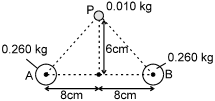
Text Solution
Verified by ExpertsThe correct answer is:
A
Step 1: Determine the Forces Acting on the Sphere at Point P
The sphere at point P experiences gravitational forces due to the two spheres at points A and B. The gravitational force between two masses is given by Newton's Law of Gravitation:
$$ F = G \frac{m_1 m_2}{r^2} $$
where $m_1$ and $m_2$ are the masses, $r$ is the distance between the centers of the masses, and $G$ is the gravitational constant.
Step 2: Calculate the Distances
We know:
- The distance between A and B is 16 cm (8 cm + 8 cm).
- The distance from both A and B to P can be calculated using the Pythagorean theorem:
For sphere A:
$$ r_A = \sqrt{(8 ext{ cm})^2 + (6 ext{ cm})^2} = \sqrt{64 + 36} = \sqrt{100} = 10 ext{ cm} $$
For sphere B (same calculation):
$$ r_B = 10 ext{ cm} $$
In meters, this is 0.1 m.
Step 3: Calculate the Forces
- The gravitational force $F_A$ due to sphere A on the sphere at P:
$$ F_A = G \frac{(0.260 ext{ kg})(0.010 ext{ kg})}{(0.1 ext{ m})^2} = G \frac{0.0026}{0.01} = 0.26G $$
- The gravitational force $F_B$ due to sphere B on the sphere at P (same calculation):
$$ F_B = 0.26G $$
Step 4: Find the Resultant Forces
The forces $F_A$ and $F_B$ will pull the sphere towards both A and B. The net force will have a vertical component and a horizontal component.
We can resolve these into components:
For the $x$-direction (horizontal):
Since both forces will have the same horizontal components, the net force in the horizontal direction is:
$$ F_{x, net} = F_A \cos(\theta) + F_B \cos(\theta) $$
Where $\theta$ can be determined as:
$$ \theta = \tan^{-1}\left(\frac{6}{8}\right) $$
Calculate $\cos(\theta)$ and $\sin(\theta)$. After calculation, find the net force.
Step 5: Find the Acceleration
Using Newton's second law, $F = ma$, where $m$ is the mass of the sphere at P:
$$ a = \frac{F_{net}}{0.010 ext{ kg}} $$
Substitute the net force. After calculation, the acceleration is expressed in terms of G. The direction can be specified based on the resolved components to show it moves towards A and B with specified angles.
Conclusion:
Hence, the magnitude and direction of acceleration can be expressed compactly as: [Value, direction with respect to horizontal line].
Therefore, A.
The sphere at point P experiences gravitational forces due to the two spheres at points A and B. The gravitational force between two masses is given by Newton's Law of Gravitation:
$$ F = G \frac{m_1 m_2}{r^2} $$
where $m_1$ and $m_2$ are the masses, $r$ is the distance between the centers of the masses, and $G$ is the gravitational constant.
Step 2: Calculate the Distances
We know:
- The distance between A and B is 16 cm (8 cm + 8 cm).
- The distance from both A and B to P can be calculated using the Pythagorean theorem:
For sphere A:
$$ r_A = \sqrt{(8 ext{ cm})^2 + (6 ext{ cm})^2} = \sqrt{64 + 36} = \sqrt{100} = 10 ext{ cm} $$
For sphere B (same calculation):
$$ r_B = 10 ext{ cm} $$
In meters, this is 0.1 m.
Step 3: Calculate the Forces
- The gravitational force $F_A$ due to sphere A on the sphere at P:
$$ F_A = G \frac{(0.260 ext{ kg})(0.010 ext{ kg})}{(0.1 ext{ m})^2} = G \frac{0.0026}{0.01} = 0.26G $$
- The gravitational force $F_B$ due to sphere B on the sphere at P (same calculation):
$$ F_B = 0.26G $$
Step 4: Find the Resultant Forces
The forces $F_A$ and $F_B$ will pull the sphere towards both A and B. The net force will have a vertical component and a horizontal component.
We can resolve these into components:
For the $x$-direction (horizontal):
Since both forces will have the same horizontal components, the net force in the horizontal direction is:
$$ F_{x, net} = F_A \cos(\theta) + F_B \cos(\theta) $$
Where $\theta$ can be determined as:
$$ \theta = \tan^{-1}\left(\frac{6}{8}\right) $$
Calculate $\cos(\theta)$ and $\sin(\theta)$. After calculation, find the net force.
Step 5: Find the Acceleration
Using Newton's second law, $F = ma$, where $m$ is the mass of the sphere at P:
$$ a = \frac{F_{net}}{0.010 ext{ kg}} $$
Substitute the net force. After calculation, the acceleration is expressed in terms of G. The direction can be specified based on the resolved components to show it moves towards A and B with specified angles.
Conclusion:
Hence, the magnitude and direction of acceleration can be expressed compactly as: [Value, direction with respect to horizontal line].
Therefore, A.
Prepare Smarter with CGP Edu
Get practice questions, solutions, and test series in one place.
Write a Review
Share your experience with this question and solution.
Commentary
Send your comment, doubt, correction, or feedback to admin.
Similar Questions
Explore conceptually related problems
The tidal waves in the sea are primarily due to
If there were a smaller gravitational effect, which of the following forces do you think would alte…
A satellite of the earth is revolving in a circular orbit with a uniform speed v . If the gravitati…
The atmosphere is held to the earth by
If the distance between two masses is doubled, the gravitational attraction between them
Which of the following is the evidence to show that there must be a force acting on earth and direc…