Published by:
CGP EDU Academic Team
Published on: September 12, 2026
For the D-T fusion reaction, find the rate at which deuterium & tritium are consumed to produce 1 MW . The Q-value of D-T reaction is 17.6 MeV & assume all the energy from the fusion reaction is available.
Text Solution
Verified by ExpertsThe correct answer is:
A
Step 1: Understanding the reaction
The D-T fusion reaction can be represented as:
$$^2H + ^3H \rightarrow ^4He + n + 17.6 \text{ MeV}$$
Here, deuterium (D) and tritium (T) fuse to form helium (He) and a neutron (n), releasing a substantial amount of energy in the form of 17.6 MeV per reaction.
Step 2: Convert MeV to Joules
The energy released per fusion reaction in Joules, given that 1 MeV = 1.6 \times 10^{-13} J, is:
$$E = 17.6 \text{ MeV} \times 1.6 \times 10^{-13} \text{ J/MeV} = 2.816 \times 10^{-12} \text{ J}$$
Step 3: Calculate the number of reactions needed for 1 MW
The power we need is 1 MW or 1 million watts, which is equivalent to 1 million Joules per second:
$$P = 1 \text{ MW} = 10^6 \text{ J/s}$$
To find the number of reactions per second:
$$N_{reactions} = \frac{P}{E} = \frac{10^6 \text{ J/s}}{2.816 \times 10^{-12} \text{ J}} \approx 3.55 \times 10^{17} \text{ reactions/s}$$
Step 4: Calculate the amount of deuterium and tritium consumed
Each reaction consumes 1 deuterium and 1 tritium atom, so the rate at which deuterium and tritium are consumed will be the same as the number of reactions:
$$\text{Rate of D consumption} = \text{Rate of T consumption} = N_{reactions} \approx 3.55 \times 10^{17} \text{ atoms/s}$$
Since we are asked for the consumption rate in terms of mass or similar, if you need the total mass of each consumed per second, that can be calculated as:
For deuterium, the molar mass is approximately 2 g/mol:\
$$\text{Mass of D consumed/s} = \frac{N_{reactions}}{N_A} \times \text{Molar Mass of D}$$
where $N_A$ (Avogadro's number) is approximately 6.022 \times 10^{23} mol^{-1}.
Therefore, the mass of D consumed per second:
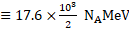
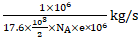
$$\approx \frac{3.55 \times 10^{17}}{6.022 \times 10^{23}} \times 2 \text{ g/mol} \approx 1.18 \times 10^{-6} \text{ g/s}$$
Similarly for tritium. However, since the question doesn't specify units, we are primarily concerned with the rate at which the fusion process occurs, which aligns with the number of atoms being consumed per second.
Conclusion
Therefore, the rate at which deuterium and tritium are consumed to produce 1 MW of energy through D-T fusion is approximately 3.55 \times 10^{17} atoms/s for each isotope.
The D-T fusion reaction can be represented as:
$$^2H + ^3H \rightarrow ^4He + n + 17.6 \text{ MeV}$$
Here, deuterium (D) and tritium (T) fuse to form helium (He) and a neutron (n), releasing a substantial amount of energy in the form of 17.6 MeV per reaction.
Step 2: Convert MeV to Joules
The energy released per fusion reaction in Joules, given that 1 MeV = 1.6 \times 10^{-13} J, is:
$$E = 17.6 \text{ MeV} \times 1.6 \times 10^{-13} \text{ J/MeV} = 2.816 \times 10^{-12} \text{ J}$$
Step 3: Calculate the number of reactions needed for 1 MW
The power we need is 1 MW or 1 million watts, which is equivalent to 1 million Joules per second:
$$P = 1 \text{ MW} = 10^6 \text{ J/s}$$
To find the number of reactions per second:
$$N_{reactions} = \frac{P}{E} = \frac{10^6 \text{ J/s}}{2.816 \times 10^{-12} \text{ J}} \approx 3.55 \times 10^{17} \text{ reactions/s}$$
Step 4: Calculate the amount of deuterium and tritium consumed
Each reaction consumes 1 deuterium and 1 tritium atom, so the rate at which deuterium and tritium are consumed will be the same as the number of reactions:
$$\text{Rate of D consumption} = \text{Rate of T consumption} = N_{reactions} \approx 3.55 \times 10^{17} \text{ atoms/s}$$
Since we are asked for the consumption rate in terms of mass or similar, if you need the total mass of each consumed per second, that can be calculated as:
For deuterium, the molar mass is approximately 2 g/mol:\
$$\text{Mass of D consumed/s} = \frac{N_{reactions}}{N_A} \times \text{Molar Mass of D}$$
where $N_A$ (Avogadro's number) is approximately 6.022 \times 10^{23} mol^{-1}.
Therefore, the mass of D consumed per second:
$$\approx \frac{3.55 \times 10^{17}}{6.022 \times 10^{23}} \times 2 \text{ g/mol} \approx 1.18 \times 10^{-6} \text{ g/s}$$
Similarly for tritium. However, since the question doesn't specify units, we are primarily concerned with the rate at which the fusion process occurs, which aligns with the number of atoms being consumed per second.
Conclusion
Therefore, the rate at which deuterium and tritium are consumed to produce 1 MW of energy through D-T fusion is approximately 3.55 \times 10^{17} atoms/s for each isotope.
Prepare Smarter with CGP Edu
Get practice questions, solutions, and test series in one place.
Write a Review
Share your experience with this question and solution.
Commentary
Send your comment, doubt, correction, or feedback to admin.
Similar Questions
Explore conceptually related problems
Consider the case of bombardment of nucleus with a thermal neutron. The fission products are & a…
Energy evolved from the fusion reaction is to be used for the production of power. Assuming the ef…
nucleus absorbs a slow neutron and undergoes fission into and nuclei. The other particles produc…
Fusion reaction is possible at high temperature because –
In a fission reaction , the binding energy per nucleon of and is 8.5 MeV whereas of. is 7.6 MeV…
Assuming that about 20 MeV of energy is released per fusion reaction, 1 H 2 + 1 H 3 → 0 n 1 + 2 He …