Published by:
CGP EDU Academic Team
Published on: September 12, 2026
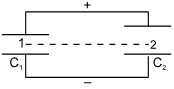
Two parallel plate capacitors with different distances between the plates are connected in parallel to a voltage source. A point positive charge Q is moved from a point 1 that is exactly in the middle between the plates of a capacitor C 1 to a point 2 (which lie in capacitor C 2 ) that lies at a distance from the negative plate of C 2 equal to half the distance between the plates of C 1 . Is any work done in the process? If yes, calculate the work done by the field if potential at 1 and 2 are V 1 and V 2 .
Text Solution
Verified by ExpertsThe correct answer is:
A
Step 1: Understand the setup: There are two capacitors, C1 and C2, connected in parallel to a voltage source. A point charge, Q, is moved from the midpoint between the plates of capacitor C1 to a position within capacitor C2.
Step 2: Define the positions:
- Point 1 is at the midpoint of C1>. Due to symmetry, the electric potential V1 at this point is calculated as:
$$ V_1 = V_{source} $$
- Point 2 is at a distance from the negative plate of C2> equal to half the distance between the plates of C1>, hence the potential at this point, located in C2>, can be denoted as V2.
Step 3: Work done by the electric field: The work done (W) on charge Q when moving from point 1 to point 2 is given by the formula:
$$ W = Q(V_2 - V_1) $$
Step 4: Identify whether there is a potential difference: If V1 and V2 are different, then work will be done. Since we assume that C2 has a different potential than C1, there is a work done.
Step 5: Calculation of work done: If the potentials are known, replace V1 and V2 appropriately. If the potentials are equal, W = 0. Thus the work done is expressed as:
$$ W = Q(V_2 - V_1) $$
Thus, depending on the values of V1 and V2, work can be done. Therefore:
Answer: Yes, work is done during the charge movement if V1 and V2 differ.
Step 2: Define the positions:
- Point 1 is at the midpoint of C1>. Due to symmetry, the electric potential V1 at this point is calculated as:
$$ V_1 = V_{source} $$
- Point 2 is at a distance from the negative plate of C2> equal to half the distance between the plates of C1>, hence the potential at this point, located in C2>, can be denoted as V2.
Step 3: Work done by the electric field: The work done (W) on charge Q when moving from point 1 to point 2 is given by the formula:
$$ W = Q(V_2 - V_1) $$
Step 4: Identify whether there is a potential difference: If V1 and V2 are different, then work will be done. Since we assume that C2 has a different potential than C1, there is a work done.
Step 5: Calculation of work done: If the potentials are known, replace V1 and V2 appropriately. If the potentials are equal, W = 0. Thus the work done is expressed as:
$$ W = Q(V_2 - V_1) $$
Thus, depending on the values of V1 and V2, work can be done. Therefore:
Answer: Yes, work is done during the charge movement if V1 and V2 differ.
Prepare Smarter with CGP Edu
Get practice questions, solutions, and test series in one place.
Write a Review
Share your experience with this question and solution.
Commentary
Send your comment, doubt, correction, or feedback to admin.
Similar Questions
Explore conceptually related problems
The capacity of a parallel plate condenser is . When a glass plate is placed between the plates of…
A capacitor is charged by using a battery which is then disconnected. A dielectric slab is then sli…
The energy of a charged capacitor is given by the expression ( $\alpha$ = charge on the conductor a…
The capacity of a condenser is $4 \times 10^{-6}$ farad and its potential is 100 volts . The energy…
The insulated spheres of radii $R_1$ and $R_2$ having charges $Q_1$ and $Q_2$ respectively are conn…
In a charged capacitor, the energy resides