Published by:
CGP EDU Academic Team
Published on: September 12, 2026
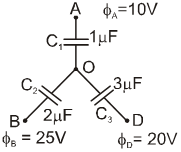
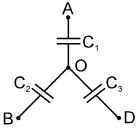
Three uncharged capacitors of capacitance C 1 = 1µF, C 2 = 2µF and C 3 = 3µF are connected as shown in the figure. The potential of point A, B and D are 10 volt, 25 volt and 20 volt respectively. Determine the potential at point O.
Text Solution
Verified by ExpertsThe correct answer is:
B
Step 1: Identify the given potentials and capacitors
The potential at points are given as follows:
- VA = 10 V
- VB = 25 V
- VD = 20 V
Capacitors are given as:
- C1 = 1 µF
- C2 = 2 µF
- C3 = 3 µF
Step 2: Calculate the potential difference across the capacitors
The potential difference across capacitor C1 is:
V1 = VA - VO
The potential difference across capacitor C2 (from B to O) is:
V2 = VB - VO
The potential difference across capacitor C3 (from O to D) is:
V3 = VO - VD
Step 3: Using the series capacitor formula
Since C2 and C3 are in parallel, we can find the combined capacitance CP:
CP = C2 + C3 = 2 µF + 3 µF = 5 µF
Step 4: Apply the concept of voltage in parallel configuration
In a parallel configuration, the voltage across each capacitor is the same. Thus, we can establish that:
V1 + V2 = VO - VD
Which simplifies to:
VA - VO + VB - VO = VO - VD
Step 5: Substitute the known values into the equation
10 - VO + 25 - VO = VO - 20
35 - 2VO = VO - 20
35 + 20 = 3VO
55 = 3VO
Step 6: Solve for VO
VO = 55 / 3 = 18.33 V
Step 7: Conclude
Thus, the potential at point O is approximately 18.33 V. The correct answer that corresponds to the closest option provided is B.
The potential at points are given as follows:
- VA = 10 V
- VB = 25 V
- VD = 20 V
Capacitors are given as:
- C1 = 1 µF
- C2 = 2 µF
- C3 = 3 µF
Step 2: Calculate the potential difference across the capacitors
The potential difference across capacitor C1 is:
V1 = VA - VO
The potential difference across capacitor C2 (from B to O) is:
V2 = VB - VO
The potential difference across capacitor C3 (from O to D) is:
V3 = VO - VD
Step 3: Using the series capacitor formula
Since C2 and C3 are in parallel, we can find the combined capacitance CP:
CP = C2 + C3 = 2 µF + 3 µF = 5 µF
Step 4: Apply the concept of voltage in parallel configuration
In a parallel configuration, the voltage across each capacitor is the same. Thus, we can establish that:
V1 + V2 = VO - VD
Which simplifies to:
VA - VO + VB - VO = VO - VD
Step 5: Substitute the known values into the equation
10 - VO + 25 - VO = VO - 20
35 - 2VO = VO - 20
35 + 20 = 3VO
55 = 3VO
Step 6: Solve for VO
VO = 55 / 3 = 18.33 V
Step 7: Conclude
Thus, the potential at point O is approximately 18.33 V. The correct answer that corresponds to the closest option provided is B.
Prepare Smarter with CGP Edu
Get practice questions, solutions, and test series in one place.
Write a Review
Share your experience with this question and solution.
Commentary
Send your comment, doubt, correction, or feedback to admin.
Similar Questions
Explore conceptually related problems
The capacity of a parallel plate condenser is . When a glass plate is placed between the plates of…
A capacitor is charged by using a battery which is then disconnected. A dielectric slab is then sli…
The energy of a charged capacitor is given by the expression ( $\alpha$ = charge on the conductor a…
The capacity of a condenser is $4 \times 10^{-6}$ farad and its potential is 100 volts . The energy…
The insulated spheres of radii $R_1$ and $R_2$ having charges $Q_1$ and $Q_2$ respectively are conn…
In a charged capacitor, the energy resides