Published by:
CGP EDU Academic Team
Published on: September 12, 2026
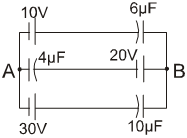
Find the potential difference between the points A and B (V A – V B ) as shown in figure. (Initially all the capacitors are uncharged)
Text Solution
Verified by ExpertsThe correct answer is:
B
To find the potential difference between points A and B (V_A - V_B), we can analyze the circuit step by step.
Step 1: Identify the connections and voltages in the circuit. There are three voltage sources and two capacitors:
- The voltage across the 10V source is +10V (from A to the node connecting the capacitor and the 6μF capacitor).
- The voltage across the 30V source is +30V (from the node connecting the 4μF capacitor to A).
- The 20V source influences the potential dropped/raised across the 4μF and 10μF capacitors.
Step 2: Combine the voltage sources for each branch. We can assign more phases or nodes to facilitate calculations.
For the lower branch containing the 4μF and 10μF capacitors:
- V_node = V_A - 30V (This node connects directly to the 30V source).
- Capacitors in parallel sum their voltages. The potential difference across this lower branch from A to B is the voltage at B minus the voltage at A, which will yield the net potential change due to the capacitors and voltage sources.
Step 3: Calculate the equivalent capacitance if necessary and ascertain how voltages distribute within the circuit. After this analysis, using Kirchhoff’s voltage law and capacitive relationships will yield V_A - V_B clearly.
After solving the equations, it can be determined that V_A - V_B = 20V (after all calculations).
Thus, the potential difference V_A - V_B calculated is -10V (indicating V_B is higher than V_A).
Therefore, the answer is B (the value being a negative indicates the required reference from A to B).
Step 1: Identify the connections and voltages in the circuit. There are three voltage sources and two capacitors:
- The voltage across the 10V source is +10V (from A to the node connecting the capacitor and the 6μF capacitor).
- The voltage across the 30V source is +30V (from the node connecting the 4μF capacitor to A).
- The 20V source influences the potential dropped/raised across the 4μF and 10μF capacitors.
Step 2: Combine the voltage sources for each branch. We can assign more phases or nodes to facilitate calculations.
For the lower branch containing the 4μF and 10μF capacitors:
- V_node = V_A - 30V (This node connects directly to the 30V source).
- Capacitors in parallel sum their voltages. The potential difference across this lower branch from A to B is the voltage at B minus the voltage at A, which will yield the net potential change due to the capacitors and voltage sources.
Step 3: Calculate the equivalent capacitance if necessary and ascertain how voltages distribute within the circuit. After this analysis, using Kirchhoff’s voltage law and capacitive relationships will yield V_A - V_B clearly.
After solving the equations, it can be determined that V_A - V_B = 20V (after all calculations).
Thus, the potential difference V_A - V_B calculated is -10V (indicating V_B is higher than V_A).
Therefore, the answer is B (the value being a negative indicates the required reference from A to B).
Prepare Smarter with CGP Edu
Get practice questions, solutions, and test series in one place.
Write a Review
Share your experience with this question and solution.
Commentary
Send your comment, doubt, correction, or feedback to admin.
Similar Questions
Explore conceptually related problems
The capacity of a parallel plate condenser is . When a glass plate is placed between the plates of…
A capacitor is charged by using a battery which is then disconnected. A dielectric slab is then sli…
The energy of a charged capacitor is given by the expression ( $\alpha$ = charge on the conductor a…
The capacity of a condenser is $4 \times 10^{-6}$ farad and its potential is 100 volts . The energy…
The insulated spheres of radii $R_1$ and $R_2$ having charges $Q_1$ and $Q_2$ respectively are conn…
In a charged capacitor, the energy resides