Home Physics Electrostatics Potential & Capacitance Capacitance A parallel-plate capacitor of plate area A a…
Physics Electrostatics Potential & Capacitance Capacitance Subjective Type
Published on: September 12, 2026

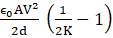
A parallel-plate capacitor of plate area A and plate separation d is charged by a ideal battery of e.m.f. V and then the battery is disconnected. A slab of dielectric constant 2k is then inserted between the plates of the capacitor so as to fill the whole space between the plates. Find the change in potential energy of the system in the process of inserting the slab.

Share this question

For Instagram sharing, use “Apps” on mobile or copy the link.

Text Solution

Verified by Experts
The correct answer is:
A
Step 1: Understand the initial conditions of the parallel-plate capacitor. When a capacitor is charged by a battery, its initial energy (Uinitial) can be expressed as:
$$ U_{initial} = \frac{1}{2} C V^2 $$
where C is the capacitance of the capacitor given by:
$$ C = \frac{\varepsilon_0 A}{d} $$
Thus,
$$ U_{initial} = \frac{1}{2} \left(\frac{\varepsilon_0 A}{d}\right) V^2 $$
Step 2: Upon disconnecting the battery, the charge (Q) on the capacitor remains constant and is given by:
$$ Q = C V = \frac{\varepsilon_0 A}{d} V $$
Step 3: When the dielectric slab of constant 2k is inserted, the new capacitance (Cnew) becomes:
$$ C_{new} = k C = 2k \left(\frac{\varepsilon_0 A}{d}\right) = \frac{2k \varepsilon_0 A}{d} $$
Step 4: After inserting the dielectric slab, the voltage across the capacitor (Vnew) can be found using the relation:
$$ V_{new} = \frac{Q}{C_{new}} = \frac{\frac{\varepsilon_0 A}{d} V}{\frac{2k \varepsilon_0 A}{d}} = \frac{V}{2k} $$
Step 5: The new potential energy (Unew) of the capacitor is:
$$ U_{new} = \frac{1}{2} C_{new} V_{new}^2 = \frac{1}{2} \left(\frac{2k \varepsilon_0 A}{d}\right) \left(\frac{V}{2k}\right)^2 $$
This simplifies to:
$$ U_{new} = \frac{1}{2} \left(\frac{2k \varepsilon_0 A}{d}\right) \left(\frac{V^2}{4k^2}\right) = \frac{\varepsilon_0 A V^2}{4d} $$
Step 6: The change in potential energy (ΔU) is then given by:
$$ \Delta U = U_{new} - U_{initial} $$
Substituting the values:
$$ \Delta U = \frac{\varepsilon_0 A V^2}{4d} - \frac{1}{2} \left(\frac{\varepsilon_0 A}{d}\right) V^2 $$
Simplifying gives:
$$ \Delta U = \frac{\varepsilon_0 A V^2}{4d} - \frac{2 \varepsilon_0 A V^2}{4d} = -\frac{\varepsilon_0 A V^2}{4d} $$
Conclusion: The change in potential energy is negative, indicating that the potential energy of the system decreases. Therefore, the final expression shows the change in potential energy due to the insertion of the dielectric slab.

Prepare Smarter with CGP Edu

Get practice questions, solutions, and test series in one place.

Write a Review

Share your experience with this question and solution.

Commentary

Send your comment, doubt, correction, or feedback to admin.

Student Reviews

What students say about this solution

No reviews yet. Be the first to write a review.

Similar Questions

Explore conceptually related problems

CG
CGP Question Assistant Question Bank + AI Help
Hi! Type your question or upload one screenshot. First I will search related questions from CGP Edu Question Bank. If none match, type YES and I will solve it with AI.
Upload only one screenshot at a time. Flow: Question Bank first → If not matched, type YES for AI solution.