Published by:
CGP EDU Academic Team
Published on: September 12, 2026
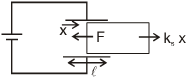
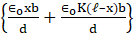
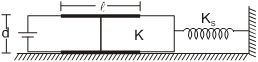
Consider the situation shown in figure. The width of each plate is b. The capacitor plates are rigidly clamped in the laboratory and connected to a battery of emf V. All surface are frictionless. Calculate the extension in the spring in equilibrium (spring is nonconducting)
Text Solution
Verified by ExpertsThe correct answer is:
A
Step 1: The force exerted by the electric field on the capacitor plates can be derived from the electric field between the plates, which is given by:
$$ E = \frac{V}{d} $$
where $V$ is the voltage and $d$ is the separation between the plates.
Step 2: The force $F$ on one plate is calculated using:
$$ F = qE $$
where $q$ is the charge on the plate given by
$$ q = C \cdot V $$
Step 3: The capacitance $C$ of a parallel plate capacitor can be expressed as:
$$ C = \frac{\varepsilon_0 A}{d} $$
where $A$ is the area of the plates. Hence,
$$ q = \frac{\varepsilon_0 A V}{d} $$
Step 4: We substitute to find the force:
$$ F = \left( \frac{\varepsilon_0 A V}{d} \right) \left( \frac{V}{d} \right) = \frac{\varepsilon_0 A V^2}{d^2} $$
Step 5: This force causes an extension in the spring ($x$) according to Hooke's law:
$$ F = K_s x $$
where $K_s$ is the spring constant. Equating the two forces, we get:
$$ K_s x = \frac{\varepsilon_0 A V^2}{d^2} $$
Step 6: From this equation, we can solve for the extension $x$:
$$ x = \frac{\varepsilon_0 A V^2}{K_s d^2} $$
Therefore, the extension in the spring in equilibrium is given by:
$$ x = \frac{\varepsilon_0 A V^2}{K_s d^2} $$
Thus, the correct answer is A.
$$ E = \frac{V}{d} $$
where $V$ is the voltage and $d$ is the separation between the plates.
Step 2: The force $F$ on one plate is calculated using:
$$ F = qE $$
where $q$ is the charge on the plate given by
$$ q = C \cdot V $$
Step 3: The capacitance $C$ of a parallel plate capacitor can be expressed as:
$$ C = \frac{\varepsilon_0 A}{d} $$
where $A$ is the area of the plates. Hence,
$$ q = \frac{\varepsilon_0 A V}{d} $$
Step 4: We substitute to find the force:
$$ F = \left( \frac{\varepsilon_0 A V}{d} \right) \left( \frac{V}{d} \right) = \frac{\varepsilon_0 A V^2}{d^2} $$
Step 5: This force causes an extension in the spring ($x$) according to Hooke's law:
$$ F = K_s x $$
where $K_s$ is the spring constant. Equating the two forces, we get:
$$ K_s x = \frac{\varepsilon_0 A V^2}{d^2} $$
Step 6: From this equation, we can solve for the extension $x$:
$$ x = \frac{\varepsilon_0 A V^2}{K_s d^2} $$
Therefore, the extension in the spring in equilibrium is given by:
$$ x = \frac{\varepsilon_0 A V^2}{K_s d^2} $$
Thus, the correct answer is A.
Prepare Smarter with CGP Edu
Get practice questions, solutions, and test series in one place.
Write a Review
Share your experience with this question and solution.
Commentary
Send your comment, doubt, correction, or feedback to admin.
Similar Questions
Explore conceptually related problems
The capacity of a parallel plate condenser is . When a glass plate is placed between the plates of…
A capacitor is charged by using a battery which is then disconnected. A dielectric slab is then sli…
The energy of a charged capacitor is given by the expression ( $\alpha$ = charge on the conductor a…
The capacity of a condenser is $4 \times 10^{-6}$ farad and its potential is 100 volts . The energy…
The insulated spheres of radii $R_1$ and $R_2$ having charges $Q_1$ and $Q_2$ respectively are conn…
In a charged capacitor, the energy resides