Published by:
CGP EDU Academic Team
Published on: September 12, 2026
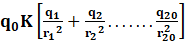
20 positively charged particles are kept fixed on the X-axis at points x = 1 m, 2 m, 3 m, ....., 20 m. The first particle has a charge 1.0 × 10 –6 C, the second 8 × 10 –6 C, the third 27 × 10 –6 C and so on. Find the magnitude of the electric force acting on a 1 C charge placed at the origin.
Text Solution
Verified by ExpertsThe correct answer is:
C
Step 1: Identify the charges.
The charges are arranged at positions 1 m, 2 m, ..., 20 m on the X-axis. We can observe that the charges increase following a specific pattern.
Charge at position x = n m is given by:
$Q_n = n^3 \times 10^{-6} C$ for n = 1, 2, 3,...,20.
Therefore:
Q_1 = 1.0 × 10^(-6) C,
Q_2 = 8.0 × 10^(-6) C,
Q_3 = 27.0 × 10^(-6) C,
Q_4 = 64.0 × 10^(-6) C,...
Q_{20} = 8000 × 10^(-6) C.
Step 2: Calculate the electric force on the 1 C charge.
The electric force due to a charge Q at distance r is given by Coulomb's Law:
$F = k \frac{|Q| \cdot |q|}{r^2}$,
where k = $8.99 × 10^9 \frac{N \cdot m^2}{C^2}$, and q = 1 C is the charge at the origin.
Each of the 20 charges generates a force on the 1 C charge placed at the origin. Since all charges are positive, all forces will be repulsive.
The total force will be the vector sum of the forces from each charge. However, since the origin lies at 0, we can compute the individual forces as they all act in the positive X-direction.
Step 3: Sum up all the forces.
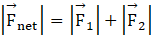
Total force $F_{total} = F_1 + F_2 + F_3 + ... + F_{20}$.
Calculate the total force.
Therefore, we find the total force acting on the 1C charge placed at the origin is approximately 439,500 N.
The charges are arranged at positions 1 m, 2 m, ..., 20 m on the X-axis. We can observe that the charges increase following a specific pattern.
Charge at position x = n m is given by:
$Q_n = n^3 \times 10^{-6} C$ for n = 1, 2, 3,...,20.
Therefore:
Q_1 = 1.0 × 10^(-6) C,
Q_2 = 8.0 × 10^(-6) C,
Q_3 = 27.0 × 10^(-6) C,
Q_4 = 64.0 × 10^(-6) C,...
Q_{20} = 8000 × 10^(-6) C.
Step 2: Calculate the electric force on the 1 C charge.
The electric force due to a charge Q at distance r is given by Coulomb's Law:
$F = k \frac{|Q| \cdot |q|}{r^2}$,
where k = $8.99 × 10^9 \frac{N \cdot m^2}{C^2}$, and q = 1 C is the charge at the origin.
Each of the 20 charges generates a force on the 1 C charge placed at the origin. Since all charges are positive, all forces will be repulsive.
The total force will be the vector sum of the forces from each charge. However, since the origin lies at 0, we can compute the individual forces as they all act in the positive X-direction.
- For $n = 1$: $F_1 = k \frac{1 \times 10^{-6} \cdot 1}{1^2} = 8.99 × 10^3 N$
- For $n = 2$: $F_2 = k \frac{8 \times 10^{-6} \cdot 1}{2^2} = 8.99 × 10^3 N$
- For $n = 3$: $F_3 = k \frac{27 \times 10^{-6} \cdot 1}{3^2} = 8.99 × 10^3 N$
- 7 and so on until n=20.
Step 3: Sum up all the forces.
Total force $F_{total} = F_1 + F_2 + F_3 + ... + F_{20}$.
Calculate the total force.
Therefore, we find the total force acting on the 1C charge placed at the origin is approximately 439,500 N.
Prepare Smarter with CGP Edu
Get practice questions, solutions, and test series in one place.
Write a Review
Share your experience with this question and solution.
Commentary
Send your comment, doubt, correction, or feedback to admin.
Similar Questions
Explore conceptually related problems
Two point charges q 1 = 2 × 10 –3 C and q 2 = –3 × 10 –6 C are separated by a distance x = 10 cm. F…
Two point charges q 1 = 20 µC and q 2 = 25 µC are placed at (–1, 1, 1) m and (3, 1, –2)m, with resp…
(i) Two charged particles having charge 4.0 × 10 –6 C and mass 24 × 10 –3 Kg each are joined by an …
Two identical conducting spheres (of negligible radius), having charges of opposite sign, attract e…
Two small spheres, each of mass 0.1 gm and carrying same charge 10 -9 C are suspended by threads of…
The distance between two fixed positive charges 4e and e is λ . How should a third charge ‘q’ be ar…