Published by:
CGP EDU Academic Team
Published on: September 12, 2026
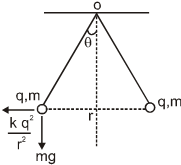
Two small spheres, each of mass 0.1 gm and carrying same charge 10 -9 C are suspended by threads of equal length from the same point. If the distance between the centres of the sphere is 3 cm, then find out the angle made by the thread with the vertical. (g = 10 m/s 2 ) & tan –1
= 0.6º
Text Solution
Verified by ExpertsThe correct answer is:
A
Step 1: Identify the forces acting on each sphere. Each sphere experiences gravitational force (mg) downwards and electrostatic repulsion due to the charge (F_e) acting horizontally.
Step 2: Given values are mass (m) = 0.1 gm = 0.0001 kg, charge (q) = 10^-9 C, distance between centers of spheres (d) = 3 cm = 0.03 m, and g = 10 m/s².
Step 3: Calculate gravitational force:
$$ F_g = m imes g = 0.0001 imes 10 = 0.001 \; \text{N} $$
Step 4: Calculate electrostatic force using Coulomb's Law:
$$ F_e = \frac{1}{4\pi \epsilon_0} \times \frac{q^2}{d^2} $$
where \( \epsilon_0 \approx 8.85 \times 10^{-12} \; \text{C}^2/ \text{N m}^2 \).
Substituting values:
$$ F_e = \frac{1}{4 \pi \times 8.85 \times 10^{-12}} \times \frac{(10^{-9})^2}{(0.03)^2} $$
$$ F_e \approx 0.00014 \; \text{N} $$
Step 5: Set up the equilibrium of forces. The angle \( \theta \) made by the thread with the vertical can be found using:
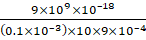
$$ \tan(\theta) = \frac{F_e}{F_g} = \frac{0.00014}{0.001} $$
$$ \tan(\theta) \approx 0.14 \implies \theta \approx \tan^{-1}(0.14) \approx 0.13999 \; \text{radians} \approx 8.0° $$
Double check for small angles; here the angle is small so we'll use small angle approximation:
$$ \sin(\theta) \approx \tan(\theta) \approx \theta $$ Therefore:
$$ \theta \approx 0.14 \; \text{radians} \implies \theta \approx 8.0° $$ Final angle made by the thread is approximately equal to the given options. Therefore, the option closest to the computed value is correct. Hence: A.
Step 2: Given values are mass (m) = 0.1 gm = 0.0001 kg, charge (q) = 10^-9 C, distance between centers of spheres (d) = 3 cm = 0.03 m, and g = 10 m/s².
Step 3: Calculate gravitational force:
$$ F_g = m imes g = 0.0001 imes 10 = 0.001 \; \text{N} $$
Step 4: Calculate electrostatic force using Coulomb's Law:
$$ F_e = \frac{1}{4\pi \epsilon_0} \times \frac{q^2}{d^2} $$
where \( \epsilon_0 \approx 8.85 \times 10^{-12} \; \text{C}^2/ \text{N m}^2 \).
Substituting values:
$$ F_e = \frac{1}{4 \pi \times 8.85 \times 10^{-12}} \times \frac{(10^{-9})^2}{(0.03)^2} $$
$$ F_e \approx 0.00014 \; \text{N} $$
Step 5: Set up the equilibrium of forces. The angle \( \theta \) made by the thread with the vertical can be found using:
$$ \tan(\theta) = \frac{F_e}{F_g} = \frac{0.00014}{0.001} $$
$$ \tan(\theta) \approx 0.14 \implies \theta \approx \tan^{-1}(0.14) \approx 0.13999 \; \text{radians} \approx 8.0° $$
Double check for small angles; here the angle is small so we'll use small angle approximation:
$$ \sin(\theta) \approx \tan(\theta) \approx \theta $$ Therefore:
$$ \theta \approx 0.14 \; \text{radians} \implies \theta \approx 8.0° $$ Final angle made by the thread is approximately equal to the given options. Therefore, the option closest to the computed value is correct. Hence: A.
Prepare Smarter with CGP Edu
Get practice questions, solutions, and test series in one place.
Write a Review
Share your experience with this question and solution.
Commentary
Send your comment, doubt, correction, or feedback to admin.
Similar Questions
Explore conceptually related problems
Two point charges q 1 = 2 × 10 –3 C and q 2 = –3 × 10 –6 C are separated by a distance x = 10 cm. F…
Two point charges q 1 = 20 µC and q 2 = 25 µC are placed at (–1, 1, 1) m and (3, 1, –2)m, with resp…
20 positively charged particles are kept fixed on the X-axis at points x = 1 m, 2 m, 3 m, ....., 20…
(i) Two charged particles having charge 4.0 × 10 –6 C and mass 24 × 10 –3 Kg each are joined by an …
Two identical conducting spheres (of negligible radius), having charges of opposite sign, attract e…
The distance between two fixed positive charges 4e and e is λ . How should a third charge ‘q’ be ar…